ACHR News
search
Ask ACHR NEWS AI
cart
facebook twitter instagram linkedin youtube
  • Sign In
  • Subscribe
  • Sign Out
  • My Account
ACHR News
  • NEWS
    • Breaking News
    • New HVAC Products
    • Featured Products
    • Manufacturer Reports
    • HVAC Data
    • Legislation
    • ACHR NEWS Centennial
  • RESIDENTIAL
    • Air Conditioners
    • Furnaces
    • Residential Heat Pumps
    • Ductless
    • Residential IAQ
    • Testing, Monitoring, Tools
    • Components & Accessories
  • COMMERCIAL
    • Air Handlers
    • Rooftop Units
    • Chillers and Cooling Towers
    • Commercial Heat Pumps
    • Boilers and Hydronics
    • VRF/Ductless
    • Commercial IAQ
  • REFRIGERATION
    • Refrigerants
    • Refrigerant Regulations
    • Leak Management
  • CONTRACTOR PRO
    • Geothermal
    • Homeowner Study
    • VRF and VRV Ductless
    • Unitary Trends
  • EDUCATION
    • Training and Education
    • Business Management
    • Service and Maintenance
    • Continuing Education
    • Market Research >
      • HVAC Brand Awareness Report
      • VRV, VRF, VRVZ Report
      • Unitary Trends Report
      • Water Heat Professionals Report
    • Webinars
    • Sponsor Insights
    • eProducts Info
    • White Papers
  • EVENTS
    • HVAC Contractor Forum
    • Industry Events and Webinars
  • MEDIA
    • Videos
    • AHR Expo 2025 Videos
    • Podcasts >
      • ACHR News Podcast
      • HARDI Podcasts
      • AHR Expo Podcasts
      • ACCA Podcasts
    • Interactive Spotlights
    • Quizzes
    • eBooks
    • HVAC Talkback
  • HVAC GROUP
    • ACHR NEWS >
      • Current Issue
      • Digital Edition
      • Subscribe
    • Distribution Trends
    • SNIPS NEWS >
      • Join SNIPS NEWS
    • Engineered Systems News >
      • Join ES News
    • HVACR Directory
    • Contests
    • Newsletters
    • Contact
    • Advertise
    • My Account

Pros And Cons Of Leak Detection Methods

By James J. Siegel
February 6, 2003
When it comes to checking for leaks in a refrigeration system, contractors have options. Some of these options have evolved over the years. The bubble method has made way for refrigerant dye kits and hand-held electronic leak detectors.

Although some leak detection methods are now dated compared to newer test instruments, the old techniques may still be reliable and useful.

Advanced Test Products (ATP), manufacturer of the Amprobe, TIF, Promax, and Robinair lines of test equipment, offers a number of leak detection options. With the amount of equipment available for leak detection, the decisions about which method to use in a given situation can be confusing.

Roger Seymour has been with ATP for decades. He retired as the company’s service department manager, but still assists the manufacturer with answering technical questions.

Seymour has seen the changes in leak detection over the years and has been able to provide insight on where and when each method is best utilized.

The TIF RX-1A leak detector. (Photo courtesy of Advanced Test Products.)

A Popular Choice

According to Seymour, without a doubt, the most popular tool of choice for contractors to detect refrigerant leaks is the electronic leak detector. Seymour said that TIF leak detectors have improved over the years.

One of the earliest electronic leak detectors to be introduced to the industry was the negative corona discharge model. The instrument works by creating a high voltage corona in the sensing tip. When the corona senses refrigerant, the device will sound an alarm.

According to Seymour, early models of the negative corona discharge detector had some problems when they were first introduced. Large doses of refrigerant could “poison” the detector and cause it to malfunction.

The other type of electronic detector is the heated diode model. The technology heats the refrigerant and breaks the molecules apart, creating positively charged chlorine or fluorine ions. The heated diode detector will sense these ions and set off an alarm.

Looking for quick answers on air conditioning, heating and refrigeration topics? Try Ask ACHR NEWS, our new smart AI search tool. Ask ACHR NEWS →

Both the negative corona and heated diode detectors have been improved over the years to prevent them from being too sensitive to large refrigerant leaks.

In fact, TIF has made an improvement on leak detection with its ZX-1 Heated Pentode™ refrigerant detector. According to the company, the heated Pentode eliminates false alarms and detector poisoning. The product can be exposed to 100 percent refrigerant and still keep working.

A false alarm is another disadvantage to some electronic leak detectors, but Seymour said that many manufacturers have been able to overcome this problem as tools become more and more sophisticated.

He explained that earlier models could detect other chemicals, which could interfere with the test. These would produce false results and indicate leaks where no leak exists.

To avoid this problem, another method of electronic leak detector was developed — the ultrasonic type. Ultrasonic detectors do not sense refrigerant. The device is used to detect the high-pitched sound of refrigerant escaping from the system.

“The advantage of these devices is that they are not gas sensitive,” said Seymour. “They are useful for sensing pressure.”

He noted that, as in the cases of the heated diode and the negative corona models, improvements in technology have eliminated many of the problems associated with ultrasonic detectors, but problems can still crop up. One of the biggest complications with an ultrasonic leak detector is the possibility of background interference. Some models, especially earlier versions, can pick up other inaudible sounds not associated with the refrigeration system and sound the alarm on the detector.
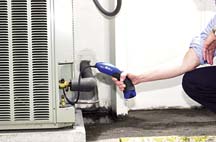
TIF's ZX-1 Heated Pentode refrigerant detector (seen above in operation and below) has been designed to eliminate false alarms. (Photos courtesy of Advanced Test Products.)

Clearly Seeing Leaks

One of the oldest methods for finding refrigerant leaks is the bubble method. Seymour said that although this option is dated, it is still effective and can be used. One of the biggest advantages of using the bubble method is that the contractor can visually confirm the leak.

To perform this method, a soapy solution is applied to points where a leak is suspected. If there is a leak, the solution will begin to bubble up due to escaping refrigerant.

Seymour said that the bubble method can be used along with some modern technology.

“You can use an ultrasonic detector with a bubble solution,” he said.

The motive behind this is to detect the inaudible crackling sound that will be made due to the refrigerant bursting the small bubbles in the solution.

A more updated method for clearly seeing refrigerant leaks is through the use of a fluorescent dye kit. A dye is injected into the refrigeration system and circulates through the refrigerant. The next step is to shine a UV light on the various parts of the system where a leak could occur. If there is a leak, the refrigerant dye will glow when detected under the UV light.

“With the UV light there are no false indications,” said Seymour. “If it shines, there is no question about it that there is a leak.”

He added that dye kits are even beneficial in automotive refrigerant systems. According to Seymour, engine oils and vapors from a car engine could skew the readings from an electronic leak detector.

But UV lights and dye kits do have drawbacks, he noted.

First, Seymour said that UV lights only work on parts of the refrigeration system that are accessible. If part of the system is hidden from view, the lights cannot be used.

Second, in some applications, dye kits cannot give instant results. According to Seymour, if the leak is very small, it could take time before the UV light can expose any seeping refrigerant.

“The limitation on dyes is that you may have to wait a day or longer for the dye to be detected,” said Seymour. “This means having to make more than one trip to the jobsite.”

He said the long wait is usually due to the size of the leak. Larger leaks will produce quicker results, but if the leaks are very small, it could take a great deal more time.

Another Option

Another way to find leaks is by using a halide torch. In another old method, the open flame of a halide torch is used to detect refrigerant leaks. The flame of the torch will change to a green color when it is exposed to a refrigerant with chlorine.

The intensity of the change in the flame will vary depending on the size of the leaks. One of the most obvious disadvantages to this method is the fact that the halide torch will only be affected by CFCs or HCFCs.

Seymour said that halide torches are still effective, but many contractors do not like the idea of using an open flame near refrigerants.

For those who do elect to use the halide torch, Seymour said there are a few things contractors should remember.

Environment and application will play a big role in the effectiveness of the instrument. Windy conditions will make it difficult for the flame to suck up the gas. Sunlight can also be a problem. If the leak is small, the flame could change to a subtle green color. If the outdoor light is too bright, it could drown out the changing color in the flame.

That is why Seymour discourages contractors from using this method outdoors, especially on rooftop units.

Publication date: 02/10/2003

Share This Story

Looking for a reprint of this article?
From high-res PDFs to custom plaques, order your copy today!


Jay

James J Siegel is the associate editor of SNIPS magazine. He has been with the magazine for eight years and is based in San Francisco.

Recommended Content

JOIN TODAY
To unlock your recommendations.

Already have an account? Sign In

  • HVAC-enrollment

    The Trades Are Back: HVACR Programs See Nearly 30% Enrollment Spike

    A new wave of future technicians is entering the pipeline.  
    Training and Education
    By: Matt Jachman
  • 2025 Top 40 Under 40

    2025 Top 40 Under 40 HVACR Professionals List

    The 11th annual Top 40 Under 40 list highlights those...
    HVAC Commercial Market
    By: Hannah Belloli-Oster
  • LG Ductless Mini-Split Systems

    The 9 Types of Heat Pumps

    As the U.S. moves toward electrification, heat pumps are...
    HVAC Residential Market
    By: Joanna R. Turpin
Subscription Center
  • Create an Account
  • Start a Subscription
  • Manage My Account
  • Sign Up for Newsletters
  • Visit Customer Service
  • Update Preferences

More Videos

Sponsored Content

Sponsored Content is a special paid section where industry companies provide high quality, objective, non-commercial content around topics of interest to The News audience. All Sponsored Content is supplied by the advertising company and any opinions expressed in this article are those of the author and not necessarily reflect the views of The News or its parent company, BNP Media. Interested in participating in our Sponsored Content section? Contact your local rep!

close
  • Piggy Bank
    Sponsored byWatercress Financial

    Energy Prices, Inflation, and HVAC: What Today’s Homeowners Care About

  • Refrigerated Food
    Sponsored bySolstice Advanced Materials

    R-455A Refrigeration: A Cold Storage Solution for the Future

  • Airex Rooftop Units
    Sponsored byAirex Manufacturing Inc

    Consolidating Roof Penetrations: A Growing Trend in Multifamily HVAC Design

Popular Stories

Refrigerants-and-gauge.jpg

HVAC Industry Warns of Counterfeit Refrigerants Entering U.S. Supply Chain

U.S. Supreme Court building

95% Furnace Efficiency Rule to Get New Hearing

Midea-training.jpg

HVAC Workforce Crisis Expands Beyond Technicians to Instructor Shortages

Data_Center_facility.jpg

HVAC Manufacturers Respond to Growing Data Center Backlash

HVAC Minute retail refrigeration system

EPA Final Rule’s Impact on R-410A Deadlines

View The ACHR NEWS
Centennial Anniversary Timeline

The ACHR News Timeline Chart
Submit a Letter
Submit a letter to our editors.

Events

November 6, 2025

Next-Gen Data Center Cooling: HVAC Innovation and Real-World Solutions

On Demand As AI workloads and high-density computing push traditional cooling methods to their limits, the data center industry is accelerating the adoption of next-generation HVAC technologies.

June 23, 2026

HVAC Duct Sealing Mastics: Why Selection Matters

In this webinar we will detail what HVAC material buyers and technicians need to know when selecting duct mastics, including matching mastic to substrate, alternatives to liquid mastic, and where UL 181 Listings fit into real world installations.

View All Submit An Event

Poll

Summer Staff

Are you fully staffed for the summer season?
View Results Poll Archive

Products

BNI Mechanical/Electrical Square Foot Costbook, 2026 Edition

BNI Mechanical/Electrical Square Foot Costbook, 2026 Edition

See More Products
HVAC Duct Sealing Mastics: Why Selection Matters - Free Webinar - 6/23/2026

Related Articles

  • Pros and Cons of Using PVC Pipes on Projects

    See More
  • The Pros and Cons of Online Service Appointments

    See More
  • Federal HVAC Systems

    The Pros and Cons of Federal Contract Work

    See More

Related Products

See More Products
  • The ACHR News - April 20, 2026

    ACHR NEWS April 20, 2026, Issue

  • The ACHR News - July 28, 2025

    ACHR NEWS July 28, 2025, Issue

See More Products

Events

View AllSubmit An Event
  • April 9, 2026

    Homeowner Expectations: Must Knows for Trades Pros

    On Demand From this webinar, attendees will learn how to meet rising consumer expectations while keeping day-to-day operations efficient. 
View AllSubmit An Event

Related Directories

  • Spectronics Corp./Spectroline Leak Detection

    Established in 1955, Spectronics Corporation is the inventor of UV fluorescent leak detection technology and manufacturer of leak detection tools for AC&R systems. Our fluorescent dyes and system additives are OEM-grade, universal (POE), co-solvent free, and NSF-certified.
  • Reliance Detection Technologies LLC

    Commercial-grade indoor plumbing leak detection and automatic water shutoff solutions for every space and budget. Monitor water mains, water heaters, washing machines, dishwashers, HVAC units.
×

Sign Up. Stay Informed.

The #1 trusted source for the HVACR industry since 1926

SUBSCRIBE
  • RESOURCES
    • Advertise
    • Contact Us
    • Advisory Board
    • Classifieds
    • Submit a Letter
    • Directories
    • Store
  • ACCOUNT CENTER
    • Create an Account
    • Start a Subscription
    • Manage My Account
    • Sign Up for Newsletters
    • Visit Customer Service
    • Update Preferences
  • SERVICES
    • Marketing Services
    • Reprints
    • Market Research
    • List Rental
    • Survey/Respondent Access
  • STAY CONNECTED
    • LinkedIn
    • Facebook
    • Instagram
    • YouTube
    • X (Twitter)
  • PRIVACY
    • PRIVACY POLICY
    • TERMS & CONDITIONS
    • DO NOT SELL MY PERSONAL INFORMATION
    • PRIVACY REQUEST
    • ACCESSIBILITY

Copyright ©2026. All Rights Reserved BNP Media, Inc. and BNP Media II, LLC.

Design, CMS, Hosting & Web Development :: ePublishing