Identifying motor retrofit opportunities in cooling towers, air handlers, exhaust fans, and
circulating pumps reflects the no-stone-unturned strategy Rutgers employs in energy management.For those motors, boiler upgrades, and future projects, the university regularly seizes on multiple incentives opportunities — ranging from utility offers to good old-fashioned intraschool competition — to teach efficiency in action.
The students have changed, and the way spaces get used is changing as well. How do we need think about educational environments to foster better thinking inside them?
Texas Women’s University found that continuous energy monitoring and verification paid off well, yielding savings above and beyond an existing performance contract. The authors explain how measuring and managing can defeat the usual suspects that drag down plant performance. Is yours hiding some untapped greatness?
A quiet learning environment, consistent comfort, and energy efficiency topped the list of requirements at Northbrook Junior High School in selecting chillers as part of a $1.88 million life-safety improvement renovation project. The two-story, 135,000-sq- ft school was originally built in 1958 and now serves 650 students in grades six through eight. The renovation project included replacement of all heating and cooling system components.
Although it’s the second-oldest college in America, the College of William & Mary boasts the oldest college building in the United States, the Sir Christopher Wren Building, which was built in 1695 before the founding of nearby Williamsburg, VA. Now fast-forward to the 1960s, when the college expanded to accommodate Baby Boom students.
A learning environment adds extra meaning to the risks of “run to fail” mode, which can have the same effect on the budget as it does on the equipment. Covering everything from specification to installation and operation, schools need a permanent plan on hand for the moment when temporary HVAC becomes necessary.
Designing a new high school to be 40% more efficient than ASHRAE 90.1 – 2001 energy requirements is a feat in itself. To achieve this degree of efficiency on a very limited capital budget while designing a state-of-the-art, energy-demanding technical high school is an even greater feat.
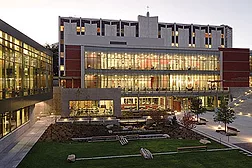
Patrick Baldwin-McCurdy fields daily indoor air temperature requests from employees and students, but Seattle University’s (SU) lead buildings control technician rarely hears HVAC complaints from the college’s new library addition featuring under floor air distribution (UFAD).
Energy efficiency and historic preservation are rarely synonymous. More often than not, one must be compromised for the sake of the other. Fortunately, the University of Arkansas found a way around such compromises when it came to the restoration and mechanical renovation of the school’s beloved Peabody Hall.
 RSS
RSS