Case In Point
Chilled beams maintain comfort, look of historic hall

|
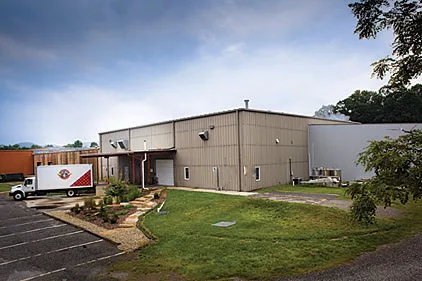
| A VAV energy recovery system preconditions the air and provides critical humidity control at this historic building. |
Built nearly one hundred years ago, this soon to be certified LEED® building, with its original tin ceilings and lovingly restored clay tile roof, is the last place you might expect to see chilled beams. However, it was this technology, that actually helped architects and engineers maintain the historic character of the Peabody Hall’s interior spaces.
Prior to the 2010 renovation, the building’s HVAC system was horribly ineffective. For decades, the massive, yet poorly ventilated, building had been absorbing moisture into its interiors like a sponge. The existing AHU, supplied with chilled water through the campus’ central plant, was not able to extract enough moisture from the building during the lengthy Fayetteville, AR cooling season. The plaster walls were starting to bubble and, on several occasions, remediation crews were called upon to remove mold from the interior walls.
“At that point, we decided ‘okay, it’s a health issue now,’” said Robert Beeler director of design and construction services. “We knew we either had to do some serious renovations or tear the building down. Overwhelmingly, the staff, faculty, and others wanted to keep the building.”
The challenge was modernizing the comfort system of the building without completely gutting and destroying its precious historic attributes. So the University hired experts Allison Architects, a firm that specializes in historic restorations, to lead the $8.5 million, all-inclusive renovation project. TME, Inc. (TME) of Little Rock, AR was hired as the mechanical engineer, the firm that also made the unexpected proposal for chilled beams.
CHILLED BEAMS? IN THE SOUTH?
Architecturally, chilled beams were the perfect choice. They would not only allow Peabody Hall to maintain the integrity of its antique tin ceilings, they would also drastically reduce the amount of invasive duct and pipe work required to update the building’s heating and cooling system. Still, Beeler had his doubts.
“I thought, ‘You’ve got to be out of your mind! You’re going to hang a radiator over my head with no drip pan underneath?’ Yes, we were very skeptical,” said Beeler.
What Beeler did not yet grasp was the very crucial role that a Semco Pinnacle® Primary Ventilation System would play in the chilled beam application. The Pinnacle unit utilizes advanced heat wheel technology to dehumidify and precondition supply ventilation air — an important part of the puzzle since chilled beams handle sensible load only, not latent (humidity) loads. The combination of the two technologies has been successfully applied in facilities throughout the U.S., including the South.
To remove all doubt that the combined systems could meet the university’s needs, Semco invited Beeler and his staff, along with TME to the Semco facility in Columbia, MO where they could speak with the manufacturer’s engineers and actually see and experience for themselves how the two technologies worked together.
“We toured the lab in Columbia and saw how the system is put together,” said Beeler. “We’re all engineers here so we understood it once we saw it.”
THE (NEW) PEABODY HALL HVAC SYSTEM
A single 9,000-cfm Pinnacle VAV energy recovery system was selected to supply pre-conditioned air to approximately 250 chilled beams located throughout the 27,230-sq-ft Peabody Hall and to completely handle the building’s latent load.
While the unit provides pre-conditioned air during both the heating and cooling season, it is the cooling mode that is the most critical in terms of moisture control. The Pinnacle unit incorporates both a total energy wheel and a passive dehumidification wheel, along with a heating and cooling coil. In typical cooling mode, supply air is cooled and dehumidified by passing through the total energy recovery wheel, which rotates through the relatively cool, dry exhaust air stream leaving the “passive” dehumidification wheel.
The supply airstream is further cooled and dehumidified by passing through the cooling coil. Before it is supplied to the space, the supply air is dehumidified even further, and moderately reheated as needed, by passing it through the passive dehumidification wheel. This air is supplied to the chilled beams, where it mixes with air that has been drawn up and into the chilled beams through induction (room) air. Before this mix occurs, the induced room air is cooled (or heated) via the chilled beam water coils to achieve space setpoints. It then mixes with ventilation air inside the chilled beam and is discharged into the room.
Airflow to the active chilled beams is typically one-half to one-third of that required by a VAV or constant volume system at peak cooling conditions. This reduces the size of ductwork and made it possible for Peabody Hall to implement the new system with minimal changes to the building aesthetics. The chilled beams are installed flush with the ceiling and painted to match the tin tiles so that they practically disappear.
“We wanted you to be able to walk into this building and feel like you were in a 1914 school building. We did that,” said Beeler, adding that the building occupants have been delighted not only with the renovation but also the comfort.
DRYING THINGS OUT
After going through an entire cooling system, Beeler is happy to report that the system has actually surpassed their expectations in terms of humidity control. The Pinnacle unit was operated at maximum capacity throughout the first cooling season to remove all the excess moisture in the building.
“We wanted to make sure we got all of the moisture out of the building and also deal with any infiltration through the walls and brick. We found we were able to get the humidity down to 30% to 35% for the entire building by running the unit at maximum capacity. Next year, we’ll back off that and still easily maintain 40% to 45% humidity,” said Hamid Habibi, Managing Principal for TME.
“Next year, we think we’ll be able to increase setpoints to 74°F and still maintain comfort while achieving more energy efficiency.”
However, when it comes to Peabody Hall, it was never just about the numbers. It was also about restoring a beloved campus icon and keeping an important part of the University’s history in tact. The architectural and engineering firms made that happen, and as a result, students and faculty get to experience that history every day in greater comfort than ever before.
Looking for a reprint of this article?
From high-res PDFs to custom plaques, order your copy today!


