Retrofitting Rutgers

In addition, the university is a member of the USGBC, Association for the Advancement of Sustainability in Higher Education, and, the New Jersey Higher Education Partnership for Sustainability, as well as Energy Star and a CHP Partner with the EPA. In 2009, the university signed a Memorandum of Understanding with the EPA and was recognized this year as the largest reducer of greenhouse gases out of all the higher education signers.
The university has more than 800 buildings throughout the state, with major campuses in New Brunswick, Piscataway, Newark, and Camden. The physical plant stock includes everything from buildings on the National Historical Register to structures that were formally part of Camp Kilmer to buildings built with the 21st century in mind.
FORMULATION OF A PLAN
Antonio Calcado, vice president of facilities and capital planning, charged his departments with the task of reducing the university’s dependence on fossil fuels and to reduce the university’s greenhouse gases with the intention of making its physical plant more sustainable.
“We believe that institutions of higher education should not only teach but should practice what they teach and lead by example. The campus should be a living laboratory, seizing on opportunities to not only better the environment for students, staff, and citizens but to have an impact on our economics as well. That’s the culture we strive to create at Rutgers,” said Calcado.
The university spends over $60 million dollars a year on energy, and Calcado’s vision led to a number of energy conservation and carbon reduction efforts.
One of the first steps was to produce a sustainable model for all departments in facilities and capital planning, including goals to reduce both greenhouse gases and energy use. The model took into account where Rutgers is now and where it wants to be in three years and subsequently in 20 years. Since the university is a state entity, it was decided the energy goals would mimic the goals of New Jersey’s Energy Master Plan.
The next step was to come up with an action plan to achieve the goals.
In the area of energy, the university realized that significant savings could be had, along with a quick ROI, using New Jersey’s Clean Energy program. The program gives rebates for changing out existing equipment with new higher efficiency equipment that meet specific criteria. It was discovered that changing out standard motors with EPACT motors and adding VFDs made perfect sense. The motors, 10 hp and above, included those found in air handlers, cooling towers, exhaust fans, and circulating pumps. The university was able to save 2.8 million kWh of electricity and 1,500 tons of CO2. The return on investment was three years. The rebate incentive itself was $78,971.
Another project was retrofitting gas boilers supplying heat for the Rutgers Ecocomplex offices, located in Bordentown, NJ. The Ecocomplex, which is dedicated to the environment and agriculture, is the first research, technology development, and outreach center in the U.S. As part of the retrofit, the burners were replaced with new burners that use carbon-neutral landfill gas for 80% of its operating hours, and technology that slows the airflow over the burner tips to avoid the flame from misdirecting from the orifice. This allows complete combustion of the landfill gas. The cost of the project was $179,100, of which $63,100 dollars was funded through the American Reinvestment Act. The result of this project is anticipated to save the university $104,600 annually, making the payback one year.
The university also completed its first phase of a 5-yr project to replace luminaires and add sensors. The university audited every luminaire in every building in the entire university and has a plan in place to upgrade them to a more efficient type. The estimated savings at the completion of the entire project is 42 million kWh of electricity per year. The first phase of this project was completed through a program by the local utility, Public Service Electric and Gas Company (PSE&G), called the Direct Install Program. Sixty percent of the cost was paid for through PSE&G. The annual savings in electric costs to the university is just under $1,000,000/yr.
RENEWABLE ENERGY PROJECTS
On the renewable energy side, the university installed a 1.4-MW ground-mounted, fixed-array solar farm. The installation uses 7,993 polycrystalline panels and provides 10% of the electricity for the Livingston Campus. The solar farm saves the university 1,300 tons of CO2 and has resulted in an annual savings of $200,000 along with earning Solar Renewable Energy Certificates..
The university has installed electric automobile charging stations in two locations with the idea of expanding the charging network in response to demand.
There are two energy projects in construction. The first is an 8.01-MW solar canopy array, with monocrystalline panels, above 28 acres of parking, which, when completed, will be one of the largest solar canopy arrays in the country. It is estimated that the canopies will power 51% of the Livingston Campus in Piscataway and reduce the university’s greenhouse gases by 6,364 tons of CO2. This project is a design-build project with financing through a lease. It is estimated that the university have a net savings of $28 million over a 28-yr period.
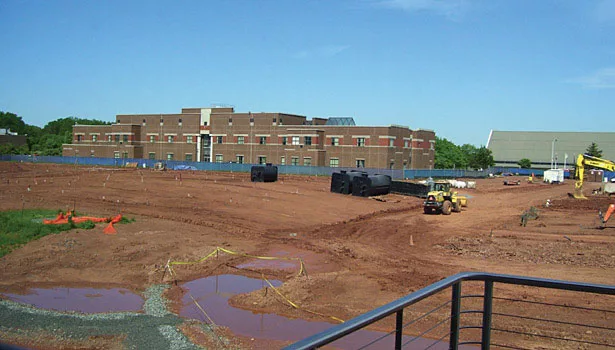
The other project is a geothermal system that will provide 700 tons of cooling to its new business school. The bore field consists of 321 wells at 500 ft deep. It will use four chiller heaters located in the basement of the building. The land above the borefield will be a park-like area.
FUTURE PROJECTS
Future projects at the university include the expansion of the 13-MW cogeneration plant; evaluation of the chilled water, high temperature hot water loops, and thermal storage; metering; and major upgrades of the building control systems.
All new buildings and major renovations at the university are being built to LEED® Silver standards. The university uses LEED as a benchmark to ensure its buildings are sustainable and has incorporated energy-efficient equipment and methods into its design standards. What was discovered is that the energy modeling for these designs show at least a 20% energy savings over a base building per ASHRAE 90.1 2007, using off-the-shelf equipment and lighting and standard building methods.
In addition, the university has an in-house commissioning agent and has incorporated commissioning for all its new buildings and major renovations, and has been retrocommissioning buildings on an as-funded basis. Another tactic for reducing energy and greenhouse gases is changing the behavior of the occupants of the university. Each year, the university holds a campus vs. campus energy competition. The campus that reduces the most energy during a specific month as compared to the year before wins a roving trophy that was purchased by a grant from PSE&G. This has shown a lasting reduction in the year after the competition.
As in all projects, communication is at the top of the list. Meeting with the endusers before the project begins and explaining what is going to be done, what the process will be, and what is the outcome expected, goes a long way in getting people on board.
Rutgers University is at the forefront of higher education in its commitment to save energy and reduce green house gases. It is continually looking for ways keep the momentum going and is now looking to its researchers to use the university as a research tool in energy efficiency, energy conservation, storage, and smart grid technology.
To hear more about what Rutgers is doing and how it is being implemented, attend my presentation at the Engineered Systems Magazine, High Performance Building Conference, September 11-13, Falls Church, VA. ES
|
Sidebar: Overview |
|
Examples of two projects: • Motor and Transformer Program • Replaced 316 motors 10 hp and above • Replaced 30 KVA to 150 KVA transformers • Cost $1,004,591 • Savings $320,510 • ROI 3.13 years
• PSEG Direct Install Program • 60% of the cost from PSEG • 40% of the cost from Rutgers • 31 buildings • Total project cost $5,621,31 • PSEG Portion $4,088,231 • Rutgers Portion $1,533,086 • Savings $955,638 • ROI Rutgers 1.6 years |
Looking for a reprint of this article?
From high-res PDFs to custom plaques, order your copy today!