AI as Your Intern, Not Your Boss: Lessons from SPIDA Boston
Bridging innovation and everyday safety in construction at the annual SPIDA meeting
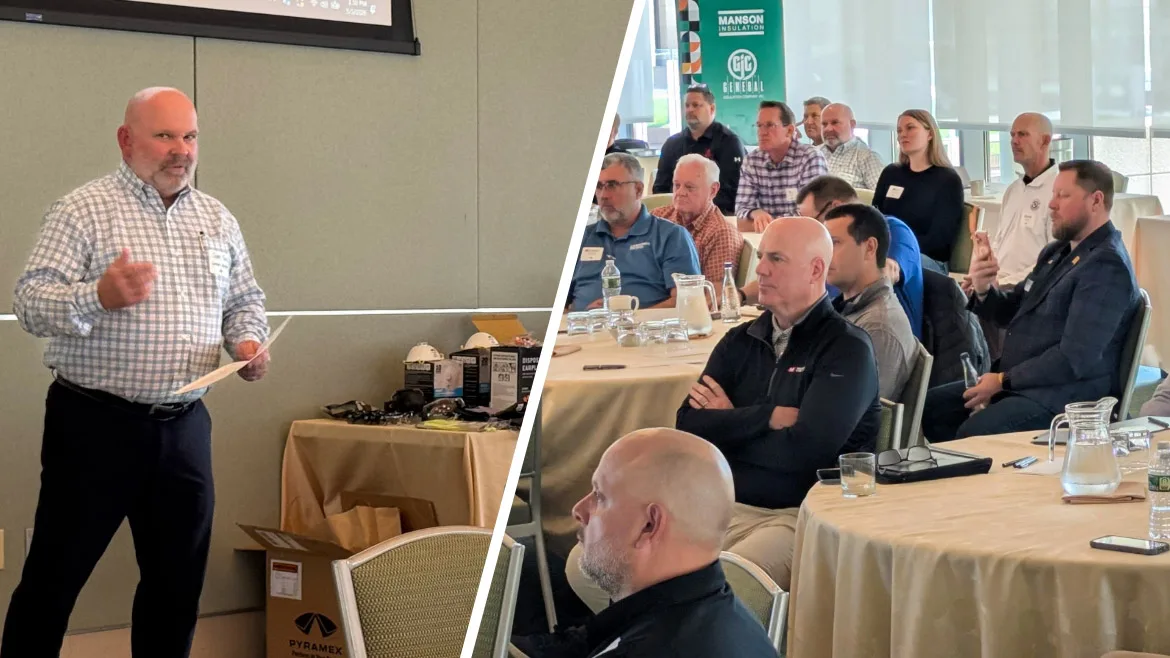
AI TO PPE: From AI to PPE, the SPIDA meeting underscores an industry balancing change with fundamentals.
Sam Richter isn’t here to peddle Silicon Valley hype. Perched at the podium, sleeves rolled up, he surveys a crowd of general contractors, engineers, and data center execs with the wry grin of a man who’s both impressed and a little exasperated by the tools of the moment.
“Treat AI like your intern,” Richter told the room at the annual Spiral Duct Manufacturers Association meeting. “Don’t expect magic. Give it direction, let it ask questions, and always double-check its work. Otherwise, you’re just automating mediocrity.”
It’s a message that lands. In an industry where schedules are tight, margins are thinner, and every hour counts, Richter’s pitch isn’t about replacing people – it’s about cutting out repetitive work and making space for what humans do best: building relationships and solving real-world problems.
SPIDA gathered in Boston this spring to wrestle with the future of construction workflows. AI is no longer a distant concept; it’s embedded in everything from estimating and logistics to onboarding and proposal writing. But Richter’s keynote cut through the noise: “If you just ask for a project plan, you’ll get a D-level answer. But if you iterate, specify your audience, and let your AI ‘intern’ learn from your feedback, you can save thousands of hours a year – and maybe your sanity.”
Richter doesn’t just talk theory. He demonstrates how, with the right prompt, an AI can churn out a 12-slide custom deck in the time it used to take to format a single slide. He shows how uploadable data – sales by zip code, for example – can help pinpoint the best new warehouse location in Texas, something that would stump even seasoned logistics pros. “I didn’t even know how to do that,” he admits, “and my AI intern did it in seconds.”
But speed isn’t the real lesson. Richter is clear: trust, ethics, and human oversight are non-negotiable. These tools are powerful but imperfect – they can dig up outdated info, or flat-out get things wrong. “That’s why oversight is critical,” he said. “If you’re using my tool and something’s off, I can retrain it. For the big platforms, you often have to work with what you get and double-check.”
Richter urges companies to be upfront about why they’re embracing AI. “People need to know: we’re using this so you can do the work you’re actually good at – the work that matters.” The shift is as big as the old days of SEO, but now, more folks are skipping Google and heading straight to chatbots for answers. “If you want your company to show up, you’ve got to speak the language of these new systems – and feed them the right data.”
But while AI dominated the conversation, another theme grounded the meeting in day-to-day reality: safety.
Safety First: Gerald Toole’s Practical Approach
No matter how fast technology changes, some priorities never shift. “Safety is always a big factor for us,” said Gerry Towle, Division Director and longtime leader in the building materials sector, as he opened his presentation on day two. “Our company takes safety very seriously – and I’m sure all of you feel the same way.”
Towle’s session was a hands-on tour of the essentials: “We’re going to cover the basics: PPE for HVAC and sheet metal, and how it applies on the job.” From eye protection (“Eye protection is mandatory – whether you’re in the warehouse or on a job site”) to the nuances of glove selection (“The level of protection really depends on what you’re working with”), Toole emphasized the value of matching the right protection to each task. “There are so many glove options – it comes down to your safety requirements and the materials you handle.”
Respiratory and hearing protection, too, were front and center. “Respiratory protection depends entirely on the environment – dust, chemicals, or confined spaces,” he noted, and “Hearing protection is simple, but critical – especially with constant exposure on jobsites.” The message was clear: while the gear may change, the commitment to getting everyone home safe at the end of the day is what matters.
Towle also highlighted evolving industry practices, like the shift from traditional hard hats to more comfortable and protective helmet styles, and the growing importance of high-visibility gear. “High-visibility gear is required no matter the conditions – it doesn’t matter if it’s 110 degrees or 55.”
Roundtable Insights: What’s On Members’ Minds
SPIDA’s roundtable discussions always bring out the heart of the industry – the practical, the candid, and the forward-looking. As the session wrapped up, attendees weighed in on what matters most, from safety to market pressures and the fast-changing landscape of AI and automation.
“Safety is a big focus for our company. If there’s anything we can do to help, just reach out,” one SPIDA member said, echoing Towle’s message. Others noted the increased need for updated safety documentation, standardized PPE, and the reality that “it really depends on the job and what the general contractor requires.”
On AI in Construction
The talk naturally turned to technology. “AI is no longer a futuristic concept – it’s already delivering measurable results,” one attendee said. The consensus: AI is best seen as a tool to enhance, not replace, human talent. “Start small, find a champion, and treat AI like the most capable intern you’ve ever hired,” another advised. Still, the group acknowledged concerns around data security and the critical role of human judgment – “If the prompt is wrong, the result won’t be useful.”
Market Pressures & The Value of Connection
Economic realities weren’t ignored. “Transportation costs and pricing volatility are still major challenges,” one contractor admitted. Others stressed that “service, knowledge, and experience are what set you apart” – not just price. Face-to-face interaction and education remain the cornerstones of success, even as automation and robotics begin to reshape the shop floor.
Above all, the value of community and collaboration came through: “The connectivity with other members is one of the biggest benefits… Networking and education provide a real financial benefit to many companies.” As one roundtable participant put it, “You walk away with ideas you can immediately take back and implement.”
Closing the Loop
In a world racing forward with AI, automation, and new safety standards, the SPIDA meeting in Boston was a reminder that success in this industry is still built on people – learning, connecting, and keeping each other safe.
Looking for a reprint of this article?
From high-res PDFs to custom plaques, order your copy today!