Inside the Hill Group’s Sheet Metal Playbook: Data, Tech, and Advice
A look at how The Hill Group is using data and technology to modernize sheet metal operations
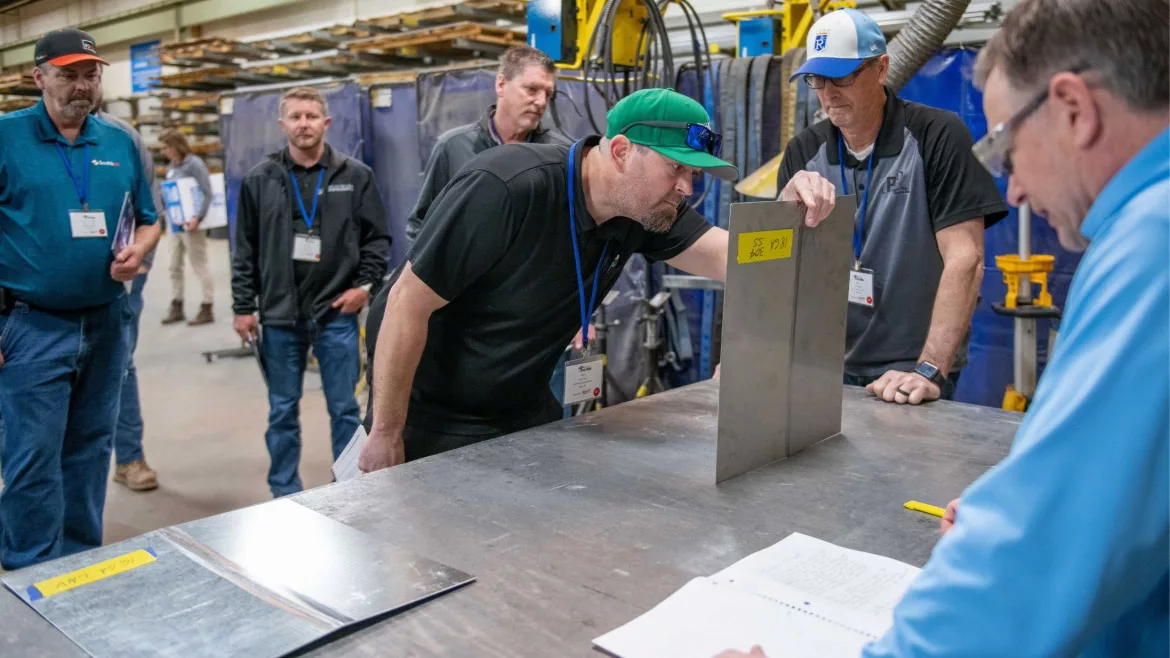
DATA FIRST: The Hill Group demonstrates how detailed tracking and model-based estimating are changing how sheet metal work is planned, built, and installed.
At this year’s SMACNA Fab Forum, The Hill Group showed contractors how data and technology are actively reshaping shop and field operations.
The conference began inside Hill’s bustling fabrication shop, with attendees weaving between spiral machines and coil lines. And several members of the Hill team didn’t just talk tech – they talked transformation.
From ‘Magic Numbers’ to Model-Based Estimating
Pikey’s message was clear: The old days of estimating jobs with “magic numbers” – labor rates per pound, ballpark percentages for hangers and ancillaries – are over. “We did it that way for decades, and we made money,” he told the room. “But once we started breaking things out – material, hangers, manufactured pieces – we saw the truth. Our labor numbers were close to the standards, but our material and ancillary costs? We were consistently short. Sometimes way short.”
The culprit, he explained, wasn’t in the labor numbers themselves – those were close to the standards set by the SMACNA Reference Manual for Labor Units (RMLU), which only covers labor time, not material costs. What really threw off their estimates were discrepancies on the material side, especially for ancillaries and hangers. By implementing RMLU labor units into their estimating system – Autodesk Fabrication ESTmep (often called “SMAP”) – Hill was able to benchmark labor against an industry standard and clearly see where material costs were coming up short. Every fitting, fastener, and labor unit became a data point – no more guesswork, at least on the labor side.
“Once your database is built, you’re faster and more accurate than ever,” Pikey stressed. “And if a young estimator misses something, the system catches it.” The change wasn’t overnight – Hill spent months programming and refining the system. But the ROI, Pikey insists, is enormous: tighter bids, fewer surprises, and a process that’s transparent enough to stand up in client negotiations or even disputes.
Pikey also highlighted how the RMLU has evolved from a static PDF to a modern, searchable web platform – making it easier for contractors to access, update, and integrate labor standards directly into their workflows. “This isn’t a set-it-and-forget-it document anymore. The committee is committed to keeping it updated,” he said, encouraging industry-wide adoption for everyone’s benefit.
Tech Investments That Pay Off
Hill’s investment in a Bescutter laser, acquired in 2019, has been a game changer for their fabrication quality and production speed. The Bescutter laser offers finer cuts compared to traditional plasma tables, improving the precision of duct and fitting fabrication. However, the team acknowledged that the laser is a more sophisticated piece of equipment and does experience more downtime than plasma machines.
To minimize production interruptions, Hill keeps a secondary laser head on hand, ready to swap out quickly if the primary one needs repair. They also praised Bescutter’s growing stateside support network, which has helped improve service and maintenance response times.
Operations Manager Anthony Camasta advised contractors considering a laser table purchase to carefully evaluate whether to opt for an open or fully enclosed system, as this decision affects safety, maintenance, and operating costs.
Meanwhile, on shop standards and aesthetics, Hill chooses not to bead their fittings unless structurally required. “It’s an added fabrication step, and honestly, beads in different directions don’t look great,” Camasta explained. By avoiding unnecessary beading, they streamline production without compromising quality.
Tracking Tools, Not Just Metal
Why track every tool with its own QR code? Years ago, Hill treated all six-foot ladders as interchangeable with the same code number – until chaos broke out in the field. By barcoding every ladder, wrench, and tool, Hill now injects accountability and rewards those who return what they check out. “Try to marry up which [tracking method] your technology supports best,” said Hill Group President Jim Hill. “We’ve been through all the platforms, and it’s got to fit your system.”
The Realities of Field Data and Models
Asked about tracking install progress, Camasta was blunt: “There isn’t a structured way off PDFs.” Sometimes, it’s still highlighters and percent-complete estimates. For model-based jobs, Hill’s analytics platform flags progress, but “if it’s not modeled, each project does its own thing.” Field and fabrication teams combine digital and old-school: updating install status in analytics, but also returning redlined markups or photos for as-builts.
On Buying vs. Building Technology
Would Hill sell its custom tools? “We’re not a software house,” Hill replied. Building a tool for in-house use is one thing; supporting it for the whole industry is another. For now, Hill’s analytics and Revit tools are tailored to their own people and processes.
Field Management and Paperwork
Hill has restructured to buy back more of the foreman’s time. Their Virtual Construction Fabrication Group (VCFG) handles the heavy lifting – quality checks, logistics, documentation – so that field leaders can focus on what matters. Notifications are customizable: some project managers want every update, others none at all.
On Contracts: Drawing the Line
Hill’s approach to contracts is pragmatic: “We’re not going to take someone else’s risk on. If we screw up, we’ll own it, but we won’t own someone else’s problem.” Sometimes that means walking away from bad deals, even with repeat clients.
A Culture of Openness
Throughout, the Hill team’s message was one of transparency. They shared what’s worked, what hasn’t, and what they’re still learning. “If you want to talk details, reach out,” Pikey said. “We’re not hiding. We want the industry to get better, together.”
As the Fab Forum closed, the message was clear: embrace the data, choose technology that fits your workflow, and don’t be afraid to say “no” to bad deals or bad solutions.
Looking for a reprint of this article?
From high-res PDFs to custom plaques, order your copy today!