Inside M&D Mechanical’s Marathon Retrofit at Marshall Space Flight Center
A 24/7 NASA lab retrofit with zero downtime allowed made prefabrication a must
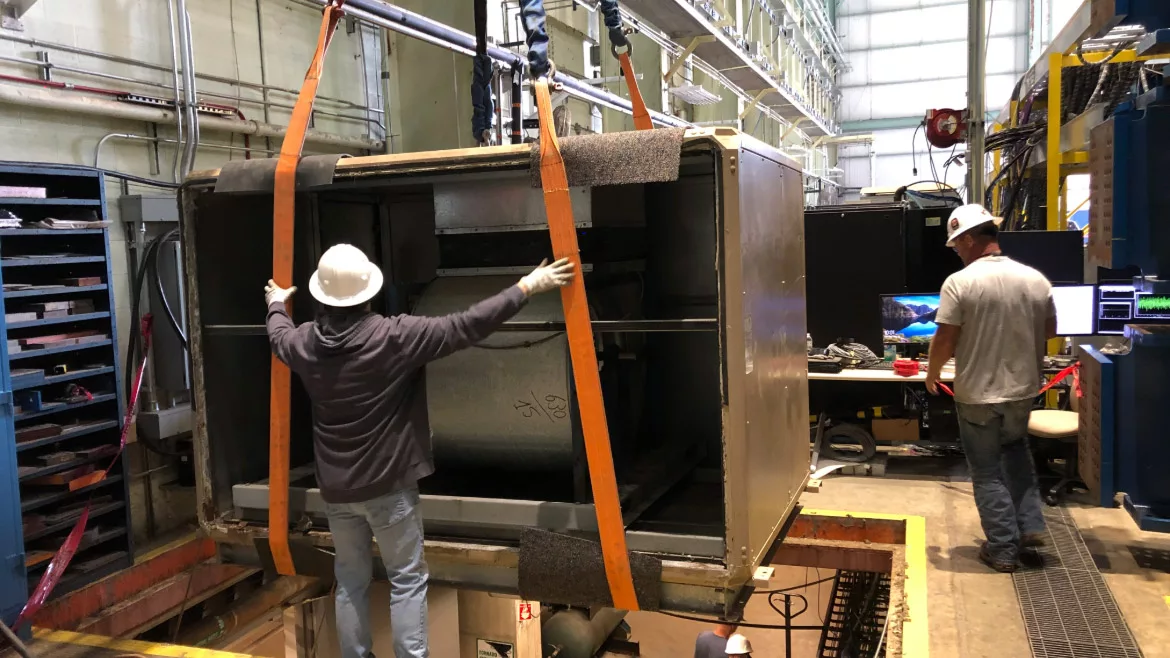
STRAT: M&D Mechanical crews coordinate in the shadow of Building 4619, where every duct and pipe upgrade had to fit around NASA’s nonstop testing schedule.
This year, M&D Mechanical’s work at Marshall Space Flight Center earned national recognition at Associated Builders and Contractors’ Excellence in Construction Awards in Las Vegas – a nod to both the technical challenges and the teamwork required to keep a 24/7 NASA lab running while overhauling its guts. The project stood out among 96 entries for its planning, precision, and pure grit in the field.
Building 4619 is a 60-year-old NASA research lab that runs around the clock, supporting critical testing and research every day of the year – and this time, it was due for nothing less than a top-to-bottom HVAC and piping overhaul.
David Coon, project manager at M&D, didn’t start the job – he inherited it after his predecessor’s retirement, coming in for the long, careful closeout on a project that spanned more than two and a half years. “We all kind of work together here,” Coon said, “so even if you’re not the one turning the first bolt, you know what’s going on.”
But this wasn’t new construction – far from it. Building 4619 is occupied 24/7, its temperature and humidity tightly controlled for space hardware testing that never stops. “There’s no shutting it down,” Coon said. “You can’t just come in and rip the old stuff out and hope for the best.”
Phased Like a Rocket Launch
Instead, M&D had to dance. New systems had to be fully functional before the old ones could be taken offline. Every move was phased, coordinated, and approved by NASA engineers with exacting standards. “A lot of planning, a lot of phasing and scheduling,” Coon said. “We had to make sure nothing disrupted their testing.”
And when you’re working in a building with blueprints that may or may not match reality – well, that’s when the field superintendents and shop foremen earn their keep.
Enter Jeff Allen, M&D’s lead sheet metal foreman on the project – one of those “galvanized metal geniuses” who can look at a pile of drawings and see, in his mind, the finished ductwork twisting through 40 feet of airspace. “Jeff’s a phenomenal sheet metal guy,” Coon said.
Allen and his team coordinated all the air handling equipment and exhaust fans, piecing together new ductwork for every lab and corridor. With access limited and downtime a luxury no one could afford, prefabrication was the name of the game. “As much as you can prefab offsite, you do,” Coon said. “It lets you get in, get out, and keep things moving – especially when you’re working weekends or after hours.”

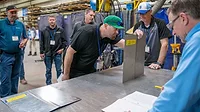
FIELD: Field superintendents and sheet metal foremen review shop drawings on-site, transforming decades-old blueprints into real-world solutions for a 24/7 research lab. (Courtesy of M&D Mechanical)
The Scope, By the Numbers
To get a sense of just how much went into the airside of the job, consider the numbers: M&D’s team logged a staggering 61,377 man-hours on the project, with 18,660 of those spent in the field working sheet metal, another 6,040 hours dedicated to pre-fabrication, and 735 hours on CAD duct design alone.
On the fabrication side, the crew installed and assembled more than 82,000 pounds of galvanized sheet metal ductwork—each piece measured, cut, and fitted to snake through the decades-old facility.
As for equipment, the scale was equally impressive: 35 hydronic unit heaters, 50 variable air volume (VAV) boxes, 20 horizontal and vertical blower coil units (providing a combined 107,300 CFM), 3 fan coil units, 6 indoor air handling units (totaling 65,000 CFM), a dedicated DX unit (7,000 CFM), and 4 side wall exhaust fans (3,850 CFM) all found new homes in Building 4619.
All of this, delivered with NASA-level quality control, and installed while the building never stopped humming.
The complexity didn’t stop with fabrication. Old buildings like 4619 rarely match their as-built drawings. “A lot of it is field dimensions, mock-ups, and just experience,” Coon said. “You get up there and you say, ‘That’s not going to fit,’ and you make a new plan.”
A Culture of Craft
M&D’s approach is equal parts old-school knowhow and new-school CAD. Shop drawings are constantly revised, field crews improvise, and guys like Allen pass their knowledge down to younger techs coming up. “Jeff’s a great teacher,” Coon said. “He just kind of oozes his knowledge onto the younger guys. He lets them handle it, lets them learn.”
In a building where even the change orders take months (NASA’s process is as slow as it is thorough), experience and adaptability count for everything. “Nothing is quick with change orders,” Coon laughed. “So you do as much as you can on the front end.”
No Room for Error
At the end of the day, the project was about more than new equipment. It was a test of coordination, patience, and pride in the trades. “Our field superintendents, our sheet metal guys, our piping guys – they make it happen,” Coon said. “You could blindfold them and send them into a building, and they’d know what kind of pipe they’re touching just by feel. That’s experience you can’t buy.”
For M&D Mechanical, the NASA retrofit stands as a showcase not just of technical skill, but of the culture and camaraderie that powers the best contractors in the business. “We try to give our field guys all the accolades,” Coon said. “They’re the ones that run the job.”
And at Marshall Space Flight Center, the air’s never been cleaner – or the ductwork tighter – thanks to a crew that treats every project like a moonshot.
A NASA Lab Overhaul, Zone by Zone
Replacing 4619’s mechanical core wasn’t just a matter of swapping HVAC units. The building’s 156,000 square feet were split into work zones, each with unique demands. In the Flat Floor Labs, for example, a stable 69°F environment had to be maintained, so new systems went live before the old ones ever shut down. In office zones, ceilings, lighting, and ductwork were replaced in rapid sequence – staff vacated, crews moved fast, and everyone was back at their desks with minimal disruption.
The high bays, where NASA’s most sensitive testing happens, brought even tighter constraints: strict temperature and humidity requirements meant M&D had to bring in temporary heating and cooling to keep testing on track while the overhaul happened above.
All told, M&D self-performed about 70% of the labor – logging 61,377 hours, including 18,660 for field sheet metal work, 6,040 of pre-fab, and 735 on CAD. More than 82,000 pounds of ductwork were installed, along with major equipment: two new natural gas boilers, six air-handling units, 35 unit heaters, 50 VAV boxes, and a host of other systems, all controlled by NASA’s advanced digital systems.
Suppliers and ABC-member partners – like Mayer Electric, Kenny Pipe, Action Concrete, and others – played key roles in keeping materials and specialty work flowing, even as M&D responded to 71 RFIs and 30 change orders, many triggered by the quirks of a 60-year-old building.
When the piping in the West High Bay turned out to be unreachable by lifts, M&D’s redesign – using scaffolding and rerouting – saved both time and budget. Those kinds of pivots, plus real-time project management tools, helped keep the job moving, no matter what curveballs came their way.
The result: a fully modernized, tightly controlled lab that never missed a day of NASA’s mission-critical work. For M&D and their partners, it was proof that with the right planning and teamwork, even the toughest retrofit can look routine.
Looking for a reprint of this article?
From high-res PDFs to custom plaques, order your copy today!