Inside a High-Stakes Build: Lincoln Food Manufacturing Plant Recap
Resourceful leadership and hands-on teamwork keep a critical food plant running during boiler installation
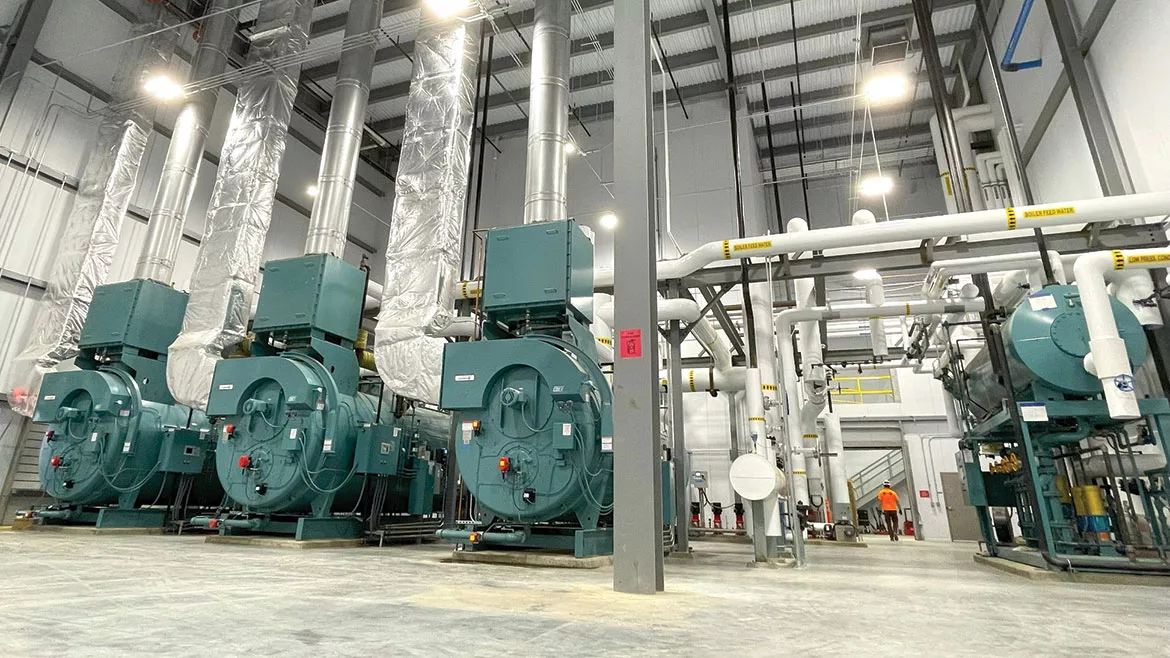
In this project, Rasmussen Mechanical Services installed three steam boilers, more than 12,000 feet of stainless piping, and a full compressed air system.
Kurt Sander remembers the first day he walked the job site in Lincoln, Nebraska. The food manufacturing facility stretched wide across the landscape, a blank slate waiting for the hum and hiss of industrial life. As project manager for Rasmussen Mechanical Services, Sander knew the scale of the job — installing three Cleaver-Brooks steam boilers, a full compressed air system, and more than 12,000 feet of stainless piping — would test his team’s resolve.
The schedule, he admitted, was “a challenge.” Sander explained that “in phase 1, the underground plumbing installation was delayed and pushed into our overhead piping installation.”
The complications didn’t end there. “In phase 2, more underground issues caused our underground installation to be modified and sequence of work adjustments were needed to get the work accomplished.”
The work wasn’t just about sheer size — it was about precision and versatility. Rasmussen’s team installed not only the three Cleaver-Brooks steam boilers, but also economizers to boost efficiency, a blowdown separator, and a state-of-the-art deaerator with a surge tank to keep the system running smoothly. Hygiene was a top priority, so the crew outfitted the plant with 11 HAACP-compliant boot washing stations and 37 process hose stations to help the facility maintain strict food safety standards. The job also called for a robust compressed air system, built around three Atlas Copco oil-free compressors, three air dryers, and three massive receiver tanks.
Once the hardware was in place, Rasmussen’s commitment didn’t stop. When it came time for start-up, the team provided 80 hours of commissioning support, running pre-functional checks, flushing, pressure testing, and meticulous temperature mapping to make sure everything ran flawlessly from day one.
Decisions about the heart of the system — the boilers and compressors — weren’t left to Sander’s crew.
“Equipment selections were made by our customer,” he said, and it was up to Rasmussen’s team to bring those specifications to life.
Throughout months of construction, the food manufacturer’s staff took an active role in keeping the operation on track. Sander described how “the manufacturer’s staff was ‘hands on’ in maintaining a separation between the construction zone and operations.” The collaboration kept work flowing while protecting the vital food safety standards embedded in every corner of the plant.
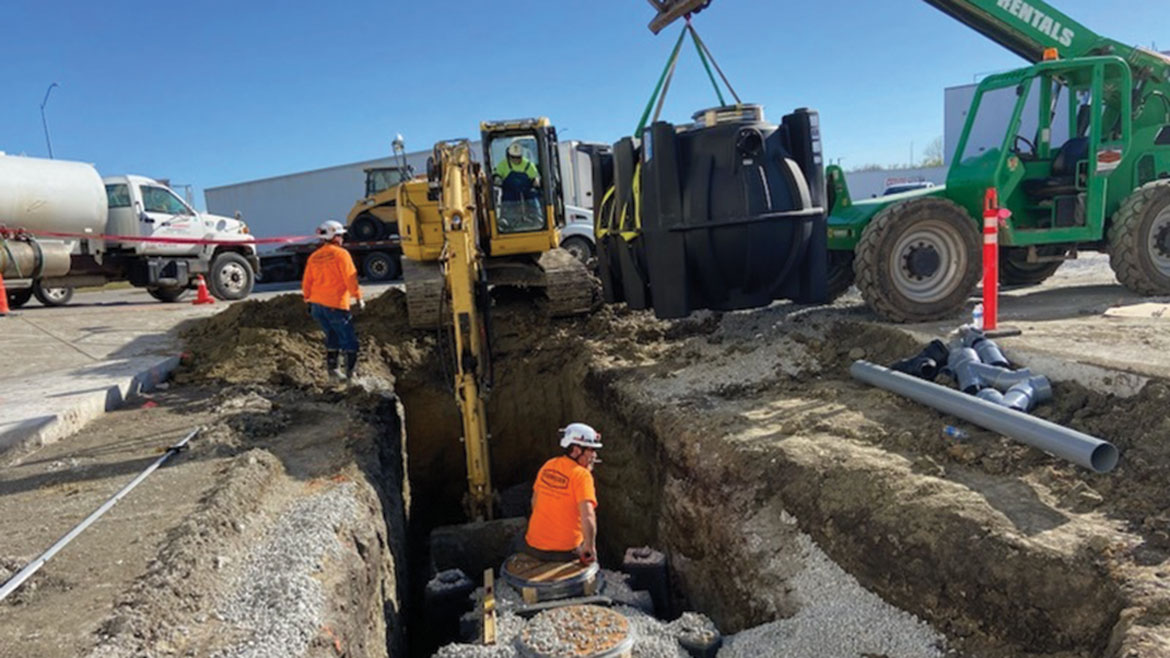
GREASE: Dividing this large project into small projects with small crews proved invaluable. (Courtesy of Rasmussen Mechanical Services)
Yet the real test came in the details. To keep a facility like this running for decades, Sander and his team needed to think ahead — and they did. “We’ve provided the Owner with a preventative maintenance program to assist them with diagnosing possible potential issues before they become larger issues,” Sander said. Reliability, he knew, started long before the first boiler roared to life.
Pulling off a project of this magnitude required more than just technical know-how. It demanded unity.
“The way the Rasmussen team pulled collectively together to accomplish this project,” Sander said, was what filled him with pride. He pointed out that “we were able to pull resources from our other branches, (Gibbon, Sioux City, Council Bluffs) to meet the demands of this project and achieve the project schedule.”
That spirit of teamwork was tested daily, but the leadership on the ground made the difference.
“We had elite field leadership on this project,” Sander said, recalling how supervisors broke down the massive project into “small packages that were manageable with small crews.” This approach, he noted, made the overwhelming feel achievable: “Reviewing the project as a whole can be a bit overwhelming. These smaller projects helped keep the crews focused on the task at hand and maximize efficiencies.”
Nothing ever goes exactly to plan — Sander knows that better than most. “There were many design changes during construction,” he said. But thanks to “constant communication,” the crew always had “the most current info released by the design team.”
So what would Sander tell another team preparing to tackle a job of this scope? His answer comes quick: “Have a complete understanding of the project scope and schedule and stay ahead of the game. Manage the project and don’t let the project manage you.”
Now, as steel gleams in the summer sun and the compressors thrum in the background, Sander looks ahead. He hopes this project will “open some eyes that Rasmussen Mechanical is the contractor of choice for similar projects.” With regional branches backing them up, he believes, “similar projects are not out of range for Rasmussen Mechanical,” he concluded.
Looking for a reprint of this article?
From high-res PDFs to custom plaques, order your copy today!



_0093.webp?height=200&t=1763415512&width=200 "Schlosser")

