search
Ask ACHR NEWS AI
cart
facebook twitter instagram linkedin youtube
  • Sign In
  • Subscribe
  • Sign Out
  • My Account
  • NEWS
  • TECHNOLOGY
    • Heating & Boilers
    • Cooling & Chillers
    • Pumps & Flow Controls
  • SECTORS
    • Commercial
    • Health Care
    • Data Center
    • Educational Facilities
  • DESIGN | CONSTRUCTION
  • OTHER TOPICS
    • High-Performance Buildings & Automation
    • Ventilation and IAQ
    • Commissioning
    • HVAC Retrofits
  • TODAY’S BOILER
    • Today’s Boiler Archives
    • Today’s Boiler Digital Edition
  • MORE
    • Case Studies
    • Podcasts
    • Videos
    • Directory
    • Webinars
    • ES NEWS Store
    • White Papers
  • SIGN UP
  • Back to The NEWS
Engineered Systems NEWSVentilation and IAQ

Some Strategies to Kill the SARS-CoV-2 Virus May Be Creating Mutations
By Stephanie Taylor, M.D., M. Arch, CIC
IAQ Vaccine
January 29, 2021

The COVID-19 virus has mutated! How did this happen and what does it mean for humans? Contrary to the mental image that many people have, viruses are not alive. Rather, they are tiny packages of either DNA or RNA genes that cannot live or reproduce on their own. To avoid extinction, viruses infect animal hosts and then turn the host cells into virus generators. During this process of replication within host cells, genetic codes of the virus are copied to create multiple “mini-me” copies. Coronaviruses, and most viruses that cause new diseases in humans, have single-stranded RNA genes that are notoriously prone to errors during replication. These errors led to mutations in the “mini-me” copy of the parent virus. While some mutated virus offspring cannot survive, others may actually have greater fitness for their environment.

In late 2019, the SARS-CoV-2 virus became known to all of us. The high mutation rate of this RNA virus enabled the virus to cross-host species and quickly move from the non-human population to humans, spread rapidly across geographical barriers, and conclusively remind us that pandemics are not a thing of the past. While we have been scurrying to create and distribute a vaccine, the virus has continued to adapt to surrounding conditions, thus preserving its ability to survive in our human environments. 

Understanding the environmental conditions that are associated with mutations in the SARS-CoV-2 RNA is key to determining future evolutionary trajectories of new strains of this virus. As herd immunity, vaccine-induced immunity, antiviral therapies, and environmental disinfection pressures expand, will these pressures promote genetic mutations that allow greater virus stability and transmissibility or drive SARS-CoV-2 to extinction? 

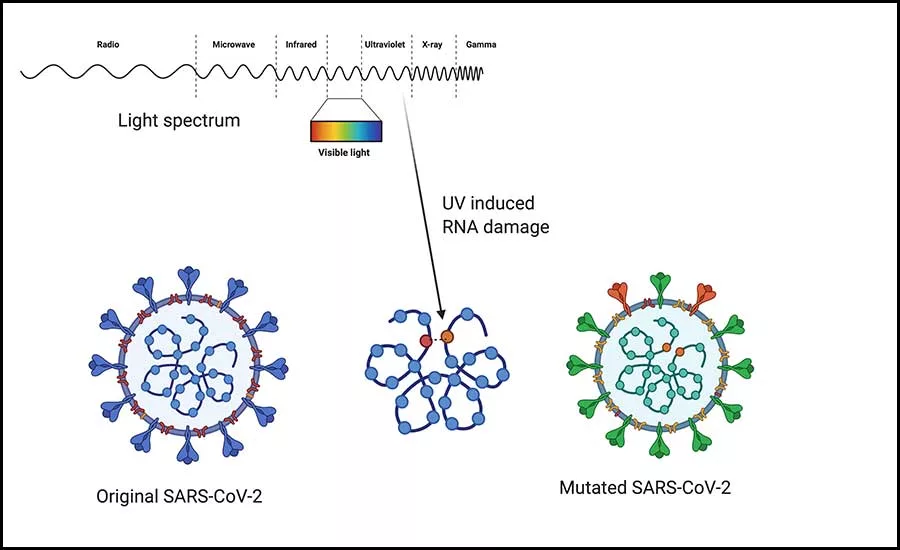
We can answer this question using new tools, such as high-throughput nucleotide sequencing to detect where, when, and how viral pathogens respond to environmental forces. These tools have revealed several mutation patterns, known as mutation signatures, that we need to be aware of as we move forward. One of the physiochemical forces with a clear mutation signature in genomes is ultraviolet light (UV) radiation from the range of wavelengths associated with UVC, UVB, and UVA. Across the SARS-CoV-2 genomes analyzed worldwide, the rate of mutation signatures associated with UV light is higher than what is expected if these events took place randomly. 

The preponderance of UV mutation signatures in SARS-CoV-2, over and above the general replication error-induced mechanism of mutagenesis, requires that we remain vigilant about the long-term effects of disinfection strategies in our indoor environments. As we work to reduce the transmission of viral infections indoors through heating, chemical disinfectants, and ultraviolet light irradiation strategies, we will need to carefully monitor the incidence of mutation signatures in global SARS-CoV-2 genomes. 

The new SARS-CoV-2 strain, fortunately, has not been found to cause more severe disease when compared to the original strain. Also, thankfully, the COVID-19 vaccines that are currently being distributed — ones based on the original virus spike sequence — are effective in inducing immunity to the new strain. While these findings allay fears right now, we need to remain cognizant of the agility of the viral RNA genome in its fight for survival. 

References available upon request.

Share This Story

Looking for a reprint of this article?
From high-res PDFs to custom plaques, order your copy today!


Dr. Stephanie Taylor is the president and founder of Building4Health Inc. After working as a physician for many decades, Dr. Taylor obtained a Masters in Architecture as well as Infection Control certification. Her lifelong commitment to patient care includes focusing on improving the healthcare physical environment and clinical work processes to help patients heal quickly and save hospitals valuable dollars. Dr. Taylor is a graduate of Harvard Medical School (MD), and Norwich University (Masters Architecture). She has numerous research publications in Nature, Science, and other peer-reviewed journals. She can be contacted at stephanie@b4hinc.com or (860) 501-8950.

Recommended Content

JOIN TODAY
To unlock your recommendations.

Already have an account? Sign In

  • HVAC-enrollment

    The Trades Are Back: HVACR Programs See Nearly 30% Enrollment Spike

    A new wave of future technicians is entering the pipeline.  
    Training and Education
    By: Matt Jachman
  • 2025 Top 40 Under 40

    2025 Top 40 Under 40 HVACR Professionals List

    The 11th annual Top 40 Under 40 list highlights those...
    HVAC Residential Market
    By: Hannah Belloli-Oster
  • LG Ductless Mini-Split Systems

    The 9 Types of Heat Pumps

    As the U.S. moves toward electrification, heat pumps are...
    Ground Source Heat Pumps
    By: Joanna R. Turpin

More Videos

Today's Boiler

Spring 2026 Issue

Today's Boiler - Spring 2026 Cover

Read More from Today's Boiler

Case in Point Logo

Smarter Hydronic Design for Data Centers - Free Webinar - January 22, 2026

Related Articles

  • A Physical View IAQ

    Accepting Airborne Transmission of SARS-COV-2: Our Greatest Fear and Greatest Opportunity

    See More
  • A Physical View IAQ

    Batman Survives COVID-19

    See More
  • As standards and mandates evolve to require healthy indoor environments, the building owners who pay for capital costs will be more motivated to manage IAQ to protect occupants.

    Incentives and obstacles in managing IAQ for occupant health

    See More

Related Products

See More Products
  • new cover.jpg

    Profit is An Attitude: The Strategies You Need to Optimize Profits

  • solidworkscourse2.gif

    SolidWorks for the Sheet Metal Guy - Course 2: Hole Patterns and Notches

  • air came to a stop.jpg

    The Air Came to a Stop

See More Products

Events

View AllSubmit An Event
  • October 14, 2025

    Maximize Every Home Visit: Indoor Air Quality Strategies to Grow HVAC Revenues

    On Demand In this webinar, you’ll learn how top HVAC pros are integrating IAQ into everyday service and sales calls to increase average job size, boost customer satisfaction and stand out from the competition.
View AllSubmit An Event
×

Sign Up. Stay Informed.

The #1 trusted source for the HVACR industry since 1926

SUBSCRIBE
  • RESOURCES
    • Advertise
    • Contact Us
    • Advisory Board
    • Classifieds
    • Submit a Letter
    • Directories
    • Store
  • ACCOUNT CENTER
    • Create an Account
    • Start a Subscription
    • Manage My Account
    • Sign Up for Newsletters
    • Visit Customer Service
    • Update Preferences
  • SERVICES
    • Marketing Services
    • Reprints
    • Market Research
    • List Rental
    • Survey/Respondent Access
  • STAY CONNECTED
    • LinkedIn
    • Facebook
    • Instagram
    • YouTube
    • X (Twitter)
  • PRIVACY
    • PRIVACY POLICY
    • TERMS & CONDITIONS
    • DO NOT SELL MY PERSONAL INFORMATION
    • PRIVACY REQUEST
    • ACCESSIBILITY

Copyright ©2026. All Rights Reserved BNP Media, Inc. and BNP Media II, LLC.

Design, CMS, Hosting & Web Development :: ePublishing