search
Ask ACHR NEWS AI
cart
facebook twitter instagram linkedin youtube
  • Sign In
  • Subscribe
  • Sign Out
  • My Account
  • NEWS
  • TECHNOLOGY
    • Heating & Boilers
    • Cooling & Chillers
    • Pumps & Flow Controls
  • SECTORS
    • Commercial
    • Health Care
    • Data Center
    • Educational Facilities
  • DESIGN | CONSTRUCTION
  • OTHER TOPICS
    • High-Performance Buildings & Automation
    • Ventilation and IAQ
    • Commissioning
    • HVAC Retrofits
  • TODAY’S BOILER
    • Today’s Boiler Archives
    • Today’s Boiler Digital Edition
  • MORE
    • Case Studies
    • Podcasts
    • Videos
    • Directory
    • Webinars
    • ES NEWS Store
    • White Papers
  • SIGN UP
  • Back to The NEWS
Engineered Systems NEWSVentilation and IAQ

Incentives and obstacles in managing IAQ for occupant health

Will we take actions to protect the health of occupants, or will we fall back on a myriad of familiar excuses?
By Stephanie Taylor, M.D., M. Arch, CIC
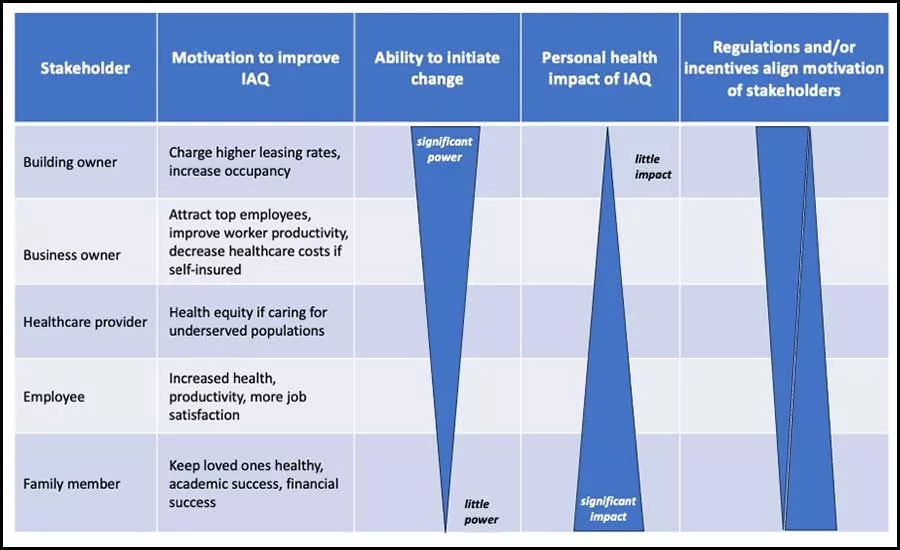
As standards and mandates evolve to require healthy indoor environments, the building owners who pay for capital costs will be more motivated to manage IAQ to protect occupants.

FIGURE 1: As standards and mandates evolve to require healthy indoor environments, the building owners who pay for capital costs will be more motivated to manage IAQ to protect occupants.


December 22, 2023

When people became aware that transmission of SARS-CoV-2 was primarily through the air, reducing airborne exposure in buildings immediately became a high priority. As a result, high ventilation rates to reduce infectious airborne contaminants were implemented.

Almost simultaneous with recommendations for increased ventilation, extreme weather events tied to atmospheric warming from greenhouse gases catalyzed mandates to decrease carbon-based emissions from buildings. Building owners became caught in the difficult conundrum of managing IAQ to support occupant health while simultaneously conserving energy — all within a profitable business model.

Of these two goals, decreasing energy consumption has clear metrics (less fuel used) and obvious motivation (save money by paying for less fuel). Conversely, managing IAQ to support occupant health has complicated outcome metrics, short of the presence or absence of a clear “supers preading event.” In addition, the financial benefits of healthy occupants may not be seen by the building owner who is responsible for paying for building improvements.

Perhaps because of these disconnects, the adoption of health-based IAQ standards has lagged behind standards for energy conservation and decarbonization. Thankfully, building incentives and government and state regulations are now evolving to motivate off-site building owners to invest in systems to protect the health of day-to-day occupants. (see Figure 1).

For example, a groundbreaking change was announced at the Greenbuild 2023 Conference (GBC 2023) in Washington, D.C. For the first time in the 30-year history of the US Green Building Council (USGBC), managing indoor air for health was incentivized in the new version of the LEED rating system for existing buildings.

To overcome the difficulty in setting performance indicators for IAQ that supports health, the following needs to occur:

  • Medical professionals must work with engineers and architects to benchmark safe IAQ thresholds.
  • Comprehensive management of IAQ for health must be based on metrics that capture the effects of multiple pollutants, as well as the products of indoor chemical reactions.
  • We must aim for safe provision of midrange relative humidity (40%–60%), to support IAQ for healthy occupants.

Unfortunately, it took a pandemic caused by an airborne virus to motivate us to take a closer look at the role of IAQ in disease transmission. On the bright side, we can now manage IAQ to support our physiology — including our immune, neuroendocrine, respiratory, and cardiovascular health. Will we take actions to protect the health of occupants, or will we fall back on a myriad of familiar excuses? I hope that building and medical professionals will work together to choose the correct path forward.

Share This Story

Looking for a reprint of this article?
From high-res PDFs to custom plaques, order your copy today!


Dr. Stephanie Taylor is the president and founder of Building4Health Inc. After working as a physician for many decades, Dr. Taylor obtained a Masters in Architecture as well as Infection Control certification. Her lifelong commitment to patient care includes focusing on improving the healthcare physical environment and clinical work processes to help patients heal quickly and save hospitals valuable dollars. Dr. Taylor is a graduate of Harvard Medical School (MD), and Norwich University (Masters Architecture). She has numerous research publications in Nature, Science, and other peer-reviewed journals. She can be contacted at stephanie@b4hinc.com or (860) 501-8950.

Recommended Content

JOIN TODAY
To unlock your recommendations.

Already have an account? Sign In

  • HVAC-enrollment

    The Trades Are Back: HVACR Programs See Nearly 30% Enrollment Spike

    A new wave of future technicians is entering the pipeline.  
    News
    By: Matt Jachman
  • 2025 Top 40 Under 40

    2025 Top 40 Under 40 HVACR Professionals List

    The 11th annual Top 40 Under 40 list highlights those...
    HVAC Light Commercial Market
    By: Hannah Belloli-Oster
  • LG Ductless Mini-Split Systems

    The 9 Types of Heat Pumps

    As the U.S. moves toward electrification, heat pumps are...
    HVAC Residential Market
    By: Joanna R. Turpin

More Videos

Today's Boiler

Spring 2026 Issue

Today's Boiler - Spring 2026 Cover

Read More from Today's Boiler

Case in Point Logo

Smarter Hydronic Design for Data Centers - Free Webinar - January 22, 2026

Related Articles

  • A Physical View IAQ

    ASHRAE Considers Occupant Health as a Building Performance Metric

    See More
  • National Institute of Building Science IAQ

    Indoor and outdoor air concentration levels can guide HVAC management to occupant health

    See More
  • carrier logo

    Carrier Launches Healthy Buildings Program to Help Customers Reinvent Their Buildings for Occupant Health

    See More

Related Products

See More Products
  • Training-Managing-System-2017.jpg

    Customer Service Training & Managing System by Steve Coscia

  • Building Information Modeling: Planning and Managing Construction Projects with 4D CAD and Simulations

See More Products

Related Directories

  • Sheet Metal Occupational Health Institute Trust-SMOHIT

    SMOHIT provides industry-leading health and safety solutions and connections that improve the physical, mental, and emotional well-being of union members and their families.
  • TRION IAQ

    Trade NamesAir Bear®Air Boss®ComfortSteam®Forever Filter®Grease Viper™Herrdraulic®Herricane®Herrmersion®Herrmidicool®Herrmidifier®Herrmidisteam®Herrtronic®Trion®
×

Sign Up. Stay Informed.

The #1 trusted source for the HVACR industry since 1926

SUBSCRIBE
  • RESOURCES
    • Advertise
    • Contact Us
    • Advisory Board
    • Classifieds
    • Submit a Letter
    • Directories
    • Store
  • ACCOUNT CENTER
    • Create an Account
    • Start a Subscription
    • Manage My Account
    • Sign Up for Newsletters
    • Visit Customer Service
    • Update Preferences
  • SERVICES
    • Marketing Services
    • Reprints
    • Market Research
    • List Rental
    • Survey/Respondent Access
  • STAY CONNECTED
    • LinkedIn
    • Facebook
    • Instagram
    • YouTube
    • X (Twitter)
  • PRIVACY
    • PRIVACY POLICY
    • TERMS & CONDITIONS
    • DO NOT SELL MY PERSONAL INFORMATION
    • PRIVACY REQUEST
    • ACCESSIBILITY

Copyright ©2026. All Rights Reserved BNP Media, Inc. and BNP Media II, LLC.

Design, CMS, Hosting & Web Development :: ePublishing