search
Ask ACHR NEWS AI
cart
facebook twitter instagram linkedin youtube
  • Sign In
  • Subscribe
  • Sign Out
  • My Account
  • NEWS
  • TECHNOLOGY
    • Heating & Boilers
    • Cooling & Chillers
    • Pumps & Flow Controls
  • SECTORS
    • Commercial
    • Health Care
    • Data Center
    • Educational Facilities
  • DESIGN | CONSTRUCTION
  • OTHER TOPICS
    • High-Performance Buildings & Automation
    • Ventilation and IAQ
    • Commissioning
    • HVAC Retrofits
  • TODAY’S BOILER
    • Today’s Boiler Archives
    • Today’s Boiler Digital Edition
  • MORE
    • Case Studies
    • Podcasts
    • Videos
    • Directory
    • Webinars
    • ES NEWS Store
    • White Papers
  • SIGN UP
  • Back to The NEWS
Engineered Systems NEWSVentilation and IAQ

Indoor and outdoor air concentration levels can guide HVAC management to occupant health

Ventilation rates don't dictate IAQ
By Stephanie Taylor, M.D., M. Arch, CIC
National Institute of Building Science IAQ

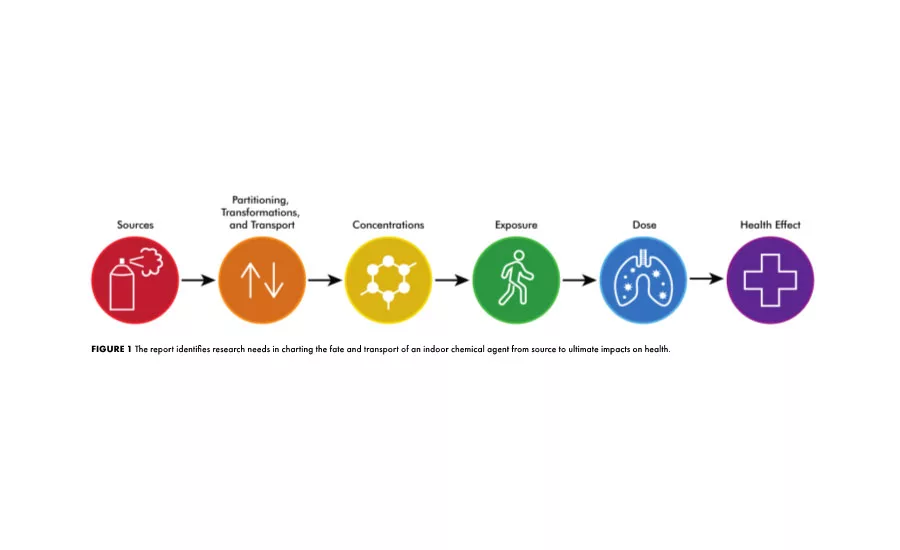
Ventilation rates do not give a consistent assessment of occupant indoor exposures, the actual cause of health problems. 
Image courtesy of National Institute of Building Science, 2023 


March 8, 2024

Managing indoor air quality (IAQ) to support health is one of the biggest public health opportunities of this century. As with most opportunities, however, there are also significant challenges. One of those challenges is changing the metric historically viewed as synonymous with good or bad IAQ: ventilation rates. Ventilation rates, per se, do not relate to human health thresholds. 

While many of us grew up hearing the phrase, “go outside and get some fresh air,” we now know that outside air is not always fresh. Changing this familiar assumption is critical if we really want to manage IAQ to support occupant health and eliminate unnecessary HVAC energy consumption. 

The presumption that high ventilation rates are synonymous with good IAQ, and conversely, low ventilation rates with poor IAQ, may be true in some settings, but this is far from a universal truth. Furthermore, ventilation rates do not give a consistent assessment of occupant indoor exposures, the actual cause of health problems. While flow rates provide a useful metric for the design engineer predicting energy use management, occupant health is not considered. 

The only air metrics that directly reflect the impact of IAQ on occupant health are contaminant concentrations within a given range of temperature and humidity. 

Ventilation reduces the levels of many indoor contaminants via dilution, but prescribing ventilation alone is not a solution creating healthy IAQ. For example, when indoor sources exist, the most effective step is to eradicate emissions. Another situation where ventilation is not effective is when indoor relative humidity (RH) is low and exhaled droplets shrink to become tiny and remain airborne through random, Brownian motion. 

Furthermore, when contaminants are present in outdoor air, increasing ventilation has the potential to make IAQ worse. Buildings that are downwind from auto emissions, industrial sites, and ground dust sources (think farms) can have poorer IAQ when ventilation rates are increased. 

Traditionally, ASHRAE management of IAQ has been to require minimum ventilation rates in liters per person or liters per square meter of space. A relatively new IAQ procedure, part of 62.1, is performance-based guidance based on indoor concentrations of contaminants, but remediation solutions are still based on flow rates with filtration added when necessary. 

The building industry around the world has no consensus on best practices for outside air ventilation, filtration, contaminant extraction, recirculation, and airflow for room pressurization. And yet, these interventions impact the first cost and operating costs of the infrastructure supporting such facilities. 

“The available data do not provide a sound basis for determining specific outdoor air ventilation rates that can be universally applicable in different public and residential buildings to protect against health risks. They cannot be used for regulative purposes, unless the required ventilation rates are related to actual exposures and are prescribed only when full advantage of other methods for controlling exposures has been taken.” 

What direction should we move in? At the present time, many people are unaware of the health significance of indoor contaminants that they cannot smell or feel through irritation of their respiratory tract. Affordable sensors revealing many of the indoor constituents that impact health now exist. Wide use of monitors displaying IAQ concentrations collected by indoor sensors is now possible. With visible displays of the data, building operators can show their commitment to providing good IAQ, thus advancing the public´s awareness. 

Share This Story

Looking for a reprint of this article?
From high-res PDFs to custom plaques, order your copy today!


Dr. Stephanie Taylor is the president and founder of Building4Health Inc. After working as a physician for many decades, Dr. Taylor obtained a Masters in Architecture as well as Infection Control certification. Her lifelong commitment to patient care includes focusing on improving the healthcare physical environment and clinical work processes to help patients heal quickly and save hospitals valuable dollars. Dr. Taylor is a graduate of Harvard Medical School (MD), and Norwich University (Masters Architecture). She has numerous research publications in Nature, Science, and other peer-reviewed journals. She can be contacted at stephanie@b4hinc.com or (860) 501-8950.

Recommended Content

JOIN TODAY
To unlock your recommendations.

Already have an account? Sign In

  • HVAC-enrollment

    The Trades Are Back: HVACR Programs See Nearly 30% Enrollment Spike

    A new wave of future technicians is entering the pipeline.  
    News
    By: Matt Jachman
  • 2025 Top 40 Under 40

    2025 Top 40 Under 40 HVACR Professionals List

    The 11th annual Top 40 Under 40 list highlights those...
    HVAC Light Commercial Market
    By: Hannah Belloli-Oster
  • LG Ductless Mini-Split Systems

    The 9 Types of Heat Pumps

    As the U.S. moves toward electrification, heat pumps are...
    Air Source Heat Pumps
    By: Joanna R. Turpin

More Videos

Today's Boiler

Spring 2026 Issue

Today's Boiler - Spring 2026 Cover

Read More from Today's Boiler

Case in Point Logo

Smarter Hydronic Design for Data Centers - Free Webinar - January 22, 2026

Related Articles

  • A Physical View IAQ

    ASHRAE Considers Occupant Health as a Building Performance Metric

    See More
  • As standards and mandates evolve to require healthy indoor environments, the building owners who pay for capital costs will be more motivated to manage IAQ to protect occupants.

    Incentives and obstacles in managing IAQ for occupant health

    See More
  • TSI logo.jpg

    TSI and Building4Health Join Forces to Manage IAQ to Optimize Occupant Health

    See More

Related Products

See More Products
  • 1819.gif

    Fire, Smoke and Radiation Damper Installation Guide for HVAC

  • ac.png

    Air Conditioning Service Guide R-410A and R-22 Systems 2nd Edition

  • Sound and Vibration.gif

    HVAC Systems Sound and Vibration Procedural Guide

See More Products

Events

View AllSubmit An Event
  • October 14, 2025

    Maximize Every Home Visit: Indoor Air Quality Strategies to Grow HVAC Revenues

    On Demand In this webinar, you’ll learn how top HVAC pros are integrating IAQ into everyday service and sales calls to increase average job size, boost customer satisfaction and stand out from the competition.
View AllSubmit An Event

Related Directories

  • Sheet Metal Occupational Health Institute Trust-SMOHIT

    SMOHIT provides industry-leading health and safety solutions and connections that improve the physical, mental, and emotional well-being of union members and their families.
×

Sign Up. Stay Informed.

The #1 trusted source for the HVACR industry since 1926

SUBSCRIBE
  • RESOURCES
    • Advertise
    • Contact Us
    • Advisory Board
    • Classifieds
    • Submit a Letter
    • Directories
    • Store
  • ACCOUNT CENTER
    • Create an Account
    • Start a Subscription
    • Manage My Account
    • Sign Up for Newsletters
    • Visit Customer Service
    • Update Preferences
  • SERVICES
    • Marketing Services
    • Reprints
    • Market Research
    • List Rental
    • Survey/Respondent Access
  • STAY CONNECTED
    • LinkedIn
    • Facebook
    • Instagram
    • YouTube
    • X (Twitter)
  • PRIVACY
    • PRIVACY POLICY
    • TERMS & CONDITIONS
    • DO NOT SELL MY PERSONAL INFORMATION
    • PRIVACY REQUEST
    • ACCESSIBILITY

Copyright ©2026. All Rights Reserved BNP Media, Inc. and BNP Media II, LLC.

Design, CMS, Hosting & Web Development :: ePublishing