search
Ask ACHR NEWS AI
cart
facebook twitter instagram linkedin youtube
  • Sign In
  • Subscribe
  • Sign Out
  • My Account
  • NEWS
  • TECHNOLOGY
    • Heating & Boilers
    • Cooling & Chillers
    • Pumps & Flow Controls
  • SECTORS
    • Commercial
    • Health Care
    • Data Center
    • Educational Facilities
  • DESIGN | CONSTRUCTION
  • OTHER TOPICS
    • High-Performance Buildings & Automation
    • Ventilation and IAQ
    • Commissioning
    • HVAC Retrofits
  • TODAY’S BOILER
    • Today’s Boiler Archives
    • Today’s Boiler Digital Edition
  • MORE
    • Case Studies
    • Podcasts
    • Videos
    • Directory
    • Webinars
    • ES NEWS Store
    • White Papers
  • SIGN UP
  • Back to The NEWS
Engineered Systems NEWSHVAC Engineering SectorsHVAC Design/Construction ProcessHigh-Performance Buildings & AutomationHealth Care HVAC

Contrasting Thermogenesis' Impact on the Human Body and Building Efficiency
By Stephanie Taylor, M.D., M. Arch, CIC
Contrasting Thermogenesis' Impact

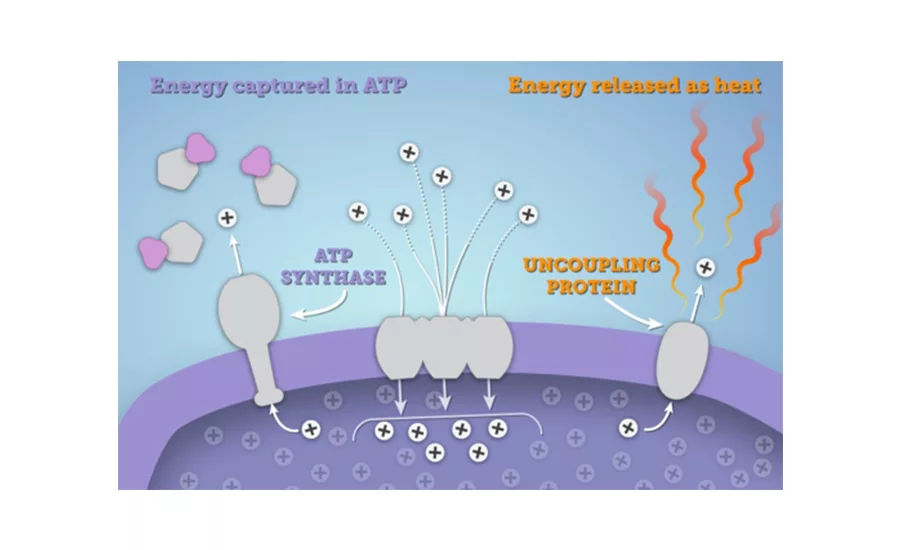
Figure1. In many cell types, the energy from food is efficiently stored as ATP. In brown fat, (above) UCP allows energy losses to produce heat.

October 4, 2018

Last month I showed you how humans discharge excess heat, when necessary, to keep our core temperature within the 1-degree (centigrade) zone essential for survival. Now that autumn is bringing cooler weather to many of us, let’s see how our bodies ramp up to keep us warm as outside temperatures fall. We can then ask if there are any takeaway lessons for us to consider when we’re designing energy-efficient ways to heat our buildings.

When temperatures decrease too much, most vertebrates, including humans, use two mechanisms to increase heat production. The first way is by involuntary shivering, where muscle contractions convert stored chemical energy into kinetic energy with heat as a byproduct. The second non-shivering way occurs in an unappreciated type of adipose tissue known as brown fat. This is not the same as white fat, which stores most of our body’s excess calories and makes our clothes tight.

In contrast to white fat, brown fat is metabolically active. When mammals need extra heat, such as immediately after birth, during a fever, or when thermal demands cannot be met with shivering, heat production in brown fat is activated. A special “uncoupling protein” (UCP) called thermogenin channels extra fuel away from storage in white fat, and heat is generated instead. While it has been well known that infants and hibernating animals carry large amounts of brown fat, until recently, we thought that adult humans had lost their stores. We now know that not only do adults have brown fat, but under certain conditions, white fat is actually converted into heat-generating (and weight-losing) brown fat. This brown fat activity in mammals not only enhances neonatal survival, it also allows for humans to have active, non-hibernating lives in cold surroundings, probably enhancing our evolutionary success.

Despite the survival benefits, increasing our core temperature through the inefficient burning of fuel comes with a high metabolic cost. The generation of enough heat to raise our body temperature only 1°C requires a 12.5 percent increase in our metabolic rate.

After a month of exposure to mild cold temperatures, independent of seasons, the participants had a 42 percent increase in brown fat volume, a 10 percent increase in fat metabolic activity, and improved insulin sensitivity after a meal. These findings suggest that in cool surroundings, humans can actually increase their brown fat stores and gain the health benefits, such as losing weight, that accompany inefficient glucose metabolism.

In a person with an overload of stored white fat (obesity) and the comorbidity of insulin-resistant diabetes, the uncoupling of excess caloric intake from ongoing storage in white fat could be a good result. Not surprisingly, researchers are now looking for ways to intentionally convert white fat to brown.

While inefficient fuel use for thermogenesis might be good for some humans, the opposite pathway — reduction of excess fuel use in heating — should be chosen for buildings. If the equation from human physiology showing a 12.5 percent loss in heating efficiency to compensate for a 1°C increase in temperature holds true in buildings, how much fuel is wasted in a poorly insulated building? As construction technology and mobility of materials make glazing and other low-insulation materials universally available, let’s not forget the “metabolic price” of high fuel bills and carbon dioxide emissions. Heating systems and building envelopes were designed according to local climates for centuries in vernacular building design with beautiful and efficient results.

Share This Story

Looking for a reprint of this article?
From high-res PDFs to custom plaques, order your copy today!


Dr. Stephanie Taylor is the president and founder of Building4Health Inc. After working as a physician for many decades, Dr. Taylor obtained a Masters in Architecture as well as Infection Control certification. Her lifelong commitment to patient care includes focusing on improving the healthcare physical environment and clinical work processes to help patients heal quickly and save hospitals valuable dollars. Dr. Taylor is a graduate of Harvard Medical School (MD), and Norwich University (Masters Architecture). She has numerous research publications in Nature, Science, and other peer-reviewed journals. She can be contacted at stephanie@b4hinc.com or (860) 501-8950.

Recommended Content

JOIN TODAY
To unlock your recommendations.

Already have an account? Sign In

  • HVAC-enrollment

    The Trades Are Back: HVACR Programs See Nearly 30% Enrollment Spike

    A new wave of future technicians is entering the pipeline.  
    News
    By: Matt Jachman
  • 2025 Top 40 Under 40

    2025 Top 40 Under 40 HVACR Professionals List

    The 11th annual Top 40 Under 40 list highlights those...
    HVAC Contracting
    By: Hannah Belloli-Oster
  • LG Ductless Mini-Split Systems

    The 9 Types of Heat Pumps

    As the U.S. moves toward electrification, heat pumps are...
    HVAC Residential Market
    By: Joanna R. Turpin

More Videos

Today's Boiler

Spring 2026 Issue

Today's Boiler - Spring 2026 Cover

Read More from Today's Boiler

Case in Point Logo

Smarter Hydronic Design for Data Centers - Free Webinar - January 22, 2026

Related Articles

  • human endoskeleton

    Defining the Importance of 40%-60% Relative Humidity on the Human Body

    See More
  • Human Body

    Linking the Human Body and the Laws of Thermodynamics

    See More
  • A Physical View IAQ

    Beyond The Hard Hat: IAQ On The Job Site

    See More

Related Products

See More Products
  • The ACHR News - October 6,  2025

    ACHR NEWS October 6, 2025, Issue

See More Products

Related Directories

  • Efficient Building Automation Corp.

    Efficient Building Automation Corporation provides products, systems, services and support that enable our partners to deliver open and integrated LonWorks building automation solutions of unequalled quality, reliability and performance.
×

Sign Up. Stay Informed.

The #1 trusted source for the HVACR industry since 1926

SUBSCRIBE
  • RESOURCES
    • Advertise
    • Contact Us
    • Advisory Board
    • Classifieds
    • Submit a Letter
    • Directories
    • Store
  • ACCOUNT CENTER
    • Create an Account
    • Start a Subscription
    • Manage My Account
    • Sign Up for Newsletters
    • Visit Customer Service
    • Update Preferences
  • SERVICES
    • Marketing Services
    • Reprints
    • Market Research
    • List Rental
    • Survey/Respondent Access
  • STAY CONNECTED
    • LinkedIn
    • Facebook
    • Instagram
    • YouTube
    • X (Twitter)
  • PRIVACY
    • PRIVACY POLICY
    • TERMS & CONDITIONS
    • DO NOT SELL MY PERSONAL INFORMATION
    • PRIVACY REQUEST
    • ACCESSIBILITY

Copyright ©2026. All Rights Reserved BNP Media, Inc. and BNP Media II, LLC.

Design, CMS, Hosting & Web Development :: ePublishing