Linking the Human Body and the Laws of Thermodynamics
The human body and the laws of thermodynamics can point us in the right direction.
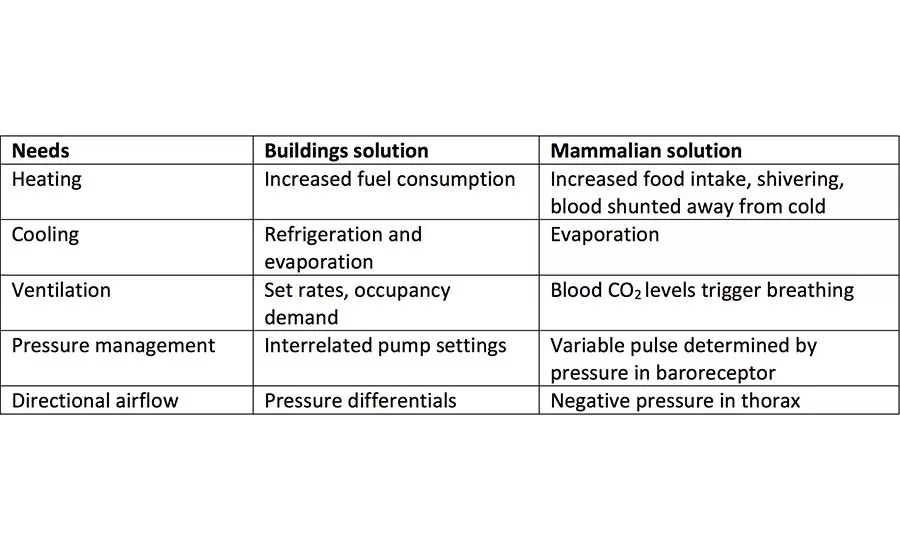
TABLE 1. Areas of overlap between HVAC and vertebrate systems.
Now that we are well into the winter of 2019, designers and managers of commercial buildings in cold climates may be concerned about the efficiency of their HVAC systems. This is a good year to start being especially vigilant. Scientists in the Intergovernmental Panel on Climate Change reported that to avoid the most devastating impacts of climate change, we only have a 12-year window to decrease carbon emissions by 45 percent. Whatever beliefs each of us have, we should not be wasteful of energy.
If you are overly optimistic and know the First Law of Thermodynamics, you might be asking how it is even possible to waste energy. This law tells us that energy is always conserved, and that the total amount never changes. If this is true, then why do we need to worry about wasting it? Why can’t we simply re-use energy over and over again?
Here comes the voice of reality in The Second Law of Thermodynamics reminding us that while energy is never gained or lost, it’s availability for work decreases each time a transformation occurs. The percentage of mechanical energy that becomes unusable kinetic energy (heat) due to friction or useless chemical reactions determines the system’s inefficiency, and no system is 100 percent efficient.
These two laws affect both biological processes and HVAC systems, so nature and human engineers have learned to capture and engage useful energy before it becomes radiated back into the universe in random molecular movements, forever lost to us.
In biology, the pressure for efficient use of the energy contained in glucose or captured by plants through photosynthesis is high — survival through natural selection. Energy inefficiency in buildings may be less immediately noticeable; however, the long-term consequences of waste are extremely costly to our budgets and health.
How does our human body efficiently maintain precise temperatures and ion concentrations in cells while controlling our metabolism within a very narrow range? This is remarkable!
Commendably, HVAC designs use many of the strategies for controlled energy transfer that are found in vertebrates. For example, the same principle behind heat exchangers in buildings operates in our kidneys during urine concentration and in keeping birds warm while they stand in cold water for prolonged periods of time.
One big difference between building systems and the human body is the immediacy of an “alarm” when something goes wrong. If we lose a mitten while skiing, we know immediately that there has been a breach in our insulation. Anyone who has had streptococcus pharyngitis knows that an infection isolated to your neck quickly sets off a body-wide alarm that cannot be ignored. As you fall back into bed with a fever, swollen lymph nodes, and a raging sore throat, your problem is quickly noticed and (hopefully) treated.
Unfortunately, this same immediate system-wide response does not occur in buildings unless BIM software alerts a facility manager. Too often, missed inspections or lack of recommissioning results in small repairs becoming expensive ones creating loss of revenue from system down-time.
Common sources of HVAC energy losses that are easily fixed: (information courtesy of Howard McKew, P.E.)
-
Clogged filters make the system work harder to move air;
-
Dirty coils require more current in order to reach the desired level of conditioning;
-
Excessively high ventilation rates;
-
Faulty damper motors and controls that bring in sub-optimal amounts of air;
-
Waterside economizer plate and frame heat exchangers, heating coils, and cooling coils that are piped incorrectly result in a loss of performance of +/- 20 percent;
-
Building managers are unaware of the actual vs. desired Btu/ft2/year, so energy consumption is 15 percent more than necessary with little to nothing done to improve the building performance; and
-
Water balancing valves on discharge of pumps are closed 10-25 percent or more to slow down the flow while the pump is using the available horsepower to achieve design flows.
While HVAC systems are often very sophisticated, we can still learn an important lesson from our bodies. Nothing good comes from, “out of sight, out of mind.” Do not neglect preventive building care.
Looking for a reprint of this article?
From high-res PDFs to custom plaques, order your copy today!