Designs In Nature Scale Successfully. Do Yours?
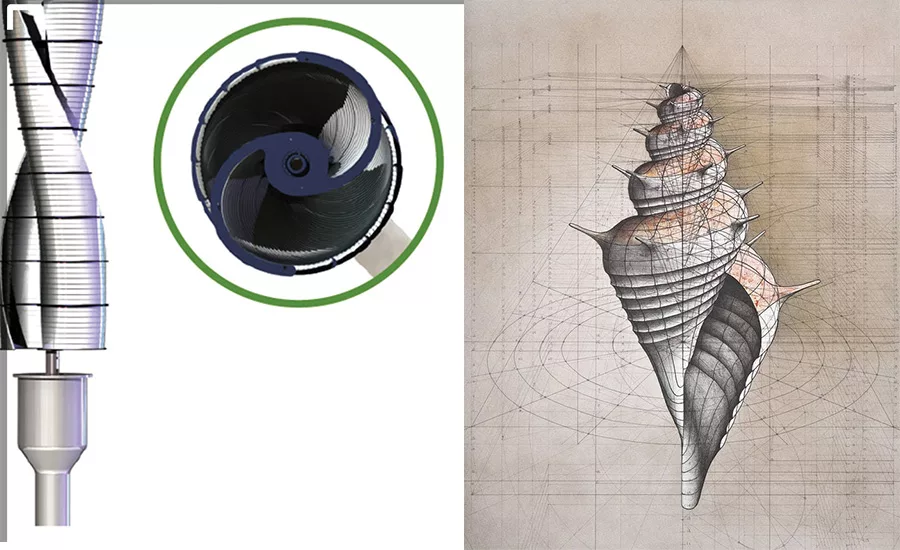
FIGURE 1. A fan and a nautilus seashell provide an example of how patterns in nature can be adopted for building systems.
In 1915, Albert Einstein stunned physicists worldwide when he connected energy, matter, and the speed of light with his mind-blowing equation E=mc2. This mathematical expression of General Relativity placed time as the fourth dimension in the interaction of space and matter. Einstein’s visionary thinking did not stop here! He postulated that all relationships between time, forces, and particles — regardless of size and distance — could be described by one mathematical theory. He believed that this “Unified Field Theory” would predict electromagnetic forces between electrons and protons in atoms, gravitational fields between suns and orbiting planets in galaxies, and the curvature of space and time in the universe.
From the 1920s until his death in 1955, Einstein worked tirelessly to solve the equations which would prove his theory. He was unsuccessful yet never gave up. While preparing a lecture, his aorta ruptured from an aneurism. From his hospital bed and in excruciating pain from internal bleeding, he requested his notebook be brought to him so he could continue his work. He died the next day at age 76.
Sadly, physicists publically criticized Einstein for his simplistic hypothesis that energy fields in nature were governed by the same principle, regardless of scale. In 2016, 60 years after his death, scientists finally documented the rippling of space and time in the wake of tremendous energy produced by the merging of two black holes 1.3 billion years prior. This documentation of gravitational fields, now considered one of the biggest breakthroughs in the history of science, indisputably proves that Einstein’s Unified Field Theory is correct. Clearly, he was ahead of his time.
What can we all learn from Einstein’s understanding of patterns in the universe, conserved across multiple scales? While we may not write the equation of a fifth dimension, we can at least be open-minded about recurring designs in nature.
Through careful observations and measurements, we now know that there are a few basic patterns which occur again and again in the “built environment” of the natural world. These patterns are elegant and can give us insight into optimal shapes and energy flow for buildings and mechanical systems designed for and by humans.
Consider The Curve
One such repetition found across vastly different scales is the expanding curve of a nautilus sea shell. This spiral is a result of the growth of internal shell chambers which have diameters that increase logarithmically from inside to outside. The enlarging diameters form ratios that can be found in almost all domains of science whenever self-organization is free to occur. This series of increasing numbers was first published around 1195 by the mathematician, Fibonacci. While counting the offspring of his continually breeding rabbits, Fibonacci was startled by the predictable expansion of his rabbit family. This progression is now called the Fibonacci series. Examples of this pattern can be seen in biology in the growth of many plants, in DNA and the genetic code, and even in airflow through our trachea and upper airways. It also occurs in physics with hydrogen bonding, in astrophysics with the movement of tornadoes, pulsating stars, and black holes, and in chemistry with quasicrystals and protein forms.
Nature is meticulously material- and energy-efficient, conserving solutions that get the maximum result for the least amount of work. Are there lessons from Fibonacci ratios that could be used by engineers to improve fans blades for air movement, size HVAC ducts, or design economical mechanical systems for a room, a building, a campus, and even an entire city? While each of these spaces will present different challenges depending on use, climate, and existing or needed infrastructure, we can at least consider proportions which have served the natural world for a very long time. Einstein would probably be gratified by our recognition of a Unified Design Theory for energy efficiency.
Looking for a reprint of this article?
From high-res PDFs to custom plaques, order your copy today!