IAQ: A PHYSICIAN'S VIEW
Why Do Students Sleep in Class?
How many classes have you slept through? For myself, this number is scary to contemplate. No matter how close I am to the front of the room, how important the subject is, or how much I respect the teacher, I have fallen asleep in far too many classes! Why do students fight fatigue and inattention in classrooms?
Students can be tired for a myriad of reasons unrelated to school. Perhaps they stayed up too late the night before, have post-prandial fatigue, or are uninterested in the subject. But students also struggle with fatigue as well as respiratory illness because of poor IAQ in classrooms. There are approximately 55 million elementary and secondary students in schools in the U.S., as well as 7 million teachers and staff, so maintaining good IAQ is an essential responsibility.
Building-related illnesses in students and teachers have been linked to volatile chemicals used in cleaning agents, off-gassing from floors or carpets, outdated or undermaintained ventilation exhaust, and intake systems or old HVAC systems. Most studies on IAQ health effects have focused on air pollutants regulated under the Clean Air Act, such as CO, ozone, particulate matter, and NO2. However, other pollutants measured less routinely have also been associated with respiratory system inflammation and serious allergic reactions.
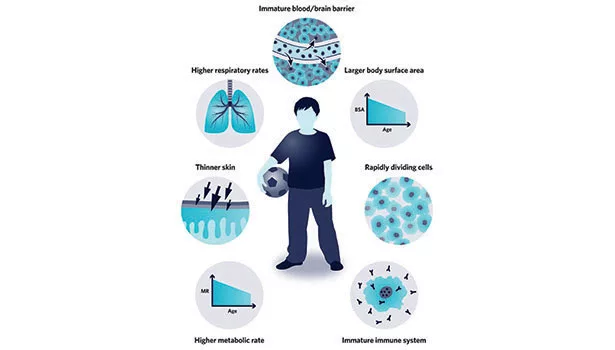
In addition to the sheer number of students in school buildings, children’s bodies are different from adults in many ways, making them especially vulnerable to problems from poor IAQ. The physiological characteristics of children make them more susceptible to indoor air toxins such as ozone, nitrogen oxides, particulate matter, lead, mercury, molds, and volatile organic compounds. This results in higher internal doses of inhaled toxins in children compared to adults.
Some of the differences in the respiratory tracts of children include the following.
-
Inhaled particles are absorbed and metabolized more quickly and thoroughly because of higher metabolic rates.
-
Children have a higher pulse resulting in rapid absorption of inhaled toxins into their blood.
-
They have a higher minute ventilation rate per kilogram of body weight than do adults at rest.
-
Children tend to be more physically active than adults.
-
The lungs, immune systems, and brains of children are developing during a period that corresponds with the cell layer lining of the respiratory tract being particularly permeable to toxins.
-
Children have a larger lung surface area in relation to their body weight and breathe 50% more air per kilogram of body weight.
-
The period of early growth and development is a critical time when air toxins can have lasting effects on the future health of the child.
-
Children have longer lifespans, which gives them a higher risk of cancer from toxins they are exposed to at a young age.
-
Children are often mouth breathers so their nose cannot act as a filter for fibers or other particles.
-
A child’s breathing zone is closer to the ground because they have a shorter stature on average than adults, so they will breathe in more heavy chemicals such as mercury if they are present.
Inadequate classroom IAQ can also cause heightened physical stress simply during the mechanical process of moving air into and out of a child’s lungs. These stresses can interfere dramatically with attention and learning. For example, small changes in the airway radius increase the resistance to airflow to the fourth power as shown by the resistance to flow equation:
Resistance ~ length / radius4
When inflammation of the respiratory tubes occurs, much more work is created for respiratory muscles, muscles that already have significant oxygen and metabolite requirements in children. In pediatric patients, the work of breathing can account for up to 40% of the cardiac output, particularly in stressed conditions.
We need to protect all people using buildings, but youngsters in particular. School is mandated up to a certain age, children’s voices do not have the same authority as adults, and complaints of student fatigue may not be taken seriously. How can we improve this situation for students?
Our schools should get IAQ report cards!
Make IAQ an essential consideration for school facility management with the following yearly requirements.
-
An on-site certified IAQ coordinator
-
A walkthrough evaluation on all school district buildings
-
The evaluation of classrooms, ventilation systems, and maintenance operations using checklists
-
A written set of policies and schedules that describes ways to correct the identified IAQ problems, prevent future problems, and respond to emergencies and concerns
-
An annual review of the plan requiring school board oversight and approval.
Looking for a reprint of this article?
From high-res PDFs to custom plaques, order your copy today!