search
Ask ACHR NEWS AI
cart
facebook twitter instagram linkedin youtube
  • Sign In
  • Subscribe
  • Sign Out
  • My Account
  • NEWS
  • TECHNOLOGY
    • Heating & Boilers
    • Cooling & Chillers
    • Pumps & Flow Controls
  • SECTORS
    • Commercial
    • Health Care
    • Data Center
    • Educational Facilities
  • DESIGN | CONSTRUCTION
  • OTHER TOPICS
    • High-Performance Buildings & Automation
    • Ventilation and IAQ
    • Commissioning
    • HVAC Retrofits
  • TODAY’S BOILER
    • Today’s Boiler Archives
    • Today’s Boiler Digital Edition
  • MORE
    • Case Studies
    • Podcasts
    • Videos
    • Directory
    • Webinars
    • ES NEWS Store
    • White Papers
  • SIGN UP
  • Back to The NEWS
Engineered Systems NEWSHVAC Engineering SectorsVentilation and IAQHealth Care HVAC

Lessons From Nature On Indoor Water Vapor Management

What does indoor air quality have in common with the blacklegged tick?
By Stephanie Taylor, M.D., M. Arch, CIC
Lessons From Nature On Indoor Water Vapor Management
December 3, 2017

The debate about the need (or lack of a need) for humidification in buildings rages on. I recently had an interesting conversation with an engineer who specializes in desiccant technology, in particular, dehumidification for operating rooms where the temperature is lowered to keep clinicians wearing sterile gowns comfortable. Since I am a proponent of balanced indoor-air hydration (humidification) to support patient healing and to decrease transmission of infectious bio-aerosols, our chat was somewhat tense.

The dislike of humidifiers, as far as I can tell, results from concerns about unhygienic equipment, condensation and mold growth in walls and ductwork, and excess energy consumption. 

And yet, water is critical to all life! In biology, successful vapor pressure management exists in even the most extreme climactic conditions, ranging from insects living in the desert to fish swimming in fresh water. Remarkably, biological strategies for internal water homeostasis are beautifully energy and material efficient. What elegant model can Mother Nature show us now?

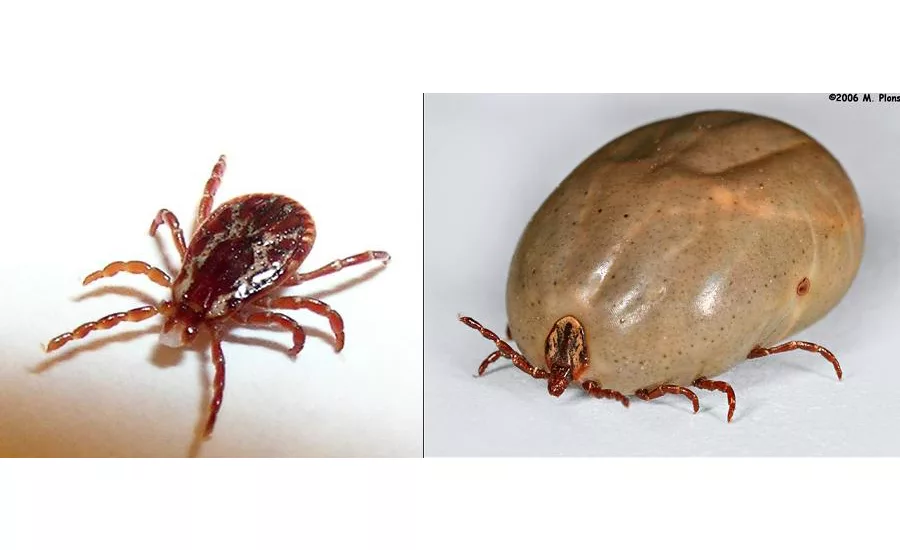
There are many examples, but a particularity interesting one is the blacklegged tick, Ixodes scapularis. This tick must avoid death due to desiccation for several months between blood-feedings on hosts. Then, after the meal, the large volume of ingested liquid must be rapidly managed to excrete excess moisture. How is their life maintained with these wild swings of water availability?


Going back to my cautious conversation with the desiccant engineer, I did not bring up tick saliva, but I did ask him what rh range he thinks is best in operating suites. He stated, “forty to sixty percent.” I laughed, because these are the same limits I recommend.


The secret to Ixodid tick survival is the osmoregulation of their saliva. During extended fasting periods, their salivary glands secrete a highly hygroscopic solution rich in Na+, K+, and Cl− onto the surface of their mouth. This solution quickly dries into hydrophilic crystals which absorb water vapor from unsaturated air because of their high osmotic pressure. Once the crystals are saturated, the tick draws the now hydrated secretion back into its body.

Biological solutions for water management with potential applications to buildings exist not only for humidity control, but also for cooling and water conservation. For example, to manage evaporation rates, some plants have guard cells with osmotic pressure sensors that open and close for optimal gas and vapor exchange as needed. In arid regions, desert plants and beetles have ribbed surfaces that can swell and shrink, creating self-shaded regions that reduce irradiation and water loss from transpiration. In other settings where humidity is too high, evaporation rates can be increased by airflow over moist and vibrating membranes.

Going back to my cautious conversation with the desiccant engineer, I did not bring up tick saliva, but I did ask him what rh range he thinks is best in operating suites. He stated, “forty to sixty percent.” I laughed, because these are the same limits I recommend. In fact, this rh scope has been known to be the healthiest since 1985 when Sterling, Avundel and Sterling published their well-known graphic for ASHRAE.

While humans clearly are not desiccated or swollen ticks, all organisms from insects to mammals need balanced water in both the vapor and liquid state to live. Once again, we can learn a few things from Mother Nature to inspire innovation in the development of desiccants, humidifiers, building envelope design, and other HVAC equipment.

Share This Story

Looking for a reprint of this article?
From high-res PDFs to custom plaques, order your copy today!


Dr. Stephanie Taylor is the president and founder of Building4Health Inc. After working as a physician for many decades, Dr. Taylor obtained a Masters in Architecture as well as Infection Control certification. Her lifelong commitment to patient care includes focusing on improving the healthcare physical environment and clinical work processes to help patients heal quickly and save hospitals valuable dollars. Dr. Taylor is a graduate of Harvard Medical School (MD), and Norwich University (Masters Architecture). She has numerous research publications in Nature, Science, and other peer-reviewed journals. She can be contacted at stephanie@b4hinc.com or (860) 501-8950.

Recommended Content

JOIN TODAY
To unlock your recommendations.

Already have an account? Sign In

  • HVAC-enrollment

    The Trades Are Back: HVACR Programs See Nearly 30% Enrollment Spike

    A new wave of future technicians is entering the pipeline.  
    Training and Education
    By: Matt Jachman
  • 2025 Top 40 Under 40

    2025 Top 40 Under 40 HVACR Professionals List

    The 11th annual Top 40 Under 40 list highlights those...
    HVAC Contracting
    By: Hannah Belloli-Oster
  • LG Ductless Mini-Split Systems

    The 9 Types of Heat Pumps

    As the U.S. moves toward electrification, heat pumps are...
    Air Source Heat Pumps
    By: Joanna R. Turpin

More Videos

Today's Boiler

Spring 2026 Issue

Today's Boiler - Spring 2026 Cover

Read More from Today's Boiler

Case in Point Logo

Smarter Hydronic Design for Data Centers - Free Webinar - January 22, 2026

Related Articles

  • A Physical View IAQ

    Lessons from Unspeakable Tragedies

    See More
  • National Institute of Building Science IAQ

    Indoor and outdoor air concentration levels can guide HVAC management to occupant health

    See More
  • A Physical View IAQ

    Using the Indoor Environment to Contain the Coronavirus

    See More

Related Products

See More Products
  • lessons learned selling.jpg

    Lessons Learned Selling HVAC Service

  • Lessons Learned Servicing Boilers

  • Lessons Learned in a Boiler Room: A common sense approach to servicing and installing commercial boilers

See More Products
×

Sign Up. Stay Informed.

The #1 trusted source for the HVACR industry since 1926

SUBSCRIBE
  • RESOURCES
    • Advertise
    • Contact Us
    • Advisory Board
    • Classifieds
    • Submit a Letter
    • Directories
    • Store
  • ACCOUNT CENTER
    • Create an Account
    • Start a Subscription
    • Manage My Account
    • Sign Up for Newsletters
    • Visit Customer Service
    • Update Preferences
  • SERVICES
    • Marketing Services
    • Reprints
    • Market Research
    • List Rental
    • Survey/Respondent Access
  • STAY CONNECTED
    • LinkedIn
    • Facebook
    • Instagram
    • YouTube
    • X (Twitter)
  • PRIVACY
    • PRIVACY POLICY
    • TERMS & CONDITIONS
    • DO NOT SELL MY PERSONAL INFORMATION
    • PRIVACY REQUEST
    • ACCESSIBILITY

Copyright ©2026. All Rights Reserved BNP Media, Inc. and BNP Media II, LLC.

Design, CMS, Hosting & Web Development :: ePublishing