search
Ask ACHR NEWS AI
cart
facebook twitter instagram linkedin youtube
  • Sign In
  • Subscribe
  • Sign Out
  • My Account
  • NEWS
  • TECHNOLOGY
    • Heating & Boilers
    • Cooling & Chillers
    • Pumps & Flow Controls
  • SECTORS
    • Commercial
    • Health Care
    • Data Center
    • Educational Facilities
  • DESIGN | CONSTRUCTION
  • OTHER TOPICS
    • High-Performance Buildings & Automation
    • Ventilation and IAQ
    • Commissioning
    • HVAC Retrofits
  • TODAY’S BOILER
    • Today’s Boiler Archives
    • Today’s Boiler Digital Edition
  • MORE
    • Case Studies
    • Podcasts
    • Videos
    • Directory
    • Webinars
    • ES NEWS Store
    • White Papers
  • SIGN UP
  • Back to The NEWS
Engineered Systems NEWSHVAC Engineering SectorsVentilation and IAQCommercial HVAC

How Do You Measure The Success Of Your HVAC System?
By Stephanie Taylor, M.D., M. Arch, CIC
Measure The Success Of Your HVAC System
December 1, 2015

Humans are quantitative creatures, and we do best when there are clear metrics to track our investments, whether they are financial, emotional, or simply the use of our time.

When it comes to designing and managing HVAC systems in commercial buildings, what outputs can we measure to determine the ROI of the system?

Metrics on HVAC performance from the perspective of the building per se are clear-cut:


  • Energy consumption
  • Chemical content of emissions
  • Moisture in building components
  • Mold in ducts or walls
  • Building structural integrity


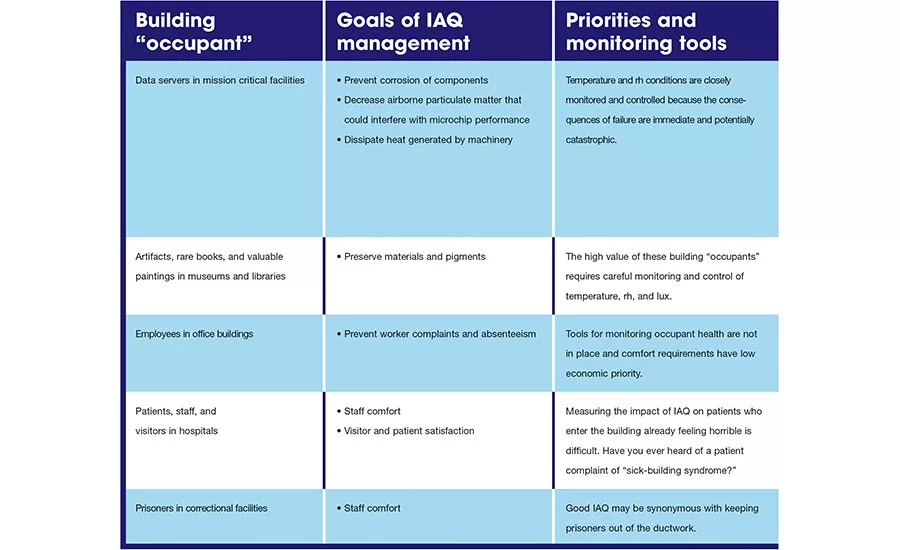
Monitoring the health of the primary “occupant” of the building, however, is not always possible or considered a high priority.

Although we now monitor occupant comfort to some extent, we have not created the measurement tools needed to understand the impact of indoor building conditions on human health. When there is overt poisoning from toxins, such as asbestos and lung disease, lead in paint and child brain dysfunction, or off-gassing of formaldehyde in a fire, there are laws prohibiting the use of the material.

Nevertheless, we lack basic information about the potential connections between chronic diseases and IAQ factors such as rh, carbon dioxide, or particulate matter. Data on trends in health conditions potentially related to the indoor environment is largely unavailable.

Now that the human genome has been fully mapped, we can link genetic predispositions to chronic diseases. Yet, inherited DNA sequences are only one of the factors that contribute to many chronic diseases. For example, a study published in 2000 on the medical histories of twins with cancer revealed that inherited genetic factors are only a minor contribution to most types of cancers. This leaves environmental influences as a driving force in cell growth dysregulation that can result in cancer. 


We know that people spend the majority of their time indoors. What we do not fully understand are the links between IAQ and chronic diseases such as asthma, auto-immune disorders such as lupus, and birth defects, to name a few. These conditions are on the increase and are costly to human lives and economics. If we can map the entire human genome, we should be able to create a database of symptoms of health and illness in building occupants, and develop a network to associate these symptoms with the indoor climates of the buildings in which we spend most of our time.

People today are asking sophisticated questions about their health. How much is illness caused by our behavior, genetic makeup, components in the air or water, or our diet? Unfortunately, we are left with too many unanswered questions. Tracking health conditions associated with both indoor and outdoor air parameters will allow us to answer some of these questions and will give us metrics to improve upon. The great news is that this understanding will allow us to remove or abate the hazards before they cause harm. ES

Share This Story

Looking for a reprint of this article?
From high-res PDFs to custom plaques, order your copy today!


Dr. Stephanie Taylor is the president and founder of Building4Health Inc. After working as a physician for many decades, Dr. Taylor obtained a Masters in Architecture as well as Infection Control certification. Her lifelong commitment to patient care includes focusing on improving the healthcare physical environment and clinical work processes to help patients heal quickly and save hospitals valuable dollars. Dr. Taylor is a graduate of Harvard Medical School (MD), and Norwich University (Masters Architecture). She has numerous research publications in Nature, Science, and other peer-reviewed journals. She can be contacted at stephanie@b4hinc.com or (860) 501-8950.

Recommended Content

JOIN TODAY
To unlock your recommendations.

Already have an account? Sign In

  • HVAC-enrollment

    The Trades Are Back: HVACR Programs See Nearly 30% Enrollment Spike

    A new wave of future technicians is entering the pipeline.  
    Training and Education
    By: Matt Jachman
  • 2025 Top 40 Under 40

    2025 Top 40 Under 40 HVACR Professionals List

    The 11th annual Top 40 Under 40 list highlights those...
    News
    By: Hannah Belloli-Oster
  • LG Ductless Mini-Split Systems

    The 9 Types of Heat Pumps

    As the U.S. moves toward electrification, heat pumps are...
    Air Source Heat Pumps
    By: Joanna R. Turpin

More Videos

Today's Boiler

Spring 2026 Issue

Today's Boiler - Spring 2026 Cover

Read More from Today's Boiler

Case in Point Logo

Smarter Hydronic Design for Data Centers - Free Webinar - January 22, 2026

Related Articles

  • How Do You Sell Green HVAC?

    How Do You Sell Green HVAC?

    See More
  • So, How Do You Keep Frost, Ice Out of Warehouses?

    See More
  • How Do You Know If the Price Is Right?

    See More

Related Products

See More Products
  • front cover only.jpg

    How to Market Your HVAC Business

  • Manual LLH Cover_Final.jpg

    Manual LLH - 2019 (HVAC System Design for Low Load Homes)

  • new cover.jpg

    Profit is An Attitude: The Strategies You Need to Optimize Profits

See More Products

Related Directories

  • Howe Corp.

    Howe manufactures flake ice making equipment for use with virtually any refrigerant including natural such as R-744, and R-717, Ice storage bins, Condensing units for our ice flakers.
×

Sign Up. Stay Informed.

The #1 trusted source for the HVACR industry since 1926

SUBSCRIBE
  • RESOURCES
    • Advertise
    • Contact Us
    • Advisory Board
    • Classifieds
    • Submit a Letter
    • Directories
    • Store
  • ACCOUNT CENTER
    • Create an Account
    • Start a Subscription
    • Manage My Account
    • Sign Up for Newsletters
    • Visit Customer Service
    • Update Preferences
  • SERVICES
    • Marketing Services
    • Reprints
    • Market Research
    • List Rental
    • Survey/Respondent Access
  • STAY CONNECTED
    • LinkedIn
    • Facebook
    • Instagram
    • YouTube
    • X (Twitter)
  • PRIVACY
    • PRIVACY POLICY
    • TERMS & CONDITIONS
    • DO NOT SELL MY PERSONAL INFORMATION
    • PRIVACY REQUEST
    • ACCESSIBILITY

Copyright ©2026. All Rights Reserved BNP Media, Inc. and BNP Media II, LLC.

Design, CMS, Hosting & Web Development :: ePublishing