search
Ask ACHR NEWS AI
cart
facebook twitter instagram linkedin youtube
  • Sign In
  • Subscribe
  • Sign Out
  • My Account
  • NEWS
  • TECHNOLOGY
    • Heating & Boilers
    • Cooling & Chillers
    • Pumps & Flow Controls
  • SECTORS
    • Commercial
    • Health Care
    • Data Center
    • Educational Facilities
  • DESIGN | CONSTRUCTION
  • OTHER TOPICS
    • High-Performance Buildings & Automation
    • Ventilation and IAQ
    • Commissioning
    • HVAC Retrofits
  • TODAY’S BOILER
    • Today’s Boiler Archives
    • Today’s Boiler Digital Edition
  • MORE
    • Case Studies
    • Podcasts
    • Videos
    • Directory
    • Webinars
    • ES NEWS Store
    • White Papers
  • SIGN UP
  • Back to The NEWS
Engineered Systems NEWSHVAC Engineering SectorsVentilation and IAQEducational Facilities HVAC

Managing IAQ In College Buildings

All the expected student behaviors can make for an unexpected number of health and HVAC vulnerabilities.
By Stephanie Taylor, M.D., M. Arch, CIC
IAQ_FT
June 8, 2015

Do you remember your first college Parents Weekend, when as a freshman you welcomed mom and dad into your room? Did you have to hastily transform your room into an “acceptable” living space just prior to this reunion?

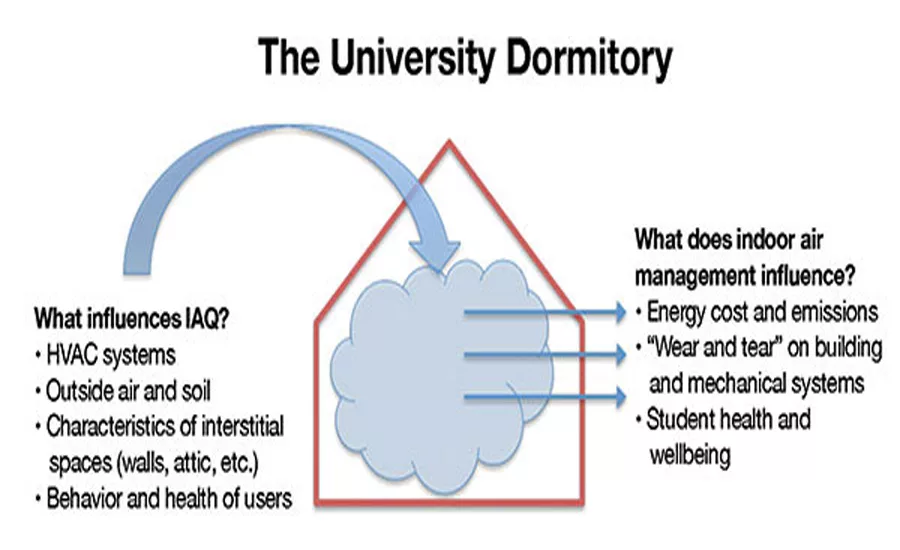
Off our kids go to college, perhaps moving out from under the watchful eyes of parents for the first time. While this transition to adulthood is ultimately strengthening in many ways, students are at a higher risk for health problems when they live in a college dormitory. Optimal indoor air management can mitigate a percentage of these health care risks. Therefore, college and university facility managers have not only the usual challenges of balancing IAQ with energy conservation and HVAC system costs, but perhaps unbeknownst to them, they also acquire some of the previous parental responsibilities for keeping students healthy and able to learn.

Student health during the college years

College students can be especially vulnerable to indoor air toxicity for several reasons. They may have temporarily weakened immune systems from a demanding schedule and are exposed to a multitude of pathogens in a confined space (the dorm). They may alter the building in ways that disable safety alarms or create other hazards.

They also leave behind microbiological and structural footprints that can impact the next group of students occupying the spaces.

Demanding classes and intense athletic schedules can cause sleep deprivation, seriously taxing a student’s immune system. New experimental behaviors such as smoking, drinking alcohol, or increased intimate contact with others increases a student’s exposure to viral and bacterial pathogens. Contact with cigarette smoke, whether inhaled directly or through second-hand exposure, inflames throat and bronchial membranes making it easier for pathogens to penetrate deeper into the respiratory tract to cause infections or reactive airways disease. This combination of decreased immune defenses and increased exposure to airborne microorganisms and toxins make college students more vulnerable to infections.

DIY Ventilation Systems

Not only are college students more vulnerable to infections and allergies because of overworked immune systems and increased exposure to microorganisms, but they often try to self-manage their room IAQ and inadvertently create additional respiratory dangers.

If a creative student wants extra privacy for a banned activity such as indoor smoking, they may custom build a ventilation system in their room that shunts air directly out their window, thereby avoiding human nostrils and smoke detectors in the hallway. Alternatively or in addition, students may try to improve their room IAQ by using humidifiers to combat dry forced air systems or ozone air cleaners for do-it-yourself indoor air deodorization. These air treatment systems can disseminate microorganisms and toxins if not cleaned and used properly.

The Microorganisms in the building

A person typically sheds approximately 37 million bacteria every hour into the surrounding air or onto surfaces touched. This has been documented in hospitals and non-healthcare buildings by researchers at the University of Oregon’s Biology and the Built Environment Center, the University of Chicago Microbiome Project, and other researchers.

 The University of Oregon microbiologist Jessica Green has documented that a building acquires a unique ecology of microorganisms determined by how it is built and operated, and by who uses it and what they do in the building. Dr. Jack Gilbert at the University of Chicago says that within hours of the arrival of a new occupant to a room, his or her microbes spread throughout the room and mix with microbes already present, making the microscopic ecology of each room unique.  

Share This Story

Looking for a reprint of this article?
From high-res PDFs to custom plaques, order your copy today!


Dr. Stephanie Taylor is the president and founder of Building4Health Inc. After working as a physician for many decades, Dr. Taylor obtained a Masters in Architecture as well as Infection Control certification. Her lifelong commitment to patient care includes focusing on improving the healthcare physical environment and clinical work processes to help patients heal quickly and save hospitals valuable dollars. Dr. Taylor is a graduate of Harvard Medical School (MD), and Norwich University (Masters Architecture). She has numerous research publications in Nature, Science, and other peer-reviewed journals. She can be contacted at stephanie@b4hinc.com or (860) 501-8950.

Recommended Content

JOIN TODAY
To unlock your recommendations.

Already have an account? Sign In

  • HVAC-enrollment

    The Trades Are Back: HVACR Programs See Nearly 30% Enrollment Spike

    A new wave of future technicians is entering the pipeline.  
    News
    By: Matt Jachman
  • 2025 Top 40 Under 40

    2025 Top 40 Under 40 HVACR Professionals List

    The 11th annual Top 40 Under 40 list highlights those...
    HVAC Contracting
    By: Hannah Belloli-Oster
  • LG Ductless Mini-Split Systems

    The 9 Types of Heat Pumps

    As the U.S. moves toward electrification, heat pumps are...
    Air Source Heat Pumps
    By: Joanna R. Turpin

More Videos

Today's Boiler

Spring 2026 Issue

Today's Boiler - Spring 2026 Cover

Read More from Today's Boiler

Case in Point Logo

Smarter Hydronic Design for Data Centers - Free Webinar - January 22, 2026

Related Articles

  • As standards and mandates evolve to require healthy indoor environments, the building owners who pay for capital costs will be more motivated to manage IAQ to protect occupants.

    Incentives and obstacles in managing IAQ for occupant health

    See More
  • school and person driving

    Children need seatbelts and good IAQ in schools

    See More
  • blue graphic, hospital safety

    Managing Your Hospital Building Can Save Patient Lives

    See More

Related Products

See More Products
  • EHEP002028.jpg

    Principles of Heating, Ventilation, and Air Conditioning in Buildings, 1st Edition

  • Training-Managing-System-2017.jpg

    Customer Service Training & Managing System by Steve Coscia

  • Building Information Modeling: Planning and Managing Construction Projects with 4D CAD and Simulations

See More Products

Related Directories

  • Building Owners & Managers Assn. (BOMA) International

    Founded in 1907, BOMA International is the leading trade association for property professionals of all commercial building types, including office, industrial, medical, corporate and mixed-use.
  • TRION IAQ

    Trade NamesAir Bear®Air Boss®ComfortSteam®Forever Filter®Grease Viper™Herrdraulic®Herricane®Herrmersion®Herrmidicool®Herrmidifier®Herrmidisteam®Herrtronic®Trion®
×

Sign Up. Stay Informed.

The #1 trusted source for the HVACR industry since 1926

SUBSCRIBE
  • RESOURCES
    • Advertise
    • Contact Us
    • Advisory Board
    • Classifieds
    • Submit a Letter
    • Directories
    • Store
  • ACCOUNT CENTER
    • Create an Account
    • Start a Subscription
    • Manage My Account
    • Sign Up for Newsletters
    • Visit Customer Service
    • Update Preferences
  • SERVICES
    • Marketing Services
    • Reprints
    • Market Research
    • List Rental
    • Survey/Respondent Access
  • STAY CONNECTED
    • LinkedIn
    • Facebook
    • Instagram
    • YouTube
    • X (Twitter)
  • PRIVACY
    • PRIVACY POLICY
    • TERMS & CONDITIONS
    • DO NOT SELL MY PERSONAL INFORMATION
    • PRIVACY REQUEST
    • ACCESSIBILITY

Copyright ©2026. All Rights Reserved BNP Media, Inc. and BNP Media II, LLC.

Design, CMS, Hosting & Web Development :: ePublishing