Troubleshooting With Compressor Amperage
These are questions commonly raised during Copeland Compressor Operation and Service Seminars (COSS).
The running or operating amperage of a refrigeration or air conditioning compressor is directly related to the load put on the compressor motor.
Various Motor Loads
One method of motor loading would be the mechanical load. Think of the relatively small amount of friction created by the matched components of the compressor, such as the crankshaft to bearings, connecting rods to the crankshaft, pistons to cylinders, etc.Another method of motor loading would be the pressures entering and exiting the compression chamber, basically the suction and discharge pressures.
Of these two loads, the mechanical load is a given. As long as the compressor is mechanically OK, the amp draw would be appropriate.
Now let's think about the motor load created by suction and discharge pressures. If a 43-psig suction pressure increases to 76 psig, how would this affect the load on the motor? Obviously it would be increased, which means the motor would have to work harder. When a motor has to work harder, what happens to the amp draw? It goes up. And so we are back to the original question, "What should the amperage be?"

Determining Amperage
Some think the compressor's rated load amperage (RLA) is its running amperage. This is not so. Think about what we have discussed so far: The mechanical load is a constant and should not change. The pressure load will fluctuate up and down depending on such things as the evaporator load and ambient temperature. We must know what the pressures are when we read the amperage.An amp reading alone tells us nothing. Once you gather the suction pressure, discharge pressure, and amperage readings, record this information along with the voltage measured at the compressor terminals. Then apply these four readings to the compressor curve sheet. Each compressor model has its own specific curve.
Let's look at Copeland compressor Model 3DS3-1500-TFC operating with HCFC-22. The suction pressure at the compressor is 43 psig and the condensing pressure at the compressor is 260 psig. We read 43 amps on our amperage meter and 230 V at the compressor terminals. Now we must apply this information to the curve sheet.
Looking for quick answers on air conditioning, heating and refrigeration topics? Try Ask ACHR NEWS, our new smart AI search tool. Ask ACHR NEWS
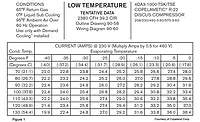
To understand how to read a curve sheet, follow along closely using Figure 1. The saturated suction temperatures and pressures are listed along the bottom of the chart. Vertically to the right of the chart, you will see the saturated condensing temperatures and pressures. Left of the chart is the amperage column. This particular curve addresses compressors that operate at a current of 230 V. Notice the multipliers for other voltages (listed above the chart in Figure 1).
Now let's look at our conditions. First, looking across the bottom of the chart, let's find 43-psig evaporating pressure; look at the vertical line extending upwards from this point. On the right side, find the 260-psig condensing pressure and follow the curved sloping line directly left of this condition. Place a dot where it intersects or crosses the vertical line that corresponds with the evaporating pressure.
From this dot, go directly and horizontally to the left; you should be at 44 amps. This is the proper amp draw for this compressor at these conditions.
Unfortunately, the RLA in our example is 59.6 for the 3DS3-1500-TFC. Why is the compressor drawing low amps?

Numbers Tell A Story
Remember, the meter reading at the compressor was 43 amps. The allowable tolerance is ±10 percent, so the compressor really is not drawing low amps. This is the proper amperage for the operating conditions we recorded. Let's say we are still operating at 43 psig and 260 psig, and our amp reading is 59 (RLA is 59.6).What is this telling us? Many technicians would think 59 amps is the correct reading, since the RLA is 59.6. However, we should recognize that the compressor is drawing an excessive amount of amperage. Something is overloading the motor, and it is not our pressures - we are using the pressures to set the dot on the curve sheet.
Think back on mechanical motor loading. The overloading could be a mechanical problem, like worn bearings, worn rods, etc. If we were looking at a single-phase compressor, the high amperage could be caused by a bad run capacitor. There are other reasons too, but that's for another article.
Let's look at another scenario. The suction pressure is up to 84 psig and the discharge has increased to 337 psig. Look again at the curve and place a new dot according to these higher pressures. Note that the compressor should be drawing 57 amps. We are within 10 percent of the RLA. Because of the high suction pressure, however, many service technicians assume the compressor is not pumping and therefore needs to be changed out.
Again, this is incorrect. We are examining the same compressor on the same system with completely different amperage draws. Both amp readings are correct because the pressures have changed.
Let's assume the compressor has one broken rod, which could cause a high suction pressure. Under this condition, what would happen to the amp draw? It would be less than where we place our dot because of a reduced mechanical load. In this instance, the amp draw would be about 30 percent lower. However, in the previous example we were drawing the proper amperage.
We need to find out why the pressures changed so severely. Are the pressures high or low? Which set of pressures is closest to the normal operating conditions for this type of system?
Remember, we are working on the system because of some reported problem. What we are trying to do is diagnose whether or not we need to replace the compressor. The amp draw will, to a great extent, assist us in that determination.
Don't Get Sidetracked
RLA is not the running amperage of the compressor; it is a mathematical formula and is used for such things as sizing fuses, wires, and contactors. The published RLA value does not change as the motor load changes.Different articles and even some instructors have stated that high evaporator loads will cause high amp draws. This can easily be misconstrued. While a higher load will increase the amp draw, it does not equate to improper amps even if the compressor trips on its overload. Think once again about what we have discussed. If the evaporator load increased, how would that affect the suction pressure? It would increase.
How does higher suction pressure affect amp draw? Yes, the amp draw is higher - but is it proper according to motor conditions?
It's more important to find out why the suction pressure is high. Return the suction pressure to its proper level and the amp draw will follow. Amperage curves are an invaluable tool in diagnosing compressor problems.
In this case, if you had a high amp draw and decided to replace the compressor, the new compressor would have operated the same as the previous one, until you found out why the suction pressure was high and you corrected it.
Voltage at the compressor terminals will also affect amp draw. There is an inverse correlation between the two: As voltage drops, amperage increases, and vice versa. If the voltage is 5 percent low, then amperage will be 5 percent high. Figure 2 contains the formula for making adjustments for either high or low voltage.
Curve sheets are available from different sources. A good source is through your local factory-authorized wholesaler, who can often provide the sheets or assist you with reading them based on your recorded information.
By looking online or contacting the compressor manufacturer, you can also obtain paper copies or a CD containing this information. You might even be surprised to find that your office already has compressor curves for reference.
No matter where you get the information, using amperage as a diagnostic tool is smart. Use it to keep from changing a compressor that otherwise may have been misdiagnosed.
Dave Bell is a training specialist with Copeland Corp., an Emerson Climate Technologies company. He has more than 30 years of experience in the industry, instructing on topics ranging from refrigeration system diagnosing and troubleshooting, and compressor operation, etc. For more information, contact Bell at Dave.Bell@EmersonClimate.com.
Publication date: 04/04/2005
Looking for a reprint of this article?
From high-res PDFs to custom plaques, order your copy today!