The Road To Recovery
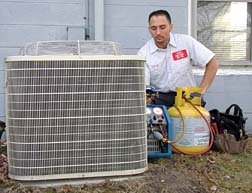
Questions to be considered by the technician:
If the system is not analyzed, recovery could take longer than necessary.
Passive Recovery
System-dependent (passive) recovery is the recovery of refrigerant from a system employing the refrigeration system’s internal pressure and/or compressor to aid the recovery process. System-dependent equipment cannot be used with appliances containing more than 15 pounds of refrigerant.To make it easier for technicians to recover refrigerant, the EPA is requiring manufacturers to install a service aperture or process stub for appliances containing Class I and II refrigerants. If a service technician uses passive or system-dependent recovery on a system with an inoperative compressor, the refrigerant must be recovered from both the low and high side of the appliance, to speed the recovery process and achieve the required recovery efficiency requirements.
A vacuum pump can be used in this procedure. However, never discharge a vacuum pump into a pressurized container. Vacuum pumps cannot handle pumping against anything but atmospheric pressure. If the compressor is operative, refrigerant can be recovered from the high side only.
In all passive recovery, the refrigerant must be recovered in a nonpressurized container. Whether or not the compressor is operative, gently striking the compressor with a wood or rubber mallet during recovery will agitate and release the refrigerant dissolved in the compressor’s crankcase oil.
Refrigerant can be removed without damage to the compressor, contingent on the following:
Active Recovery
The most common method of system refrigerant removal is through use of a certified, self-contained recovery unit. Self-contained (active) recovery equipment has it own means of removing refrigerant from appliances and is capable of reaching the required recovery rates, whether or not the appliance’s compressor is operable.Self-contained recovery equipment stores refrigerant in a pressurized recovery tank. Before operating a self-contained recovery machine, make sure that the tank inlet valve is open, and that the recovery tank does not contain excess noncondensables (such as air). Follow the operating instruction supplied by the recovery equipment manufacturer regarding purging of noncondensables.
All refrigerant recovery equipment should be checked for oil level and refrigerant leaks on a daily basis. Some machines are capable of both liquid and vapor removal. A higher ambient temperature facilitates more rapid recovery due to increased system internal vapor pressure.
R-410A Considerations
Because the higher pressures of R-410A (50 percent to 70 percent higher than R-22), components and service equipment have been redesigned to withstand the increased pressure. Recovery and recycling equipment rated for the higher R-410A pressures must be used. (Consult manufacturers for proper equipment recommendations.)Recovery cylinders must have a service rating of 400 psig. (DOT 4BA 400 and DOT 4BW 400 are acceptable cylinders.) Do not use standard DOT recovery or storage cylinders rated at 300 psig with R-410A.
Manifold gauges used with R-410A require a high-side range of 800 psig and a low side of 250 psig, with a 550-psig low-side retard. Hoses are required to have a service pressure rating of 800 psig.
Avoid mixing R-410A with any other refrigerant during the recovery and recycling of system refrigerants. To prevent the mixing of refrigerants (sometimes called cross contamination), the technician should use a self-clearing or purging recovery/ recycling unit. Manifold gauges, hoses, and recovery cylinders should be evacuated after every recovery job.
Another method that will eliminate cross contamination is to dedicate equipment to R-410A systems. All dedicated equipment should be marked clearly for R-410A use only. This would include:
Refrigerant Charging
The proper refrigerant charge is necessary to ensure equipment is operating at its maximum efficiency and functioning as designed by the manufacturer. Many problems occur if the system is undercharged or overcharged.An undercharge can cause excessive flash gas to enter the metering device creating the following:
An overcharge can cause the metering device to overfeed the evaporator and backup liquid refrigerant in the condenser. These conditions could create the following:
R-410A System Charging
Even though R-410A has very small fractionation potential, it cannot be ignored completely when charging. To avoid fractionation, charging of an air conditioning system incorporating R-410A should be done with “liquid” to maintain optimum system performance.Follow the instructions on the charging cylinder if you are unsure of the charging procedure. To ensure that the proper blend composition is charged into the system, it is important that liquid only be removed from the charging cylinder.
Some cylinders supplied by manufacturers have dip tubes, which allow liquid refrigerant to be removed from the cylinder when it is in the upright position. Cylinders without dip tubes must be tipped upside down in order for liquid to be removed.
You must differentiate between which type of charging cylinder you are using to avoid removing vapor refrigerant instead of liquid refrigerant, to avoid fractionation and for safety concerns.
Once the liquid is removed from the charging cylinder, R-410A can then be charged into the system as vapor as long as all the refrigerant in the charging cylinder is charged into the system.
Remember, if you want to add liquid refrigerant to an operating system, make sure liquid is throttled, thus vaporized, into the low side of the system to avoid compressor damage.
A throttling valve can be used to ensure that liquid is converted to vapor before it enters the system. Proper manipulation (restricting) of the manifold gauge set can also act as a throttling device to ensure liquid is not entering the compressor.
Many technicians often attempt to charge an air conditioning or refrigeration system by making sure the liquid line sight glass is full of liquid refrigerant. Often, as a refrigerant blend travels through a liquid line sight glass, some of the liquid flashes when it passes through the increased volume of the sight glass.
Once the small percentage of flashed liquid leaves the sight glass and re-enters the smaller liquid line, it will form 100 percent liquid again. Because of this flashing phenomenon within the sight glass with certain blends, technicians may think the system is undercharged. Therefore, if the system has a sight glass, it is of utmost importance for technicians not to try to clear the slight glass when charging with blends like R-410A and -407C. Attempts to clear a sight glass may overcharge the system and lead to poor performance and/or compressor damage.
Charging For Proper Subcooling With R-410A
If a system uses a thermostatic expansion valve, the device will regulate the refrigerant flow over a wide range of load and charge conditions. Therefore, some manufacturers recommend using subcooling to check for proper charge conditions.Note: Restrict airflow across the condenser and bring the condenser pressure to 350 psig if the outdoor temperature is less than 65 degrees F.
1. Operate the system for at least 10 minutes to stabilize.
2. Attach gauges to the liquid valve port and measure the liquid line pressure. Use a pressure/temperature chart or gauge to determine the saturation temperature that corresponds to that pressure.
3. Measure the temperature at the liquid line, as close to the outdoor coil as possible, using a fast-reading temperature probe.
The difference between the saturation temperature and the actual liquid line temperature is the subcooling. Follow the manufacturers’ recommendations. If no information is available, use a subcooling value of 10 to 15 degrees.
4. Make any adjustments by adding refrigerant to increase subcooling and removing refrigerant to decrease subcooling.
This method of charging requires the use of accurate refrigeration gauges, drybulb thermometer, and a pressure/temperature chart (or the pressure/temperature conversion face on gauges).
Charging For Proper Superheat With R-410A
This applies only to fixed metering device systems, such as fixed orifice (restrictor) or capillary tube. This method is for cooling-only charging. Refer to the equipment manufacturer’s instructions for heat pump charging.Note: Restrict airflow across the condenser and bring the condenser pressure to 350 psig if the outdoor temperature is less than 65 degrees.
1. Operate the system at least 10 minutes to stabilize.
2. Attach gauges to the suction valve port and measure the suction pressure. Use a pressure/temperature chart or gauge to determine the saturation temperature that corresponds to the suction pressure.
3. Measure the suction temperature at the suction line, approximately 6 inches before the compressor inlet, using a fast-reading temperature probe.
The difference between the saturation temperature and the actual suction line temperature is the superheat. Compare the calculated superheat with the allowable range of superheats for existing conditions, indicated by the manufacturer’s specifications.
4. Make any adjustments by adding refrigerant to lower superheat and removing refrigerant to increase superheat.
Precautions
This method of charging requires the use of accurate refrigerant gauges, a psychrometer, or wetbulb and drybulb thermometers and a pressure/temperature chart (or the pressure/temperature conversion face on the gauges).
Charging Systems With R-407C
R-407C has the ability to fractionate and cause a permanent change in the composition of the refrigerant charge. Because of this, it is recommended to remove R-407C from the charging cylinder as a liquid to ensure maximum system performance.Follow the instructions on the charging cylinder if you are unsure of the charging procedure. Once the liquid is removed from the charging cylinder, R-407C can be charged into the system as a vapor as long as all the refrigerant removed from the charging cylinder is charged in the system.
Remember, when adding liquid refrigerant to an operating system, make sure the liquid is throttled, thus vaporized, into the low side of the system to avoid compressor damage.
The same methods used for charging R-410A systems hold true for R-407C systems, even though R-407C systems have more fractionation potential. Since R-407C system pressures and temperatures are somewhat similar to an R-22 system, the same manifold gauge set and charging cylinder types can be used.
Since R-407C and -410A are both HFC-based refrigerant blends, the same methods and procedures hold for both refrigerants on the subject of refrigerant leaks and leak detectors.
John Tomczyk and Joe Nott are co-authors of the book Universal R-410A Safety & Training, from which this article was excerpted. The 102-page book is published by Esco Press. For ordering information, please call the publisher at 800-726-9696.
Publication date: 03/03/2003
Looking for a reprint of this article?
From high-res PDFs to custom plaques, order your copy today!


