The Professor: Replacement Blend HFC-410A
[Editor’s note: This article is the first in a series focusing on refrigerants and refrigerant blends. This month’s article will concentrate on the HCFC-22 air conditioning replacement refrigerant blend HFC-410A.]
HFC-410A, or better known as R-410A, is a refrigerant blend of R-32 and R-125. Both R-32 and R-125 are hydrofluorocarbons (HFCs). HFCs are void of chlorine, thus have a zero ozone depletion potential (ODP). HFCs do have a global warming potential (GWP). Both ODP and GWP will be covered in a later article.
Refrigerant blends consisting of two refrigerants are referred to as binary blends. R-410A is a long-term, high-efficiency replacement refrigerant for R-22. R-410A has a very small evaporator temperature of glide 0.2°F, and has negligible fractional potential. R-410A is replacing R-22 in new residential and light commercial air conditioning applications. It is by no means a direct drop-in replacement for R-22.
Retrofitting an R-22 system to an R-410A system is not recommended because of the higher system operating pressures of R-410A. Also, R-410A systems use a synthetic polyolester lubricant in their crankcases, where R-22 systems usually use conventional mineral oils.
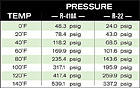
If an air conditioning system were operating at a 45° evaporating temperature and a 110° condensing temperature, the corresponding pressures would be as follows:
• R-410A: 130 psig evaporating pressure; 365 psig condensing pressure.
• R-22: 76 psig evaporating pressure; 226 psig condensing pressure.
The chart above represents a pressure-temperature comparison of R-410A and R-22 in table form.
Because of these higher pressures of R-410A, different gauge manifold sets, hoses, recovery equipment, and recovery storage cylinders all have to be designed to handle these higher pressures of R-410A. Also, different gauge line connections are used for R-410A when compared to R-22. This prevents the service technician from mistakenly connecting R-22 gauges and hoses on an R-410A system. The gauge and manifold set for R-410A are required to range up to 800 psig on the high side and 250 psig on the low side with a 550-psig low side retard. The hoses for R-410A must have service ratings of 800 psig. Even the liquid line filter driers and suction line filters and/or driers must be compatible for R-410A and rated for its higher pressures.
In summary, never use R-22 or any other refrigerant service equipment on R-410A equipment. Service equipment must be rated to handle the higher operating pressures of R-410A. Air conditioning equipment has been redesigned, and safer service tools have been introduced to handle the higher operating pressures of R-410A. As with all refrigerants, safety glasses and gloves must always be worn when handling R-410A.
Publication date: 06/01/2009
HFC-410A, or better known as R-410A, is a refrigerant blend of R-32 and R-125. Both R-32 and R-125 are hydrofluorocarbons (HFCs). HFCs are void of chlorine, thus have a zero ozone depletion potential (ODP). HFCs do have a global warming potential (GWP). Both ODP and GWP will be covered in a later article.
Refrigerant blends consisting of two refrigerants are referred to as binary blends. R-410A is a long-term, high-efficiency replacement refrigerant for R-22. R-410A has a very small evaporator temperature of glide 0.2°F, and has negligible fractional potential. R-410A is replacing R-22 in new residential and light commercial air conditioning applications. It is by no means a direct drop-in replacement for R-22.
Retrofitting an R-22 system to an R-410A system is not recommended because of the higher system operating pressures of R-410A. Also, R-410A systems use a synthetic polyolester lubricant in their crankcases, where R-22 systems usually use conventional mineral oils.
PRESSURE-TEMPERATURE RELATIONSHIPS
In air conditioning applications, R-410A systems operate at about 60 percent higher pressures than conventional R-22 air conditioning systems.If an air conditioning system were operating at a 45° evaporating temperature and a 110° condensing temperature, the corresponding pressures would be as follows:
• R-410A: 130 psig evaporating pressure; 365 psig condensing pressure.
• R-22: 76 psig evaporating pressure; 226 psig condensing pressure.
The chart above represents a pressure-temperature comparison of R-410A and R-22 in table form.
Because of these higher pressures of R-410A, different gauge manifold sets, hoses, recovery equipment, and recovery storage cylinders all have to be designed to handle these higher pressures of R-410A. Also, different gauge line connections are used for R-410A when compared to R-22. This prevents the service technician from mistakenly connecting R-22 gauges and hoses on an R-410A system. The gauge and manifold set for R-410A are required to range up to 800 psig on the high side and 250 psig on the low side with a 550-psig low side retard. The hoses for R-410A must have service ratings of 800 psig. Even the liquid line filter driers and suction line filters and/or driers must be compatible for R-410A and rated for its higher pressures.
In summary, never use R-22 or any other refrigerant service equipment on R-410A equipment. Service equipment must be rated to handle the higher operating pressures of R-410A. Air conditioning equipment has been redesigned, and safer service tools have been introduced to handle the higher operating pressures of R-410A. As with all refrigerants, safety glasses and gloves must always be worn when handling R-410A.
Publication date: 06/01/2009
Looking for a reprint of this article?
From high-res PDFs to custom plaques, order your copy today!


