ACHR News
search
Ask ACHR NEWS AI
cart
facebook twitter instagram linkedin youtube
  • Sign In
  • Subscribe
  • Sign Out
  • My Account
ACHR News
  • NEWS
    • Breaking News
    • New HVAC Products
    • Featured Products
    • Manufacturer Reports
    • HVAC Data
    • Legislation
    • ACHR NEWS Centennial
  • RESIDENTIAL
    • Air Conditioners
    • Furnaces
    • Residential Heat Pumps
    • Ductless
    • Residential IAQ
    • Testing, Monitoring, Tools
    • Components & Accessories
  • COMMERCIAL
    • Air Handlers
    • Rooftop Units
    • Chillers and Cooling Towers
    • Commercial Heat Pumps
    • Boilers and Hydronics
    • VRF/Ductless
    • Commercial IAQ
  • REFRIGERATION
    • Refrigerants
    • Refrigerant Regulations
    • Leak Management
  • CONTRACTOR PRO
    • Geothermal
    • Homeowner Study
    • VRF and VRV Ductless
    • Unitary Trends
  • EDUCATION
    • Training and Education
    • Business Management
    • Service and Maintenance
    • Continuing Education
    • Market Research >
      • HVAC Brand Awareness Report
      • VRV, VRF, VRVZ Report
      • Unitary Trends Report
      • Water Heat Professionals Report
    • Webinars
    • Sponsor Insights
    • eProducts Info
    • White Papers
  • EVENTS
    • HVAC Contractor Forum
    • Industry Events and Webinars
  • MEDIA
    • Videos
    • AHR Expo 2025 Videos
    • Podcasts >
      • ACHR News Podcast
      • HARDI Podcasts
      • AHR Expo Podcasts
      • ACCA Podcasts
    • Interactive Spotlights
    • Quizzes
    • eBooks
    • HVAC Talkback
  • HVAC GROUP
    • ACHR NEWS >
      • Current Issue
      • Digital Edition
      • Subscribe
    • Distribution Trends
    • SNIPS NEWS >
      • Join SNIPS NEWS
    • Engineered Systems News >
      • Join ES News
    • HVACR Directory
    • Contests
    • Newsletters
    • Contact
    • Advertise
    • My Account

The New Wave Of Blends

February 2, 2003
The latest wave of refrigerants includes a number of blends. They are often referred to as zeotropes and they need to be understood clearly.

By definition, zeotropic refrigerants are blends of two or more components whose equilibrium vapor-phase and liquid-phase compositions are different at given pressures. A couple of issues that arise with these refrigerants deal with fractionation and glide.

Fractionation is “the separation of a liquid mixture into parts by the preferential evaporation of the more volatile component,” according to ASHRAE. Glide is “the temperature range that the most volatile component to the least volatile component changes state from liquid to vapor.”

Fractionation

Blended refrigerants must be charged in a liquid state. If charged in vapor state, the resulting composition in the system and the cylinder has been compromised.

With the components changing state over a range of temperatures (glide), the effectiveness of the coil surface is increased. In the context of a leak, fractionation only occurs when liquid and vapor are present together and vapor leaks.

The 400 Series

ASHRAE-designated 400 Series refrigerants, such as 404A and 410A, are zeotropes. When a zeotropic refrigerant is moving through the evaporator and condenser, it has an unequal phase change. One of the original concerns with zeotropic blends was that if a system leaked, the result could be a change in the component percentage of the blend.

After several years of testing and field experience, it has been demonstrated that blends will not separate easily through system leaks, and — for the most part — if it’s going to occur, it will take place with a system that has laid dormant and leaked over a very long period of time. Therefore, topping off a leaking system with zeotropes has become a common service practice.

Glide

The temperature glide of a refrigerant is measured from the point in the evaporator or condenser at which the component of the blend with the highest vapor pressure and lowest boiling point changes state, to the component with the lowest vapor pressure and highest boiling point changes state.

The operational glide of a blend has no adverse effects on system performance (with the exception of flooded evaporator or centrifugal systems). It does, however, directly relate to the increase in system efficiency.
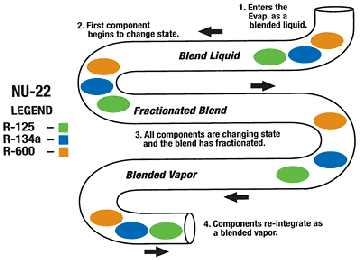
Figure 1. This diagram illustrates the process a zeotropic refrigerant (such as R-417A) goes through in the evaporator. (Courtesy of ICOR International.)

System Charging

The process of system charging zeotropes starts with evacuation. Pull a vacuum with a two-stage vacuum pump. A deep vacuum is necessary to remove moisture and noncondensables that can damage a system. Unless moisture is eliminated, hydrolysis may create acids and other harmful byproducts.

Industry standards specify a 500-micron vacuum. An accurate determination of vacuum cannot be determined with a gauge set alone; it requires the use of an electronic vacuum gauge (micron).

All 400 Series ASHRAE-designated blends must be charged (leave the cylinder) in a liquid state. Charging by vapor will cause the blend to fractionate in the cylinder, creating an improper composition in the system and cylinder. This may result in decreased system performance and oil return problems.

Looking for quick answers on air conditioning, heating and refrigeration topics? Try Ask ACHR NEWS, our new smart AI search tool. Ask ACHR NEWS →

In general, current alternatives to R-22 charge relative to the refrigerant’s volume and density. However, consult the manufacturer for charging specifics.

Once the system has stabilized, check the operational pressures, temperatures, and amp draws. Verify the superheat and subcooling readings. Adjust the charge if necessary, then record the final reading and document the amount of charge.

Two Terms

A couple of terms to remember in the context of zeotropes are “bubble point” and “dewpoint.”

As heat is absorbed by the saturated liquid, the temperature increases until the vapor of the most-volatile component begins to form. This establishes the bubble point.

As heat is removed from the saturated vapor to the point that the least volatile component forms liquid droplets, that establishes the dewpoint.

The Noncondensable Test

If you are concerned that a blended refrigerant you have recovered from a leaking system has lost its integrity, you can perform a simple noncondensable test to help determine if this has occurred.

Note: Before testing, make sure the recovered blend is at ambient temperature. If necessary, direct a fan across the cylinder to expedite the process.

1. Connect the high-side gauge on your manifold to the liquid port of the recovery cylinder.

2. Measure the liquid temperature of the recovered refrigerant.

3. Compare your gauge reading and liquid temperature to the corresponding bubble point reading on your pressure and temperature (P/T) chart.

4.a. If the pressure is within 5% of the P/T conversion (i.e., at 80 degrees F the pressure is 149.16 psig), the blend is acceptable, and you can recharge the system with the gas and top it off.

4.b. If the pressure is outside the 5% allowable range, return the refrigerant to the distributor for proper disposal.

A higher-than-normal reading can also reflect the presence of air in the cylinder. You can test this by slightly opening the vapor side of the cylinder to let the air escape. Then close the vapor valve and repeat the test.

Hale is tech support supervisor and McKinney is national sales director for ICOR International, based in Indianapolis. More information may be obtained at www.icorinternational.com.

Publication date: 02/03/2003

Share This Story

Looking for a reprint of this article?
From high-res PDFs to custom plaques, order your copy today!


Recommended Content

JOIN TODAY
To unlock your recommendations.

Already have an account? Sign In

  • HVAC-enrollment

    The Trades Are Back: HVACR Programs See Nearly 30% Enrollment Spike

    A new wave of future technicians is entering the pipeline.  
    News
    By: Matt Jachman
  • 2025 Top 40 Under 40

    2025 Top 40 Under 40 HVACR Professionals List

    The 11th annual Top 40 Under 40 list highlights those...
    News
    By: Hannah Belloli-Oster
  • LG Ductless Mini-Split Systems

    The 9 Types of Heat Pumps

    As the U.S. moves toward electrification, heat pumps are...
    HVAC Commercial Market
    By: Joanna R. Turpin
Subscription Center
  • Create an Account
  • Start a Subscription
  • Manage My Account
  • Sign Up for Newsletters
  • Visit Customer Service
  • Update Preferences

More Videos

Sponsored Content

Sponsored Content is a special paid section where industry companies provide high quality, objective, non-commercial content around topics of interest to The News audience. All Sponsored Content is supplied by the advertising company and any opinions expressed in this article are those of the author and not necessarily reflect the views of The News or its parent company, BNP Media. Interested in participating in our Sponsored Content section? Contact your local rep!

close
  • Piggy Bank
    Sponsored byWatercress Financial

    Energy Prices, Inflation, and HVAC: What Today’s Homeowners Care About

  • Refrigerated Food
    Sponsored bySolstice Advanced Materials

    R-455A Refrigeration: A Cold Storage Solution for the Future

  • Airex Rooftop Units
    Sponsored byAirex Manufacturing Inc

    Consolidating Roof Penetrations: A Growing Trend in Multifamily HVAC Design

Popular Stories

HVAC-Price-Increase-graphic

HVAC Price Increase List: June 2026

Trump-Section-232.jpg

Trump Reduces Section 232 Tariffs on HVAC Equipment to 15%

R410A-Refrigerant-Cylinder.jpg

Refrigerant Recovery is a Revenue Opportunity

Heat-pump-cutaway.jpg

PFAS Rules and A2L Building Codes Continue to Evolve

Midea-training.jpg

HVAC Workforce Crisis Expands Beyond Technicians to Instructor Shortages

View The ACHR NEWS
Centennial Anniversary Timeline

The ACHR News Timeline Chart
Submit a Letter
Submit a letter to our editors.

Events

November 6, 2025

Next-Gen Data Center Cooling: HVAC Innovation and Real-World Solutions

On Demand As AI workloads and high-density computing push traditional cooling methods to their limits, the data center industry is accelerating the adoption of next-generation HVAC technologies.

June 17, 2026

Decarbonization Without Disruption

This webinar will explore practical HVAC decarbonization strategies that minimize disruption while maximizing long-term performance and ROI.

View All Submit An Event

Poll

Summer Staff

Are you fully staffed for the summer season?
View Results Poll Archive

Products

BNI Mechanical/Electrical Square Foot Costbook, 2026 Edition

BNI Mechanical/Electrical Square Foot Costbook, 2026 Edition

See More Products
Decarbonization Without Disruption - Free Webinar - 6/17/2026

Related Articles

  • Extra Return Duct and Grill

    Are Duct Cleaners the New Wave of Duct Renovators?

    See More
  • How to Profit From the Industry’s New Wave of Consolidation - The ACHR News

    How to Profit From the HVAC Industry’s New Wave of Consolidation

    See More
  • Peter’s Point of View: New Wave of Specifications

    See More

Related Products

See More Products
  • The ACHR News - June 16, 2025

    ACHR NEWS June 16, 2025, Issue

  • The ACHR NEWS - September 08, 2025

    ACHR NEWS September 8, 2025, Issue

See More Products

Related Directories

  • The New Flat Rate (Manufacturer)

    We help residential service contractors nationwide by providing a menu pricing system for them to use with their customers. Available in printed book or digital iPad formats. When using menu pricing, technicians can easily present multiple options to their customers on every repair job. Thus, customers choose the level of service that best fits their budget.
×

Sign Up. Stay Informed.

The #1 trusted source for the HVACR industry since 1926

SUBSCRIBE
  • RESOURCES
    • Advertise
    • Contact Us
    • Advisory Board
    • Classifieds
    • Submit a Letter
    • Directories
    • Store
  • ACCOUNT CENTER
    • Create an Account
    • Start a Subscription
    • Manage My Account
    • Sign Up for Newsletters
    • Visit Customer Service
    • Update Preferences
  • SERVICES
    • Marketing Services
    • Reprints
    • Market Research
    • List Rental
    • Survey/Respondent Access
  • STAY CONNECTED
    • LinkedIn
    • Facebook
    • Instagram
    • YouTube
    • X (Twitter)
  • PRIVACY
    • PRIVACY POLICY
    • TERMS & CONDITIONS
    • DO NOT SELL MY PERSONAL INFORMATION
    • PRIVACY REQUEST
    • ACCESSIBILITY

Copyright ©2026. All Rights Reserved BNP Media, Inc. and BNP Media II, LLC.

Design, CMS, Hosting & Web Development :: ePublishing