Stop Blowing Hot Air
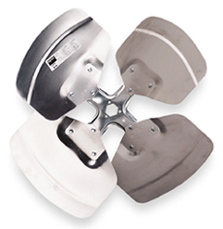
If you want to keep equipment operating in peak condition, make sure you select the proper replacement fan blade when replacing a worn or damaged one.
Proper fan blade selection sometimes gets overlooked. The main contributor is that, unlike motors, fan blades typically do not list any key specifications that would help in the replacement process. Many times you have to rely on the motor's nameplate information to help in the selection process. However, the nameplate alone doesn't provide all the necessary information to make an informed choice.
The purpose of a fan blade is to create air motion. When choosing a replacement fan blade, it's important that the new blade provide the same airflow performance as the original.
In a condenser system, airflow through the coils removes the heat trapped in the refrigerant allowing the compressor to convert the hot gas back into liquid. Too little airflow will remove less heat from the refrigerant and reduce overall system efficiency, most likely causing the air conditioning system to run for longer periods of time. It will also contribute to improper motor cooling (if the application is air over) causing the motor to overheat or fail prematurely. Too much airflow in this same application may cause the motor to overload, leading to a higher operating temperature, resulting in shorter motor life and/or failure.

HOW DOES MOTOR DESIGN AFFECT
APPLICATION AND BLADE SELECTION?
In many cases a failed fan blade will lead to motor failure. Matching a replacement motor and blade to the original design will be the goal. The motor nameplate will contain much of the information needed to make the motor selection and will also provide some key information for fan blade selection.In a direct-drive application the fan is connected directly to the motor shaft. In a belt-drive application the fan is powered by a V-belt. In direct-drive applications the motor is typically designed to use the fan's airflow for its cooling. Too little airflow and the motor will run hot. Too much airflow and the motor will strain and also run hot. In a belt-drive application the motor may not directly be in the airflow of the fan; however, improper selection of the fan blade can easily cause motor overload.
GENERAL FAN BLADE SELECTION CONSIDERATIONS
1. Blade diameterEven number of blades: Distance measured from the outside tip of one blade to the outside tip across from the first blade.
Odd number of blades: Distance measured from the center of fan hub to the outside tip of one blade and multiplied by two.
2. Number of blades
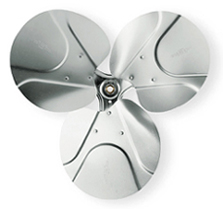
The number of blades will impact airflow; the greater the number of blades for the same pitch and diameter will provide greater airflow. It is possible to replace a three-blade fan with a four-blade fan, or vice versa, as long as the designed cubic feet per minute (cfm) is a match.
Looking for quick answers on air conditioning, heating and refrigeration topics? Try Ask ACHR NEWS, our new smart AI search tool. Ask ACHR NEWS
3. Hp and rpm
It is important to match a fan blade to a motor's horsepower and speed. Do not replace a 1,100-rpm motor with a 1,725-rpm motor using the same fan blade, as the increased speed can cause the motor to overload.
4. Fan blade hub
The fan blade hub or center connects the fan blade to the drive shaft. The bore size of the hub is a critical measurement and will need to match the motor's shaft dimensions or drive shaft dimensions in a belt-drive application.
5. Cfm
Cfm is the volume of air moved by the fan blade per minute. A small variance in cfm can exist without substantially affecting the application's performance.
6. Pitch
The blade's pitch is the amount of twist the blade has on the hub, and can be measured using a pitch gauge. Pitch is measured at the spider/lobe, not on the blade, and it's common for fan blades to have slightly different pitches and still achieve the same performance. For example, an 18-inch diameter blade with a 33-degree pitch will move 10 percent more air than an 18-inch blade with a 27-degree pitch.
7. Rotation
Clockwise or counterclockwise, facing front of the fan blade.
Note on rotation:
Fan blade rotation is determined to be either clockwise or counterclockwise when viewed from the air-discharged side. The motor's nameplate, depending on manufacturer, may contain information on direction of blade rotation. If the motor is in good working order you can always double check by a quick start/stop to determine if application is clockwise or counterclockwise.
Tech tip:
The leading edge of the blade will be covered with dirt.
8. Fan blade type
Free air or condenser.
Match as many of the eight selection considerations above as possible, with focus placed on matching the correct motor nameplate hp and speed. Make sure to maintain the correct airflow over the motor for proper cooling and system performance.
Example: A 20-inch, 24-degree pitch fan blade operating at 1,140 rpm will require a 1/6 hp motor for proper motor and system performance. That same blade operating at 1,725 rpm will require a 1/2 hp rated motor. The blade is designed to work in both applications; however, the increase in operating speed has a direct impact on the hp requirements. Operating this fan blade at the higher rpm requires a minimum 1/2 hp motor. Less than 1/2 hp will most likely cause the motor to operate in an overload condition.
Another consideration is the specific application. If you're not sure which type of replacement fan blade you need, it's always best to consult with the manufacturer of the original equipment.
If the application is in a hazardous location, then all replacement components must meet local and national codes for the designated location. Again, it's always best to contact your local inspector for code requirements.
Common Terms
Static pressure(Inches of water): A measure of resistance to airflow caused by system obstructions. As static pressure is increased, horsepower requirements increase, and cfm decreases.
Free air
A term used to define zero static pressure.
Condenser fan blades
Fan blades designed to operate against a static pressure.
Free air fan blades
Fan blades designed to operate at zero static pressure, typically found on pedestal and box fan applications.
Reprinted with permission from On the Job, April 2006, Grainger's quarterly newsletter for professional contractors. For more information, visit www.grainger.com/contractor.
Note: This information has been checked for suitability. However, a successful solution depends on individual accuracy, skill, and caution. For this reason, W.W. Grainger Inc. does not guarantee the result of procedure compliance or assume responsibility for personal injury or property damage to persons following these procedures.
Publication date: 06/12/2006
Looking for a reprint of this article?
From high-res PDFs to custom plaques, order your copy today!