ACHR News
search
Ask ACHR NEWS AI
cart
facebook twitter instagram linkedin youtube
  • Sign In
  • Subscribe
  • Sign Out
  • My Account
ACHR News
  • NEWS
    • Breaking News
    • New HVAC Products
    • Featured Products
    • Manufacturer Reports
    • HVAC Data
    • Legislation
    • ACHR NEWS Centennial
  • RESIDENTIAL
    • Air Conditioners
    • Furnaces
    • Residential Heat Pumps
    • Ductless
    • Residential IAQ
    • Testing, Monitoring, Tools
    • Components & Accessories
  • COMMERCIAL
    • Air Handlers
    • Rooftop Units
    • Chillers and Cooling Towers
    • Commercial Heat Pumps
    • Boilers and Hydronics
    • VRF/Ductless
    • Commercial IAQ
  • REFRIGERATION
    • Refrigerants
    • Refrigerant Regulations
    • Leak Management
  • CONTRACTOR PRO
    • Geothermal
    • Homeowner Study
    • VRF and VRV Ductless
    • Unitary Trends
  • EDUCATION
    • Training and Education
    • Business Management
    • Service and Maintenance
    • Continuing Education
    • Market Research >
      • HVAC Brand Awareness Report
      • VRV, VRF, VRVZ Report
      • Unitary Trends Report
      • Water Heat Professionals Report
    • Webinars
    • Sponsor Insights
    • eProducts Info
    • White Papers
  • EVENTS
    • HVAC Contractor Forum
    • Industry Events and Webinars
  • MEDIA
    • Videos
    • AHR Expo 2025 Videos
    • Podcasts >
      • ACHR News Podcast
      • HARDI Podcasts
      • AHR Expo Podcasts
      • ACCA Podcasts
    • Interactive Spotlights
    • Quizzes
    • eBooks
    • HVAC Talkback
  • HVAC GROUP
    • ACHR NEWS >
      • Current Issue
      • Digital Edition
      • Subscribe
    • Distribution Trends
    • SNIPS NEWS >
      • Join SNIPS NEWS
    • Engineered Systems News >
      • Join ES News
    • HVACR Directory
    • Contests
    • Newsletters
    • Contact
    • Advertise
    • My Account
Service and MaintenanceHVAC Residential MarketAir Conditioners

Single-Pole And Double-Pole Contactors

July 31, 2003
Contactors are nothing more than a coil and a set of contacts. The coil of the contactor can be 24, 115, or 230 V, and even higher depending on the application.

The contactor arrangement can be single pole, double pole, or triple pole, depending on the phase and application. Many residential and light commercial air conditioning systems, as well as some packaged open- and closed-loop water-source heat pump systems, use a single-pole contactor along with dual-run capacitors (Figure 1).

Figure 1. Off-cycle crankcase heat using a run capacitor with a single-pole connection. The cycling control is the contact of the single-pole contactor.

A Dual Purpose

As the name implies, dual-run capacitors serve a dual purpose. During the off cycle (Figure 1), alternating current charges and discharges the 20-microfarad run capacitor 60 times per second (60 hertz) through the start winding (between S and C). This current is shown in green in Figure 1. This allows the start winding to act as a small crankcase heater during the off cycle.

As long as power is supplied to lines 1 and 2 through the disconnect switch and the contactor’s contacts are opened, the crankcase heater will be energized.

Many manufacturers recommend crankcase heat during the off cycles and at least 24 hours before seasonal startups. This warms the crankcase and drives out any refrigerant that has migrated to the oil in the crankcase. This helps prevent foaming of the oil in the compressor’s crankcase on start-ups, which can score bearings and may cause slugging of refrigerant and/or oil. (Migration and slugging are covered at the conclusion of this article.)

A second purpose for the dual-run capacitor is to act as one larger capacitor wired between the run and start windings during the run cycle. This is referred to as a permanent split capacitance (PSC) motor. Remember, capacitors wired in parallel add in capacitance. So, in Figure 2 the motor sees both the 20- and 15-microfarad capacitor in parallel. Both are wired between the run and start windings (R and S). This gives the motor 35 microfarads (15 + 20) for running and starting torque. Both capacitors are wired in parallel with the run winding, and in series with the start winding.

The green line in Figure 3 shows an incomplete circuit. This is why it is of utmost importance for service technicians to recognize off-cycle crankcase heat when changing contactors.

Never change a single-pole contactor for a double-pole contactor when this type of circuit is used, because it will render the off-cycle crankcase heater useless. This will eventually lead to compressor damage because there is no crankcase heat to rid the crankcase of refrigerant that has migrated during off cycles and long shutdowns. Compressor slugging can occur.
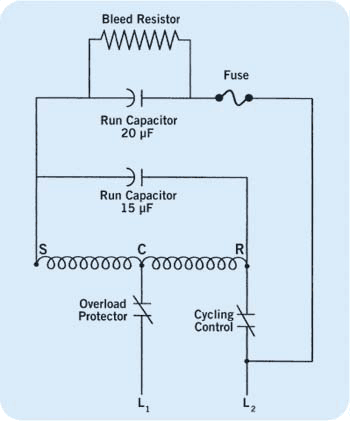
Figure 2. A PSC motor during the running cycle, using a single-pole contact. The motor sees both the 20- and 15-microfarad capacitor in parallel.

Migration

Migration is what happens when liquid or vapor refrigerant returns to the compressor’s crankcase or suction line during the off cycle. Migration only occurs during the off cycle of the compressor. Causes could include:

  • The absence of a crankcase heater during an off cycle or long shutdown period;

  • The absence of an automatic pumpdown system; and/or

  • A leaky liquid line (pumpdown) solenoid.

    During the compressor’s off cycle, liquid and vapor refrigerant tend to migrate to the compressor’s crankcase; once there, the refrigerant lays under the oil. Refrigeration oil has a much lower vapor pressure than liquid or vapor refrigerant; thus, migration or flow of refrigerant to the compressor takes place because this is where the lowest pressure exists.

    If the compressor is located in a cold ambient environment, migration will take place much faster. Migration can even take place from a suction line accumulator to a compressor because of the difference in vapor pressure.

    Because migration can take place as a vapor, the refrigerant can flow uphill or downhill. Once the refrigerant vapor reaches the crankcase, it will condense and settle to the bottom of the crankcase under the oil only if the compressor remains off long enough. Oil and refrigerant are very soluble in one another. During short off cycles, the refrigerant will not have a chance to settle under the oil but will mix with the oil. When the compressor turns on, the sudden crankcase pressure drop will cause the oil-refrigerant mixture in the crankcase to flash. The oil level in the crankcase will drop and mechanical parts can be scored.

    Oil foaming now occurs, and a combination of oil and refrigerant can be forced around piston rings and pumped by the compressor. High current draws, motor overheating, and broken valves can result.

    The only sure remedy for compressor migration is an automatic pumpdown system. Clear all refrigerant (liquid and vapor) from the evaporator and suction line before every off cycle. Automatic pumpdown is accomplished with a thermostat controlling a liquid-line solenoid in combination with a low-pressure controller terminating the on cycle once the evaporator and suction lines are void of any refrigerant. This ensures that there is no refrigerant in the evaporator or suction line to migrate towards the compressor.

    However, during long seasonal shutdowns, automatic pumpdown systems are not the answer. The answer is to energize the crankcase heater for at least 24 hours while the system is off.

    It is often thought that having a crankcase heater will prevent migration. Crankcase heaters will keep the compressor’s crankcase warm and prevent migration to the compressor’s oil. However, condensed migrated refrigerant will be driven from the compressor and will sit in the suction line near the compressor, waiting for the next on cycle. If an excessive amount of liquid refrigerant has been driven to the suction line, severe liquid slugging may occur during startup. Compressor damage can include broken valves and damaged pistons.
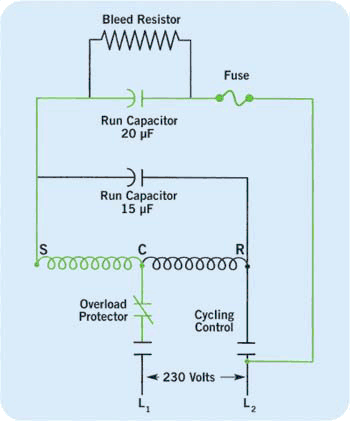
    Figure 3. There is no current flow due to an incomplete circuit. Line 1 (L1) is opened. (All figures courtesy of ESCO Press.)

    Slugging

    Crankcase heaters can be effective in combating migration, but they won’t remedy slugging at startups from liquid floodback unless they are used in conjunction with a properly sized suction line accumulator.

    Slugging is what happens when liquid refrigerant (or liquid refrigerant and oil) enters the compressor’s cylinder during an on cycle.

    Causes of slugging include:

  • No compressor crankcase heat during off cycles and long shutdowns;

  • Migration during the off cycle;

  • No compressor superheat;

  • Bad TXV;

  • Low load;

  • End of cycle (lowest load);

  • Evaporator fan out;

  • Iced evaporator coil;

  • Defrost timer or heater out;

  • Dirty evaporator;

  • Cap tube overfeeding; and

  • Overcharge.

    Air-cooled semi-hermetic compressors are more prone to slugging than are refrigerant-cooled semi-hermetics. Refrigerant is often drawn directly into an air-cooled semi-hermetic’s cylinder without passing through the motor barrel. Slugging can result in broken valves, head gaskets, and connecting rods, and compressor damage in general.

    Refrigerant-cooled semi-hermetic compressors often draw liquid from the suction line through hot motor windings in the motor barrel, which assists in vaporizing any liquid. Even if liquid refrigerant gets past the motor windings, the check valve in the partition between the crankcase and the motor barrel will prevent any liquid refrigerant from entering the crankcase. High current draws (from dense refrigerant vapors entering the compressor cylinder) will be noticeable.

    Most hermetic compressor suction lines end at the shell of the compressor. If liquid refrigerant enters the compressor, liquid will fall directly into the crankcase oil and will be flashed eventually. This is called flooding. It causes oil to foam and results in excessively high crankcase pressures. Refrigerant and oil droplets can then reach the compressor’s cylinder; slugging is the result.

    Slugging in hermetic compressors can occur also from a migration problem. As mentioned be-fore, foaming oil and refrigerant in the crankcase due to migration will generate excessive crankcase pressures during the on cycle. These oil and refrigerant droplets can get past piston rings and other small openings and enter the compressor’s cylinder. The result is slugging. Slugging can damage reed valves, piston rods, bearings, and many other compressor parts.

    Tomczyk is a professor of HVAC at Ferris State University, Big Rapids, Mich., and the author of Troubleshooting and Servicing Modern Air Conditioning & Refrigeration Systems, published by ESCO Press. To order, call 800-726-9696. Tomczyk can be reached at tomczykj@tucker-usa.com.

    Publication date: 08/04/2003

  • Looking for quick answers on air conditioning, heating and refrigeration topics? Try Ask ACHR NEWS, our new smart AI search tool. Ask ACHR NEWS →

    Share This Story

    Looking for a reprint of this article?
    From high-res PDFs to custom plaques, order your copy today!


    Recommended Content

    JOIN TODAY
    To unlock your recommendations.

    Already have an account? Sign In

    • HVAC-enrollment

      The Trades Are Back: HVACR Programs See Nearly 30% Enrollment Spike

      A new wave of future technicians is entering the pipeline.  
      News
      By: Matt Jachman
    • 2025 Top 40 Under 40

      2025 Top 40 Under 40 HVACR Professionals List

      The 11th annual Top 40 Under 40 list highlights those...
      HVAC Commercial Market
      By: Hannah Belloli-Oster
    • LG Ductless Mini-Split Systems

      The 9 Types of Heat Pumps

      As the U.S. moves toward electrification, heat pumps are...
      Air Source Heat Pumps
      By: Joanna R. Turpin
    Subscription Center
    • Create an Account
    • Start a Subscription
    • Manage My Account
    • Sign Up for Newsletters
    • Visit Customer Service
    • Update Preferences

    More Videos

    Sponsored Content

    Sponsored Content is a special paid section where industry companies provide high quality, objective, non-commercial content around topics of interest to The News audience. All Sponsored Content is supplied by the advertising company and any opinions expressed in this article are those of the author and not necessarily reflect the views of The News or its parent company, BNP Media. Interested in participating in our Sponsored Content section? Contact your local rep!

    close
    • Piggy Bank
      Sponsored byWatercress Financial

      Energy Prices, Inflation, and HVAC: What Today’s Homeowners Care About

    • Refrigerated Food
      Sponsored bySolstice Advanced Materials

      R-455A Refrigeration: A Cold Storage Solution for the Future

    • Airex Rooftop Units
      Sponsored byAirex Manufacturing Inc

      Consolidating Roof Penetrations: A Growing Trend in Multifamily HVAC Design

    Popular Stories

    HVAC-Price-Increase-graphic

    HVAC Price Increase List: June 2026

    Trump-Section-232.jpg

    Trump Reduces Section 232 Tariffs on HVAC Equipment to 15%

    R410A-Refrigerant-Cylinder.jpg

    Refrigerant Recovery is a Revenue Opportunity

    Heat-pump-cutaway.jpg

    PFAS Rules and A2L Building Codes Continue to Evolve

    Midea-training.jpg

    HVAC Workforce Crisis Expands Beyond Technicians to Instructor Shortages

    View The ACHR NEWS
    Centennial Anniversary Timeline

    The ACHR News Timeline Chart
    Submit a Letter
    Submit a letter to our editors.

    Events

    November 6, 2025

    Next-Gen Data Center Cooling: HVAC Innovation and Real-World Solutions

    On Demand As AI workloads and high-density computing push traditional cooling methods to their limits, the data center industry is accelerating the adoption of next-generation HVAC technologies.

    June 17, 2026

    Decarbonization Without Disruption

    This webinar will explore practical HVAC decarbonization strategies that minimize disruption while maximizing long-term performance and ROI.

    View All Submit An Event

    Poll

    Summer Staff

    Are you fully staffed for the summer season?
    View Results Poll Archive

    Products

    BNI Mechanical/Electrical Square Foot Costbook, 2026 Edition

    BNI Mechanical/Electrical Square Foot Costbook, 2026 Edition

    See More Products
    Decarbonization Without Disruption - Free Webinar - 6/17/2026

    Related Articles

    • Eaton Corp.: Single-, Double-Pole Contactors

      See More
    • Eaton Corp.: Single-, Double-Pole Contactors

      See More
    • Eaton Corp.: Single-, Double-Pole Contactors

      See More

    Related Products

    See More Products
    • The ACHR News - February 16, 2026

      ACHR NEWS February 16, 2026, Issue

    • The ACHR NEWS - March 16, 2026

      ACHR NEWS March 16, 2026, Issue

    See More Products

    Related Directories

    • J. Bee Enterprise Inc.

      Sheet metal hand tool scribes double bar single bar
    • Associated Builders and Contractors Inc.

      A national trade association representing more than 23,000 merit shop contactors, subcontractors, material suppliers and related firms in 67 chapters across the United States.
    • Edwards Coil Corp.

      Condensers, heat exchangers, tube-in-tube, single and vented double wall, finned, in copper, cupronickel, titanium and steel tubing.
    ×

    Sign Up. Stay Informed.

    The #1 trusted source for the HVACR industry since 1926

    SUBSCRIBE
    • RESOURCES
      • Advertise
      • Contact Us
      • Advisory Board
      • Classifieds
      • Submit a Letter
      • Directories
      • Store
    • ACCOUNT CENTER
      • Create an Account
      • Start a Subscription
      • Manage My Account
      • Sign Up for Newsletters
      • Visit Customer Service
      • Update Preferences
    • SERVICES
      • Marketing Services
      • Reprints
      • Market Research
      • List Rental
      • Survey/Respondent Access
    • STAY CONNECTED
      • LinkedIn
      • Facebook
      • Instagram
      • YouTube
      • X (Twitter)
    • PRIVACY
      • PRIVACY POLICY
      • TERMS & CONDITIONS
      • DO NOT SELL MY PERSONAL INFORMATION
      • PRIVACY REQUEST
      • ACCESSIBILITY

    Copyright ©2026. All Rights Reserved BNP Media, Inc. and BNP Media II, LLC.

    Design, CMS, Hosting & Web Development :: ePublishing