ACHR News
search
Ask ACHR NEWS AI
cart
facebook twitter instagram linkedin youtube
  • Sign In
  • Subscribe
  • Sign Out
  • My Account
ACHR News
  • NEWS
    • Breaking News
    • New HVAC Products
    • Featured Products
    • Manufacturer Reports
    • HVAC Data
    • Legislation
    • ACHR NEWS Centennial
  • RESIDENTIAL
    • Air Conditioners
    • Furnaces
    • Residential Heat Pumps
    • Ductless
    • Residential IAQ
    • Testing, Monitoring, Tools
    • Components & Accessories
  • COMMERCIAL
    • Air Handlers
    • Rooftop Units
    • Chillers and Cooling Towers
    • Commercial Heat Pumps
    • Boilers and Hydronics
    • VRF/Ductless
    • Commercial IAQ
  • REFRIGERATION
    • Refrigerants
    • Refrigerant Regulations
    • Leak Management
  • CONTRACTOR PRO
    • Geothermal
    • Homeowner Study
    • VRF and VRV Ductless
    • Unitary Trends
  • EDUCATION
    • Training and Education
    • Business Management
    • Service and Maintenance
    • Continuing Education
    • Market Research >
      • HVAC Brand Awareness Report
      • VRV, VRF, VRVZ Report
      • Unitary Trends Report
      • Water Heat Professionals Report
    • Webinars
    • Sponsor Insights
    • eProducts Info
    • White Papers
  • EVENTS
    • HVAC Contractor Forum
    • Industry Events and Webinars
  • MEDIA
    • Videos
    • AHR Expo 2025 Videos
    • Podcasts >
      • ACHR News Podcast
      • HARDI Podcasts
      • AHR Expo Podcasts
      • ACCA Podcasts
    • Interactive Spotlights
    • Quizzes
    • eBooks
    • HVAC Talkback
  • HVAC GROUP
    • ACHR NEWS >
      • Current Issue
      • Digital Edition
      • Subscribe
    • Distribution Trends
    • SNIPS NEWS >
      • Join SNIPS NEWS
    • Engineered Systems News >
      • Join ES News
    • HVACR Directory
    • Contests
    • Newsletters
    • Contact
    • Advertise
    • My Account

Remember, Cash Is King

March 18, 2004
[Editor's note: This is the third installment of an eight-part series on business management by Mark Roberts, who details the lessons he learned as a result of placing his HVACR business into Chapter 7 bankruptcy liquidation. His goal: to prevent other business owners from going through the same ordeal. Here, Roberts shows contractors how to determine a company's short-term cash requirements.]

A lot has been written on the importance of cash flow planning in the HVAC industry, with good reason. Changes in the weather can often be enough to leave contractors scrambling to make payroll during off seasons. Add late-paying customers and unforeseen truck repairs, and a recipe for disaster can exist.

Long-term cash flow planning can often be difficult, simply because sales can be difficult to forecast in an often volatile industry. While long-term cash flow planning is a good idea, especially when new asset purchases will be required, I am going to leave that for you and your accountant to discuss. Basic accounting software packages sold at all the local business and office stores now perform cash forecasting functions that are helpful as well.

For this discussion, I am going to focus our attention on short-term cash forecasting. I will show you how to figure out your company's short-term cash needs based on a couple of easy liquidity formulas and then show you how to determine an overall picture of your company's ongoing cash requirements.

We will look at four distinct formulas. You may be using a couple of them already in your daily operation. The formulas cover:

1. Cash ratio.

2. Quick ratio.

3. Current ratio.

4. Cash cycle.

Definitions

Before we begin, a few definitions should be provided:

  • Accounting cycle: Usually one year. For the terms of our cash discussion, however, we are going to look at an accounting cycle in relationship to your company's cash cycle and reduce this to 30 days.

  • Current assets: Any assets that can be converted into cash within the short term, usually one accounting cycle. Current assets include such items as cash, marketable securities (short-term investments in which your company might invest its cash to earn interest), accounts receivable, and inventory.

  • Current liabilities: Any financial obligations that will come due, requiring repayment by your company in the short term, usually one accounting cycle. Current liabilities include such items as vendor payments, short-term loans, payroll, and the current portion of long-term liabilities.

  • Cash ratio: This ratio simply shows you how much cash your company currently has on hand to meet current liabilities that are coming due. The equation is shown here.

  • Quick ratio: This ratio shows you how much cash and receivables your company has on hand to meet your liabilities that are coming due. The equation is shown here.

  • Current ratio: This ratio combines all of your company's current assets and compares them to the company's current liabilities. The assumption is that these current assets should be able to be converted into cash fairly easily to ensure the payment of your liabilities. Most accountants recommend that this ratio equal at least 2:1. The formula for the current ratio is shown here.

    The Cash Cycle

    I have attended many seminars over the years, and one of the most frequent questions that I have heard contractors ask is, "How much cash should our company have on hand?" However, in my experience, no one ever seemed to have a good answer to this question. The typical answers were, "It depends on your company," and, "Your company should have a ratio of $2 of current assets to every $1 of current liabilities."

    While these answers might be considered correct for many companies, I was curious as to how much cash my company should have on hand. I needed a clear answer to help me plan for my company's cash needs, without having to forecast elaborate cash flow spreadsheets, which often prove inaccurate.

    The answer can be found in what is called the "cash cycle." Your company's cash cycle will give you a big picture of the minimum amount of cash that will be needed to keep operations going. The cash cycle emphasizes the importance of timely receivable collections and inventory turnover. Best of all, your company's cash cycle is accurate and easy to predict once you've gathered some basic relevant information.

    To figure your company's cash cycle, you will need to know the following items, spelled out in detail below:
  • Your company's projected daily sales.

  • Your company's average collection days.

  • The average days your inventory is on hand.

  • Your company's average payable days.

    Once you have this information, you can determine your company's cash cycle and your minimum cash reserve requirements.

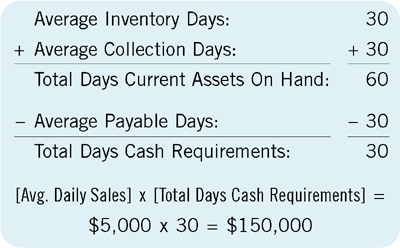
    The minimum amount of cash your company will require on hand (or have access to) to safely maintain operations can be figured out as in the example below. (The example assumes 30-day averages and an average daily sales figure of $5,000.)
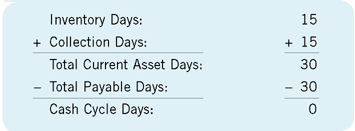
    Figure 1. The company’s cash reserve requirements in the second example case.
    In this example, with $5,000 in average daily sales, the contractor would need $150,000 in cash reserve requirements to safely meet the company's current obligations and maintain ongoing operations. (Average daily sales assumes a profitable enterprise.)

    Assume that this company turned its inventory over more quickly and reduced the amount of average days inventory was held on hand to 15 days. Further assume that the contractor collected down payments before work began and reduced its average days receivables were outstanding to 15 days. What would happen to the company's minimum cash reserve requirements? The results are shown in Figure 1.
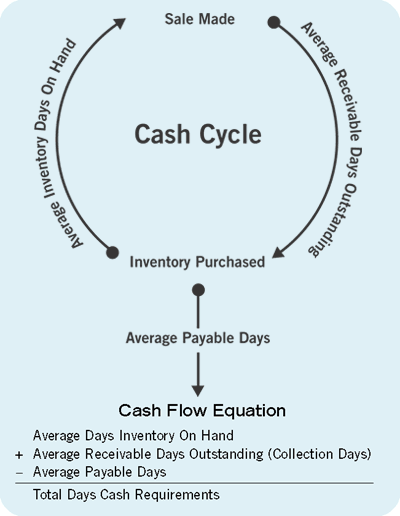
    Figure 2. The cash cycle diagram.
    This company would require little to no cash to maintain its operations because its inventory days and receivable days are timed perfectly with its payable days. In the real world, things would rarely be so simple, as companies are constantly in motion.

    However, by figuring out your company's cash cycle, you will have a big picture of your company's overall minimum cash reserve needs. It also gives you a pretty good incentive to collect your money promptly and to manage your inventory more efficiently. You should figure out your cash cycle annually - more often if sales are growing rapidly.

    Next week: Contracting requires large capital investments, so understanding risk management is essential.

    Roberts is owner of Roberts Commercial Lending Co. LLC. He provides corporate finance and debt consulting, business loans, and leasing services. He can be reached at 586-716-8329 or CommercialFnnc@aol.com.

    Publication date: 03/22/2004

  • Looking for quick answers on air conditioning, heating and refrigeration topics? Try Ask ACHR NEWS, our new smart AI search tool. Ask ACHR NEWS →

    Share This Story

    Looking for a reprint of this article?
    From high-res PDFs to custom plaques, order your copy today!


    Recommended Content

    JOIN TODAY
    To unlock your recommendations.

    Already have an account? Sign In

    • HVAC-enrollment

      The Trades Are Back: HVACR Programs See Nearly 30% Enrollment Spike

      A new wave of future technicians is entering the pipeline.  
      News
      By: Matt Jachman
    • 2025 Top 40 Under 40

      2025 Top 40 Under 40 HVACR Professionals List

      The 11th annual Top 40 Under 40 list highlights those...
      HVAC Contracting
      By: Hannah Belloli-Oster
    • LG Ductless Mini-Split Systems

      The 9 Types of Heat Pumps

      As the U.S. moves toward electrification, heat pumps are...
      Heat Pumps
      By: Joanna R. Turpin
    Subscription Center
    • Create an Account
    • Start a Subscription
    • Manage My Account
    • Sign Up for Newsletters
    • Visit Customer Service
    • Update Preferences

    More Videos

    Sponsored Content

    Sponsored Content is a special paid section where industry companies provide high quality, objective, non-commercial content around topics of interest to The News audience. All Sponsored Content is supplied by the advertising company and any opinions expressed in this article are those of the author and not necessarily reflect the views of The News or its parent company, BNP Media. Interested in participating in our Sponsored Content section? Contact your local rep!

    close
    • Piggy Bank
      Sponsored byWatercress Financial

      Energy Prices, Inflation, and HVAC: What Today’s Homeowners Care About

    • Refrigerated Food
      Sponsored bySolstice Advanced Materials

      R-455A Refrigeration: A Cold Storage Solution for the Future

    • Airex Rooftop Units
      Sponsored byAirex Manufacturing Inc

      Consolidating Roof Penetrations: A Growing Trend in Multifamily HVAC Design

    Popular Stories

    HVAC-Price-Increase-graphic

    HVAC Price Increase List: June 2026

    Trump-Section-232.jpg

    Trump Reduces Section 232 Tariffs on HVAC Equipment to 15%

    R410A-Refrigerant-Cylinder.jpg

    Refrigerant Recovery is a Revenue Opportunity

    Heat-pump-cutaway.jpg

    PFAS Rules and A2L Building Codes Continue to Evolve

    Midea-training.jpg

    HVAC Workforce Crisis Expands Beyond Technicians to Instructor Shortages

    View The ACHR NEWS
    Centennial Anniversary Timeline

    The ACHR News Timeline Chart
    Submit a Letter
    Submit a letter to our editors.

    Events

    November 6, 2025

    Next-Gen Data Center Cooling: HVAC Innovation and Real-World Solutions

    On Demand As AI workloads and high-density computing push traditional cooling methods to their limits, the data center industry is accelerating the adoption of next-generation HVAC technologies.

    June 17, 2026

    Decarbonization Without Disruption

    This webinar will explore practical HVAC decarbonization strategies that minimize disruption while maximizing long-term performance and ROI.

    View All Submit An Event

    Poll

    Summer Staff

    Are you fully staffed for the summer season?
    View Results Poll Archive

    Products

    BNI Mechanical/Electrical Square Foot Costbook, 2026 Edition

    BNI Mechanical/Electrical Square Foot Costbook, 2026 Edition

    See More Products
    Decarbonization Without Disruption - Free Webinar - 6/17/2026

    Related Articles

    • Cash Flow is King? You Betcha

      See More
    • Overcoming Economic Uncertainty: Contractors Insist Cash is Key

      See More
    • Getting past the cash flow hoax is possible (really)

      See More

    Related Products

    See More Products
    • new cover.jpg

      Profit is An Attitude: The Strategies You Need to Optimize Profits

    • Technician Soft Skills Book & DVD Bundle

    See More Products

    Related Directories

    • Flame King

      Flame King is a trusted supplier known for delivering high-grade propane tanks and propane accessories to meet the diverse needs of recreational, commercial, industrial, and home applications.
    ×

    Sign Up. Stay Informed.

    The #1 trusted source for the HVACR industry since 1926

    SUBSCRIBE
    • RESOURCES
      • Advertise
      • Contact Us
      • Advisory Board
      • Classifieds
      • Submit a Letter
      • Directories
      • Store
    • ACCOUNT CENTER
      • Create an Account
      • Start a Subscription
      • Manage My Account
      • Sign Up for Newsletters
      • Visit Customer Service
      • Update Preferences
    • SERVICES
      • Marketing Services
      • Reprints
      • Market Research
      • List Rental
      • Survey/Respondent Access
    • STAY CONNECTED
      • LinkedIn
      • Facebook
      • Instagram
      • YouTube
      • X (Twitter)
    • PRIVACY
      • PRIVACY POLICY
      • TERMS & CONDITIONS
      • DO NOT SELL MY PERSONAL INFORMATION
      • PRIVACY REQUEST
      • ACCESSIBILITY

    Copyright ©2026. All Rights Reserved BNP Media, Inc. and BNP Media II, LLC.

    Design, CMS, Hosting & Web Development :: ePublishing
