ACHR News
search
Ask ACHR NEWS AI
cart
facebook twitter instagram linkedin youtube
  • Sign In
  • Subscribe
  • Sign Out
  • My Account
ACHR News
  • NEWS
    • Breaking News
    • New HVAC Products
    • Featured Products
    • Manufacturer Reports
    • HVAC Data
    • Legislation
    • ACHR NEWS Centennial
  • RESIDENTIAL
    • Air Conditioners
    • Furnaces
    • Residential Heat Pumps
    • Ductless
    • Residential IAQ
    • Testing, Monitoring, Tools
    • Components & Accessories
  • COMMERCIAL
    • Air Handlers
    • Rooftop Units
    • Chillers and Cooling Towers
    • Commercial Heat Pumps
    • Boilers and Hydronics
    • VRF/Ductless
    • Commercial IAQ
  • REFRIGERATION
    • Refrigerants
    • Refrigerant Regulations
    • Leak Management
  • CONTRACTOR PRO
    • Geothermal
    • Homeowner Study
    • VRF and VRV Ductless
    • Unitary Trends
  • EDUCATION
    • Training and Education
    • Business Management
    • Service and Maintenance
    • Continuing Education
    • Market Research >
      • HVAC Brand Awareness Report
      • VRV, VRF, VRVZ Report
      • Unitary Trends Report
      • Water Heat Professionals Report
    • Webinars
    • Sponsor Insights
    • eProducts Info
    • White Papers
  • EVENTS
    • HVAC Contractor Forum
    • Industry Events and Webinars
  • MEDIA
    • Videos
    • AHR Expo 2025 Videos
    • Podcasts >
      • ACHR News Podcast
      • HARDI Podcasts
      • AHR Expo Podcasts
      • ACCA Podcasts
    • Interactive Spotlights
    • Quizzes
    • eBooks
    • HVAC Talkback
  • HVAC GROUP
    • ACHR NEWS >
      • Current Issue
      • Digital Edition
      • Subscribe
    • Distribution Trends
    • SNIPS NEWS >
      • Join SNIPS NEWS
    • Engineered Systems News >
      • Join ES News
    • HVACR Directory
    • Contests
    • Newsletters
    • Contact
    • Advertise
    • My Account

Pressure measurement can improve building air quality
July 5, 1999
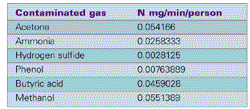
Table 1. Typcial building contaminants and concentrations. (Engineered Systems, February 1999)
There is a misconception that the reason buildings require ventilation is to supply outdoor air so people can breathe oxygen. ASHRAE Standard 62-1989 dispels this misconception and explains the oxygen consumption rate as follows:

“The oxygen consumption rate is 0.36 l/min (0.013 cfm) when the activity level is 1.2 met (met = level of body activity such as filing/seated). For ventilation at a rate of 15 cfm and an activity of 1.2 met units, the room oxygen level will be reduced from an outdoor concentration to 20.9%. Thus, the oxygen content of the room is reduced from 21.0% to 20.9%, a change of only 0.5%. The carbon dioxide is raised from the background of 0.03% (300 ppm) to 0.1% (1,000 ppm), a change of 230%. Thus dilution of carbon dioxide is clearly more significant than replacing oxygen.”

This explanation indicates that the oxygen supply is not the primary reason that buildings require ventilation. The odors (contaminants, see Table 1) produced by people, and gases (odors) from furnishings, office, and manufacturing equipment are the primary reason buildings require ventilation.

Measuring each of these odors would require different instruments. Since carbon dioxide (CO2) is discharged by the occupants and present in the atmosphere, it is used as a reference for measuring odors in a building.

We cannot assume that outdoor air is free from contaminants. Fumes can enter into the ventilation air intake grille from outside and be distributed through the building.

Delivering the right amount of outdoor fresh air to dilute odors, and controlling the proper exhaust, is critical to air quality.

In most instances, ventilation is not delivered directly into each room. Most commercial building ventilation systems are designed with large ducts that branch off to smaller ducts with vav boxes, which may contain the cooling and heating elements, and then into the space requiring the ventilation.
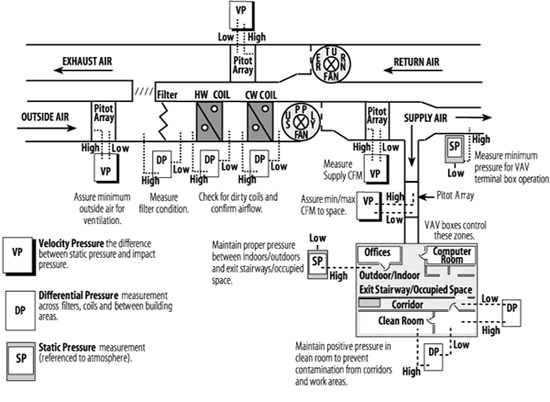
Figure 1. Ventilation air path.

However, laboratories and manufacturers involved in critical processes that require isolation of contaminants, or the manufacture of products that produce pungent odors, may require individual room ventilation systems.

Pressure transducers are used throughout the ventilation system (see Figure 1). They are used to measure the flow of returned air, fresh outside air, and total air to the ventilation system.

Looking for quick answers on air conditioning, heating and refrigeration topics? Try Ask ACHR NEWS, our new smart AI search tool. Ask ACHR NEWS →

The pressure transducers (static pressure monitors) placed throughout the system ensure the proper amount of air in each distribution branch, as well as the main trunk.

Static pressure is the pressure inside the duct and is measured perpendicular to the flow of air. There are pressure gradient differences from the inside wall toward the center of the duct. A pitot array installed vertically in a cross section of the duct has many pressure ports averaging the gradient. An array provides a more accurate pressure reading than a single pressure point.

A pitot array installed into the flow of air measures the static pressure and upstream pressure. The reference port of the pressure transducer measures the static pressure, and the positive pressure port measures the upstream pressure.

Flow measurement uses the differential pressure between static pressure and impact pressure created by airflow. This differential is known as velocity pressure. The air velocity pressure measurement is used to calculate flow, measured in feet per minute (fpm) and, if the cross sectional area of the duct is known, as cubic feet per minute (cfm).

Formula for Flow Rate:

Velocity pressure in in. wc (using pitot tube array) ­VP x 4,005 = fpm fpm x area (sq ft) = cfm Range Airflow 0 to 0.1 in. wc 1,266 fpm 0 to 0.25 in. wc 2,002 fpm 0 to 0.5 in. wc 2,831 fpm 0 to 1 in. wc 4,000 fpm

Proper ventilation dilutes the contaminants, but does not dispose of bacteria, mildew, or fungus that can accumulate on filters and coils.

Pressure transducers measure differential pressure across filters and coils to determine when cleaning or replacement is needed. Clogged filters and coils cause a decrease in airflow, which is indicated by an increase in differential pressure.

Maintenance personnel sanitize or change filters and coils when the differential pressure reaches a certain value.

Fluctuations

Occupancy and building conditions can fluctuate. To maintain the proper flow of ventilated air and ensure that the proper cfm is delivered, differential pressure is measured between indoors-outdoors, exit stairways, and occupied space.

An electronically controlled system responds and makes adjustments in the hvac and air-handling systems that will compensate for these changing conditions.

In applications that require maintaining a positive or negative pressure, such as in cleanrooms and isolation wards, differential pressure transducers are used to monitor positive pressure in cleanrooms to prevent contamination from outside and negative pressure in isolation wards to prevent bacteria from escaping.

Static pressure measurement (pressure measured relative to atmosphere) maintains a minimum pressure in the ducts that lead to vav terminal boxes. A mixture of outdoor and reconditioned air is delivered through the main duct to the vav box.

The vav box varies the amount of air supplied to the space by modulating the fan speed, inlet vanes, or discharge dampers on the supply fan (and return fan, if any).

Pressure transducers are an integral part of any building energy maintenance system. Monitoring changes in pressure inside a building, along with the proper maintenance of the air ventilating and exhaust systems, ensures the delivery of the right mixture of fresh and conditioned air, which improves air quality and provides a better, cleaner environment in which to live and work.

Share This Story

Looking for a reprint of this article?
From high-res PDFs to custom plaques, order your copy today!


Recommended Content

JOIN TODAY
To unlock your recommendations.

Already have an account? Sign In

  • HVAC-enrollment

    The Trades Are Back: HVACR Programs See Nearly 30% Enrollment Spike

    A new wave of future technicians is entering the pipeline.  
    Training and Education
    By: Matt Jachman
  • 2025 Top 40 Under 40

    2025 Top 40 Under 40 HVACR Professionals List

    The 11th annual Top 40 Under 40 list highlights those...
    HVAC Light Commercial Market
    By: Hannah Belloli-Oster
  • LG Ductless Mini-Split Systems

    The 9 Types of Heat Pumps

    As the U.S. moves toward electrification, heat pumps are...
    HVAC Residential Market
    By: Joanna R. Turpin
Subscription Center
  • Create an Account
  • Start a Subscription
  • Manage My Account
  • Sign Up for Newsletters
  • Visit Customer Service
  • Update Preferences

More Videos

Sponsored Content

Sponsored Content is a special paid section where industry companies provide high quality, objective, non-commercial content around topics of interest to The News audience. All Sponsored Content is supplied by the advertising company and any opinions expressed in this article are those of the author and not necessarily reflect the views of The News or its parent company, BNP Media. Interested in participating in our Sponsored Content section? Contact your local rep!

close
  • Piggy Bank
    Sponsored byWatercress Financial

    Energy Prices, Inflation, and HVAC: What Today’s Homeowners Care About

  • Refrigerated Food
    Sponsored bySolstice Advanced Materials

    R-455A Refrigeration: A Cold Storage Solution for the Future

  • Airex Rooftop Units
    Sponsored byAirex Manufacturing Inc

    Consolidating Roof Penetrations: A Growing Trend in Multifamily HVAC Design

Popular Stories

HVAC-Price-Increase-graphic

HVAC Price Increase List: June 2026

Trump-Section-232.jpg

Trump Reduces Section 232 Tariffs on HVAC Equipment to 15%

Heat-pump-cutaway.jpg

PFAS Rules and A2L Building Codes Continue to Evolve

Midea-training.jpg

HVAC Workforce Crisis Expands Beyond Technicians to Instructor Shortages

Refrigerants-and-gauge.jpg

HVAC Industry Warns of Counterfeit Refrigerants Entering U.S. Supply Chain

View The ACHR NEWS
Centennial Anniversary Timeline

The ACHR News Timeline Chart
Submit a Letter
Submit a letter to our editors.

Events

November 6, 2025

Next-Gen Data Center Cooling: HVAC Innovation and Real-World Solutions

On Demand As AI workloads and high-density computing push traditional cooling methods to their limits, the data center industry is accelerating the adoption of next-generation HVAC technologies.

June 17, 2026

Decarbonization Without Disruption

This webinar will explore practical HVAC decarbonization strategies that minimize disruption while maximizing long-term performance and ROI.

View All Submit An Event

Poll

Summer Staff

Are you fully staffed for the summer season?
View Results Poll Archive

Products

BNI Mechanical/Electrical Square Foot Costbook, 2026 Edition

BNI Mechanical/Electrical Square Foot Costbook, 2026 Edition

See More Products
Decarbonization Without Disruption - Free Webinar - 6/17/2026

Related Articles

  • Contractors Can Improve Building Energy Efficiency With Data Loggers

    See More
  • Honeywell International Inc., Home and Building Control: AIR QUALITY SYSTEM

    See More
  • IAQ Schools Denver Hernandez Taylor

    How Contractors Can Lead Air Quality Improvement in Schools

    See More

Related Products

See More Products
  • pewtpm.png

    Pressure Enthalpy Without Tears Manual

  • Manual Q.jpg

    Manual Q - Low Pressure, Low Velocity Duct System Design

  • Tech_CommRef_Guide_Small.jpg

    Technician’s Guide & Workbook for Quality Maintenance on Commercial Refrigeration Equipment

See More Products

Events

View AllSubmit An Event
  • October 14, 2025

    Maximize Every Home Visit: Indoor Air Quality Strategies to Grow HVAC Revenues

    On Demand In this webinar, you’ll learn how top HVAC pros are integrating IAQ into everyday service and sales calls to increase average job size, boost customer satisfaction and stand out from the competition.
View AllSubmit An Event

Related Directories

  • Dynamic Air Quality Solutions

    High-performance air filtration systems that remove ultrafine particles, viruses, odors and gas phase contaminants, without Ozone. Low static pressure reduces energy and operating costs.
×

Sign Up. Stay Informed.

The #1 trusted source for the HVACR industry since 1926

SUBSCRIBE
  • RESOURCES
    • Advertise
    • Contact Us
    • Advisory Board
    • Classifieds
    • Submit a Letter
    • Directories
    • Store
  • ACCOUNT CENTER
    • Create an Account
    • Start a Subscription
    • Manage My Account
    • Sign Up for Newsletters
    • Visit Customer Service
    • Update Preferences
  • SERVICES
    • Marketing Services
    • Reprints
    • Market Research
    • List Rental
    • Survey/Respondent Access
  • STAY CONNECTED
    • LinkedIn
    • Facebook
    • Instagram
    • YouTube
    • X (Twitter)
  • PRIVACY
    • PRIVACY POLICY
    • TERMS & CONDITIONS
    • DO NOT SELL MY PERSONAL INFORMATION
    • PRIVACY REQUEST
    • ACCESSIBILITY

Copyright ©2026. All Rights Reserved BNP Media, Inc. and BNP Media II, LLC.

Design, CMS, Hosting & Web Development :: ePublishing