ACHR News
search
Ask ACHR NEWS AI
cart
facebook twitter instagram linkedin youtube
  • Sign In
  • Subscribe
  • Sign Out
  • My Account
ACHR News
  • NEWS
    • Breaking News
    • New HVAC Products
    • Featured Products
    • Manufacturer Reports
    • HVAC Data
    • Legislation
    • ACHR NEWS Centennial
  • RESIDENTIAL
    • Air Conditioners
    • Furnaces
    • Residential Heat Pumps
    • Ductless
    • Residential IAQ
    • Testing, Monitoring, Tools
    • Components & Accessories
  • COMMERCIAL
    • Air Handlers
    • Rooftop Units
    • Chillers and Cooling Towers
    • Commercial Heat Pumps
    • Boilers and Hydronics
    • VRF/Ductless
    • Commercial IAQ
  • REFRIGERATION
    • Refrigerants
    • Refrigerant Regulations
    • Leak Management
  • CONTRACTOR PRO
    • Geothermal
    • Homeowner Study
    • VRF and VRV Ductless
    • Unitary Trends
  • EDUCATION
    • Training and Education
    • Business Management
    • Service and Maintenance
    • Continuing Education
    • Market Research >
      • HVAC Brand Awareness Report
      • VRV, VRF, VRVZ Report
      • Unitary Trends Report
      • Water Heat Professionals Report
    • Webinars
    • Sponsor Insights
    • eProducts Info
    • White Papers
  • EVENTS
    • HVAC Contractor Forum
    • Industry Events and Webinars
  • MEDIA
    • Videos
    • AHR Expo 2025 Videos
    • Podcasts >
      • ACHR News Podcast
      • HARDI Podcasts
      • AHR Expo Podcasts
      • ACCA Podcasts
    • Interactive Spotlights
    • Quizzes
    • eBooks
    • HVAC Talkback
  • HVAC GROUP
    • ACHR NEWS >
      • Current Issue
      • Digital Edition
      • Subscribe
    • Distribution Trends
    • SNIPS NEWS >
      • Join SNIPS NEWS
    • Engineered Systems News >
      • Join ES News
    • HVACR Directory
    • Contests
    • Newsletters
    • Contact
    • Advertise
    • My Account

Periodic Cicadas Are Coming
April 15, 2004
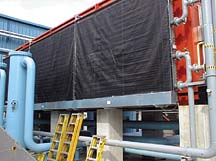
This dry cooling tower has three air intake filters installed. (Article photos courtesy of Randy Simmons.)
Did you ever wonder what insects make that very loud buzzing sound in trees during the daytime in summer? It's a widely heard but rarely seen kind of insect called a cicada. The ones you hear every summer are nonperiodical, some of them appearing as adults every year despite requiring several years to develop to adulthood.

Unfortunately, the ones appearing as adults in the next few years can overwhelm your cooling towers, evaporative condensers, and air-handling units. They emerge as adults in 17-year intervals in large and generally nonoverlapping geographic regions of the northeastern United States.

Because of this separation in time and place, these species are called periodical cicadas, and their various widespread populations are called broods. A total of a dozen such broods are recognized, according to Dr. Thomas E. Moore, Museum of Zoology, University of Michigan, Ann Arbor, Mich., who provided all of the cicada distribution and biological information for this article.

The single largest 17-year brood, known as "Brood X" (10), is expected to appear in 16 states in 2004. (Click on the link at the bottom of this story to see a PDF of Table 1 showing state and county distribution). Another brood should appear in 2007, and a third brood in 2008. (Some states have more than one brood).

One can identify periodical cicadas by the combination of largely black bodies, reddish eyes, and reddish veins in their wings.

If your company is in a region affected by Brood X this year, you need to begin planning how you will deal with the potential problem; it could have a devastating impact on your operation if you wait until it is too late.

So What's The Big Deal?

When periodic cicadas emerge, their population density is enormous. It can exceed 1 million per square acre (several hundreds of thousands is usual).

If your facility is in a brood-infested region, and your cooling towers, evaporative condensers, and air-handling units are in or near naturally forested areas, or surrounded by trees, your system may be vulnerable.

These otherwise harmless insects can be sucked into your equipment while flying past the draft zone of the intake opening as they make their way to the nearest tree.

Looking for quick answers on air conditioning, heating and refrigeration topics? Try Ask ACHR NEWS, our new smart AI search tool. Ask ACHR NEWS →

Units located on rooftops and away from trees or in the middle of a paved area are less likely to encounter cicada-related problems than those that are near the ground, or surrounded by trees or woody plants.

If your facility is immediately adjacent to or nestled away in affected wooded areas, your systems are likely to be at risk.

When Will They Emerge?

These insects are about the size of your little finger, measuring about 0.5 inches wide and 1.5 inches long. Three species usually emerge mixed together in the same area. Their songs are quite different, and they vary in average size.

They are expected to emerge from the soil in early May and June, and are active as adults (only males sing) for 30 to 50 days. During their short time above ground, they feed both day and night by sucking the sap of trees and other woody plants. They do not chew or bite leaves or people. The songs of males promote mating. After mating, females lay hundreds of eggs in woody tissue by making slits in the bark of pencil-sized twigs.

Shortly after mating and laying eggs, the adult cicadas die, leaving massive numbers of carcasses everywhere. In about nine weeks the eggs hatch and pale, ant-sized baby cicadas drop from the twigs to the ground, where they burrow underground and remain there for 17 years, sucking sap from the roots of plants.

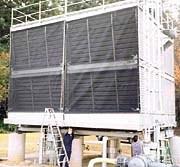
Air intake filters offer a way to protect cooling towers from cicadas (above and below).

Here's What Can Happen

"The last time the periodic cicadas emerged, we had to clean our cooling tower strainers and flume several times per day," recalled one stationary steam engineer, who works at a major consumer products manufacturer in the Cincinnati area. "If we didn't clean the strainers, we would lose our chiller due to high-pressure conditions and it would shut down our cooling system.

"We had to maintain our cooling towers around the clock just to keep our systems operational."

If your facility is in an affected area and you don't anticipate the emergence of the cicadas, it can impact your annual maintenance budget and have an economic impact on your business in the following ways.

Cooling towers and evaporative condensers
  • Clog cooling tower film, reducing airflow.

  • Overwhelm sump water, increasing organic content and increasing bacteria count.

  • Increase water treatment chemical consumption and associated costs.

  • Clog strainers, reduce flow rates, and impact chiller efficiency.

  • Clog solenoid blowdown valves in the open position, resulting in increased makeup water and water treatment chemical consumption.

  • Clog heat exchangers, reducing flow rates and heat transfer efficiency.

  • Increase maintenance costs.

  • Can cause production downtime, lost productivity, and missed shipments.

    Air-handling units

  • Clog internal filters.

  • Load intake air pathways with insect debris.

  • Increase filter changes.

  • Reduce internal air quality.

  • Cause excessive service and maintenance costs.

    In short, periodic cicadas can cause real havoc to companies that are not prepared.

    How You Can Prevent Trouble

    First of all, you need to determine if you are located in an affected region. If you had a problem the last time they emerged, and if there has been little construction or disruption to the soil or forested area around your operation, then you are likely to have trouble again.

    If you are in an affected region, it is recommended that you identify your most critical systems and set extra maintenance dollars aside specifically for protecting and maintaining those systems that support production or other revenue-generating operations.

    Anticipate extra maintenance and service, increased water treatment chemical consumption, frequent filter changes on air handlers, and overtime or investment in preventive technology (such as air intake filters that stop the insects and debris from entering your systems).

    Research your alternatives. Water filtration and air intake filtration are two good options. De-pending on the level of protection you are seeking, each provides varying degrees of protection.

    Water filtration will help you manage the insects (and other airborne debris) after they have entered the cooling tower, and will protect downstream systems, including chillers and heat exchangers.

    However, water filtration cannot protect the cooling tower, where most of the maintenance will be required. Air intake filtration systems, which mount to the outside of the cooling tower or other air intake openings (as in chillers and air-handling units), will filter the air at the point of entry into your system, keeping airborne matter out of the tower in the first place and protecting the entire system (cooling tower, chiller, and heat exchanger).

    After the cicadas have gone, the air intake filters can provide long-term protection against annual airborne debris, such as cottonwood seed, small and large insects (e.g., mayflies/fishflies and ladybugs), leaves, pine needles, paper and wrappers, harvest chaff, construction debris, and birds.

    Knowing if you will be affected and developing a plan of action is the first step in reducing the impact on your operation.

    Taking a preventive approach is usually more cost effective than simply reacting when the problem occurs, and can literally save you thousands of dollars while keeping your operation running smoothly.

    Choose Your Filter Wisely

    When airborne debris becomes a serious problem, the natural tendency is to look for something to cover the intake opening to prevent entry of the debris.

    Never use window screen, roll filter media, or mesh purchased from a hardware store to cover air intake openings on cooling towers or evaporative condenser units. These materials are not designed to allow proper airflow and can drastically increase static pressure, increase energy costs, and impede cooling efficiency.

    When using air intake filtration, it should provide less than 1/10-inch drop in static pressure (as measured in inches H2O).

    Air intake filtration specifically designed for use on cooling towers and evaporative condensers and chillers is highly recommended.

    Simmons is with Air Solution Co., a manufacturer of air intake filter systems. He may be reached at 513-860-9784; 513-509-0939 (cell); airsolutioncompany@hotmail.com; or, visit www.airsolutioncompany.com.

    Publication date: 04/19/2004

    Click here to download a pdf of Table 1.

  • Share This Story

    Looking for a reprint of this article?
    From high-res PDFs to custom plaques, order your copy today!


    Recommended Content

    JOIN TODAY
    To unlock your recommendations.

    Already have an account? Sign In

    • HVAC-enrollment

      The Trades Are Back: HVACR Programs See Nearly 30% Enrollment Spike

      A new wave of future technicians is entering the pipeline.  
      News
      By: Matt Jachman
    • 2025 Top 40 Under 40

      2025 Top 40 Under 40 HVACR Professionals List

      The 11th annual Top 40 Under 40 list highlights those...
      HVAC Residential Market
      By: Hannah Belloli-Oster
    • LG Ductless Mini-Split Systems

      The 9 Types of Heat Pumps

      As the U.S. moves toward electrification, heat pumps are...
      HVAC Commercial Market
      By: Joanna R. Turpin
    Subscription Center
    • Create an Account
    • Start a Subscription
    • Manage My Account
    • Sign Up for Newsletters
    • Visit Customer Service
    • Update Preferences

    More Videos

    Sponsored Content

    Sponsored Content is a special paid section where industry companies provide high quality, objective, non-commercial content around topics of interest to The News audience. All Sponsored Content is supplied by the advertising company and any opinions expressed in this article are those of the author and not necessarily reflect the views of The News or its parent company, BNP Media. Interested in participating in our Sponsored Content section? Contact your local rep!

    close
    • Piggy Bank
      Sponsored byWatercress Financial

      Energy Prices, Inflation, and HVAC: What Today’s Homeowners Care About

    • Refrigerated Food
      Sponsored bySolstice Advanced Materials

      R-455A Refrigeration: A Cold Storage Solution for the Future

    • Airex Rooftop Units
      Sponsored byAirex Manufacturing Inc

      Consolidating Roof Penetrations: A Growing Trend in Multifamily HVAC Design

    Popular Stories

    HVAC-Price-Increase-graphic

    HVAC Price Increase List: June 2026

    Trump-Section-232.jpg

    Trump Reduces Section 232 Tariffs on HVAC Equipment to 15%

    Heat-pump-cutaway.jpg

    PFAS Rules and A2L Building Codes Continue to Evolve

    Midea-training.jpg

    HVAC Workforce Crisis Expands Beyond Technicians to Instructor Shortages

    Refrigerants-and-gauge.jpg

    HVAC Industry Warns of Counterfeit Refrigerants Entering U.S. Supply Chain

    View The ACHR NEWS
    Centennial Anniversary Timeline

    The ACHR News Timeline Chart
    Submit a Letter
    Submit a letter to our editors.

    Events

    November 6, 2025

    Next-Gen Data Center Cooling: HVAC Innovation and Real-World Solutions

    On Demand As AI workloads and high-density computing push traditional cooling methods to their limits, the data center industry is accelerating the adoption of next-generation HVAC technologies.

    June 17, 2026

    Decarbonization Without Disruption

    This webinar will explore practical HVAC decarbonization strategies that minimize disruption while maximizing long-term performance and ROI.

    View All Submit An Event

    Poll

    Summer Staff

    Are you fully staffed for the summer season?
    View Results Poll Archive

    Products

    BNI Mechanical/Electrical Square Foot Costbook, 2026 Edition

    BNI Mechanical/Electrical Square Foot Costbook, 2026 Edition

    See More Products
    Decarbonization Without Disruption - Free Webinar - 6/17/2026

    Related Articles

    • Robot Automation

      The Robots Are Coming — Are Your Employees Ready?

      See More
    • New load calculations are coming your way

      See More
    • Polarized-Media EACs Are Coming Of Age

      See More

    Related Products

    See More Products
    • The ACHR News - August 25, 2025

      ACHR NEWS August 25, 2025, Issue

    See More Products

    Events

    View AllSubmit An Event
    • May 12, 2026

      Peak Season Prep: Capture Every Dollar Coming Your Way

      On Demand In this session, we’ll break down how to prepare your business to capture every opportunity during peak demand. You’ll learn how to improve response times, convert more inbound inquiries, and use tools like AI to handle calls and texts, book jobs faster, and maximize revenue—without overloading your team.
    View AllSubmit An Event
    ×

    Sign Up. Stay Informed.

    The #1 trusted source for the HVACR industry since 1926

    SUBSCRIBE
    • RESOURCES
      • Advertise
      • Contact Us
      • Advisory Board
      • Classifieds
      • Submit a Letter
      • Directories
      • Store
    • ACCOUNT CENTER
      • Create an Account
      • Start a Subscription
      • Manage My Account
      • Sign Up for Newsletters
      • Visit Customer Service
      • Update Preferences
    • SERVICES
      • Marketing Services
      • Reprints
      • Market Research
      • List Rental
      • Survey/Respondent Access
    • STAY CONNECTED
      • LinkedIn
      • Facebook
      • Instagram
      • YouTube
      • X (Twitter)
    • PRIVACY
      • PRIVACY POLICY
      • TERMS & CONDITIONS
      • DO NOT SELL MY PERSONAL INFORMATION
      • PRIVACY REQUEST
      • ACCESSIBILITY

    Copyright ©2026. All Rights Reserved BNP Media, Inc. and BNP Media II, LLC.

    Design, CMS, Hosting & Web Development :: ePublishing