ACHR News
search
Ask ACHR NEWS AI
cart
facebook twitter instagram linkedin youtube
  • Sign In
  • Subscribe
  • Sign Out
  • My Account
ACHR News
  • NEWS
    • Breaking News
    • New HVAC Products
    • Featured Products
    • Manufacturer Reports
    • HVAC Data
    • Legislation
    • ACHR NEWS Centennial
  • RESIDENTIAL
    • Air Conditioners
    • Furnaces
    • Residential Heat Pumps
    • Ductless
    • Residential IAQ
    • Testing, Monitoring, Tools
    • Components & Accessories
  • COMMERCIAL
    • Air Handlers
    • Rooftop Units
    • Chillers and Cooling Towers
    • Commercial Heat Pumps
    • Boilers and Hydronics
    • VRF/Ductless
    • Commercial IAQ
  • REFRIGERATION
    • Refrigerants
    • Refrigerant Regulations
    • Leak Management
  • CONTRACTOR PRO
    • Geothermal
    • Homeowner Study
    • VRF and VRV Ductless
    • Unitary Trends
  • EDUCATION
    • Training and Education
    • Business Management
    • Service and Maintenance
    • Continuing Education
    • Market Research >
      • HVAC Brand Awareness Report
      • VRV, VRF, VRVZ Report
      • Unitary Trends Report
      • Water Heat Professionals Report
    • Webinars
    • Sponsor Insights
    • eProducts Info
    • White Papers
  • EVENTS
    • HVAC Contractor Forum
    • Industry Events and Webinars
  • MEDIA
    • Videos
    • AHR Expo 2025 Videos
    • Podcasts >
      • ACHR News Podcast
      • HARDI Podcasts
      • AHR Expo Podcasts
      • ACCA Podcasts
    • Interactive Spotlights
    • Quizzes
    • eBooks
    • HVAC Talkback
  • HVAC GROUP
    • ACHR NEWS >
      • Current Issue
      • Digital Edition
      • Subscribe
    • Distribution Trends
    • SNIPS NEWS >
      • Join SNIPS NEWS
    • Engineered Systems News >
      • Join ES News
    • HVACR Directory
    • Contests
    • Newsletters
    • Contact
    • Advertise
    • My Account

Parallel Compressor Rack Oil Systems
May 30, 2001
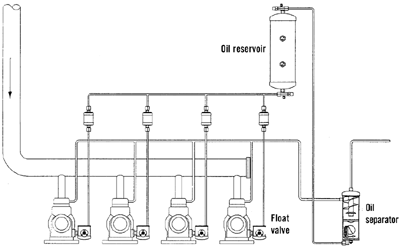
Figure 1. Parallel compressor system with an oil reservoir and oil separator. (Courtesy of AC&R Components, Inc.)


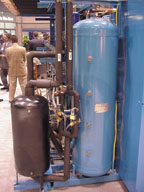
Figure 2. Large oil reservoir.
For large commercial applications, parallel compressor systems provide diversification, flexibility, load matching, and higher efficiencies, which lead to lower operating costs when compared to single compressor systems.

Service techs who work on these systems can improve their troubleshooting skills by paying attention to the points covered in this article.

Parallel compressor systems employ two or more compressors to a common suction header and a common discharge header (Figure 1). However, parallel compressor systems can often have oil-related problems.

One common problem is maintaining correct oil levels in each compressor. Another problem arises in separating the oil from the refrigerant in the often-oversized discharge line at partial loads.

Both of these problems will be explored in this article, along with an understanding of the complete oil system.


Figure 3. Combination oil separator-reservoir.

REDUCED LOADS

Often, only one or two compressors on the parallel rack will be running because of a decreased load in the store.

This can occur in the winter, when low humidity levels decrease the latent heat loads on the refrigeration cases. It also can occur during nighttime hours, when cases are not being used as often and setback thermostats have reduced the ambient temperature by a few degrees.

At partial load, the common discharge line is often a bit oversized. This happens because of the common discharge line having to be a certain diameter when handling full-load operations with all of the compressors running. At partial load, the same-diameter discharge line now has to handle only one or two compressors.

This mismatch often causes lower refrigerant velocities in the discharge line at partial loads. Lower refrigerant velocities often relate to oil not being moved along the lines as designed.

Looking for quick answers on air conditioning, heating and refrigeration topics? Try Ask ACHR NEWS, our new smart AI search tool. Ask ACHR NEWS →

This is one reason why the first component in the discharge line is a large oil separator (Figure 1).
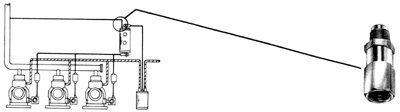


Figure 4. Reservoir pressure difference valve. (Courtesy of AC&R Components, Inc.)

VARYING LOADS

As loads vary, a pressure transducer mounted in the common suction header linked to a microprocessor turns compressors on and off in response to these changing loads. Because of this, oil return is often not equal to each compressor.

Some compressors are overfilled with oil and some are underfilled. Even a slight difference in pumping rate between like-sized compressors or significant differences in pumping rates caused by different-sized compressors on parallel racks will cause uneven oil return rates to the compressors involved.

The solution to this oil problem is a sophisticated oil separation and return system that separates the oil from the refrigerant gas and keeps every compressor in the parallel rack supplied with equal amounts of oil.


Figure 5. Oil level regulators on oil float valves. (Courtesy of AC&R Components, Inc.)

OIL SEPARATOR

As the oil-laden discharge gas enters the oil separator as a fog, its velocity is immediately slowed down. This low velocity is the key to good oil separation. The refrigerant-oil fog mixture runs into external baffling, which causes the fog mixture to change directions.

At the same time, the baffles cause the fog mixture to slow down rapidly. This causes very fine oil particles to collide with one another and form heavier particles. Fine-mesh screens separate the oil-and-refrigerant mixture even more, causing larger oil droplets to form and drop to the bottom of the oil separator.

When the level of the oil becomes high enough to raise a float, an oil return needle is opened and oil is sent to an oil reservoir.

The method of oil separation just described is just one scheme used in the industry.


Figure 7. Oil float valves ensure adequate oil level in the compressor crankcase.

OIL RESERVOIR

The oil reservoir is essentially a storage volume for oil while it is waiting to be transported to the compressor crankcases. The oil reservoir receives oil from the oil separator by a difference in pressure between the two components.

The oil reservoir is vented to suction pressure by a reservoir pressure difference valve (Figure 4). This valve maintains a set pressure difference (5 to 20 psi) between reservoir pressure and suction pressure. This prevents oil foaming and overfeeding when the oil is to be later delivered to the compressor’s crankcase through the oil level regulators.

Oil reservoirs often have sight glasses on them to let the service technician know at a glance how much oil is in the reservoir. A large oil reservoir (large blue upright tank with sight glasses) is shown in Figure 2. In some installations, a combination oil separator-reservoir is used (Figure 3).


Figure 8. Electronic oil level controllers with transducers offer oil level control and low oil-level alarm capabilities. (Courtesy of AC&R Components, Inc.)

OIL FLOAT VALVES

From the reservoir, the oil passes through oil filters on its way to the oil float valves (Figure 5). Oil float valves, sometimes called oil level regulator valves, are mounted on each compressor at its sight glass location (Figures 6 and 7). These float-activated valves are often fully adjustable and open and close as necessary to ensure adequate oil level in the compressor crankcase.

Manufacturers often use electronic oil level controllers incorporating transducers that offer oil level control, along with low-oil-level alarm capabilities (Figure 8).

Tomczyk is a professor of hvacr at Ferris State University, Big Rapids, MI.

Sidebar: Emerson’s Internet Innovations Draw Praise

Emerson Electric has been selected as one of the “Innovation 100” companies for its focus on customer service messages and customer needs.

Research teams from the newsmagazine , CMP Media, and Cap Gemini Ernst & Young, a management and consulting firm, spotlighted what they called “industry leaders in defining and implementing innovative customer-centric business and technology strategies within the new connected economy.”

The report said that “Emerson Electric not only sells refrigeration equipment, but also uses the Internet to moderate the temperature of each refrigerator it sells.”

Publication date: 06/04/2001

Share This Story

Looking for a reprint of this article?
From high-res PDFs to custom plaques, order your copy today!


Recommended Content

JOIN TODAY
To unlock your recommendations.

Already have an account? Sign In

  • HVAC-enrollment

    The Trades Are Back: HVACR Programs See Nearly 30% Enrollment Spike

    A new wave of future technicians is entering the pipeline.  
    News
    By: Matt Jachman
  • 2025 Top 40 Under 40

    2025 Top 40 Under 40 HVACR Professionals List

    The 11th annual Top 40 Under 40 list highlights those...
    HVAC Light Commercial Market
    By: Hannah Belloli-Oster
  • LG Ductless Mini-Split Systems

    The 9 Types of Heat Pumps

    As the U.S. moves toward electrification, heat pumps are...
    Air Source Heat Pumps
    By: Joanna R. Turpin
Subscription Center
  • Create an Account
  • Start a Subscription
  • Manage My Account
  • Sign Up for Newsletters
  • Visit Customer Service
  • Update Preferences

More Videos

Sponsored Content

Sponsored Content is a special paid section where industry companies provide high quality, objective, non-commercial content around topics of interest to The News audience. All Sponsored Content is supplied by the advertising company and any opinions expressed in this article are those of the author and not necessarily reflect the views of The News or its parent company, BNP Media. Interested in participating in our Sponsored Content section? Contact your local rep!

close
  • Piggy Bank
    Sponsored byWatercress Financial

    Energy Prices, Inflation, and HVAC: What Today’s Homeowners Care About

  • Refrigerated Food
    Sponsored bySolstice Advanced Materials

    R-455A Refrigeration: A Cold Storage Solution for the Future

  • Airex Rooftop Units
    Sponsored byAirex Manufacturing Inc

    Consolidating Roof Penetrations: A Growing Trend in Multifamily HVAC Design

Popular Stories

HVAC-Price-Increase-graphic

HVAC Price Increase List: June 2026

Refrigerants-and-gauge.jpg

HVAC Industry Warns of Counterfeit Refrigerants Entering U.S. Supply Chain

U.S. Supreme Court building

95% Furnace Efficiency Rule to Get New Hearing

Midea-training.jpg

HVAC Workforce Crisis Expands Beyond Technicians to Instructor Shortages

Data_Center_facility.jpg

HVAC Manufacturers Respond to Growing Data Center Backlash

View The ACHR NEWS
Centennial Anniversary Timeline

The ACHR News Timeline Chart
Submit a Letter
Submit a letter to our editors.

Events

November 6, 2025

Next-Gen Data Center Cooling: HVAC Innovation and Real-World Solutions

On Demand As AI workloads and high-density computing push traditional cooling methods to their limits, the data center industry is accelerating the adoption of next-generation HVAC technologies.

June 23, 2026

HVAC Duct Sealing Mastics: Why Selection Matters

In this webinar we will detail what HVAC material buyers and technicians need to know when selecting duct mastics, including matching mastic to substrate, alternatives to liquid mastic, and where UL 181 Listings fit into real world installations.

View All Submit An Event

Poll

Summer Staff

Are you fully staffed for the summer season?
View Results Poll Archive

Products

BNI Mechanical/Electrical Square Foot Costbook, 2026 Edition

BNI Mechanical/Electrical Square Foot Costbook, 2026 Edition

See More Products
HVAC Duct Sealing Mastics: Why Selection Matters - Free Webinar - 6/23/2026

Related Articles

  • Five compressor parallel compressor rack.

    Refrigerated Food for Thought: Parallel Compressor Racks in Commercial/Industrial Applications

    See More
  • Ice Breaker: Advantages of Parallel Compressor Racks

    See More
  • PH21LPR303-µRack-DIN-builtin.jpg

    µRack Compressor Rack Controller – CAREL

    See More

Related Products

See More Products
  • compressormotorwindingsdvd.jpg

    UNDERSTANDING COMPRESSOR MOTOR WINDINGS

  • Troubleshooting Tips for Servicing Refrigeration Systems

  • Evaluating-and-Troubleshooting-Refrigeration-Systems-Video-Cover-210x300.jpg

    Evaluating Refrigeration Systems Troubleshooting & Identifying Problems CONTINUED

See More Products

Events

View AllSubmit An Event
  • September 30, 2025

    HVAC Pumping Systems for Commercial Building Applications

    On Demand Join us for an exclusive webinar on the latest advancements in parallel commercial HVAC pumping solutions designed to simplify installation and improve system efficiency.
View AllSubmit An Event

Related Directories

  • Rack Engineering Div.

    Rack Engineering Division specializes in manufacturing storage and material handling products specifically designed for high weight capacities and heavy use.
×

Sign Up. Stay Informed.

The #1 trusted source for the HVACR industry since 1926

SUBSCRIBE
  • RESOURCES
    • Advertise
    • Contact Us
    • Advisory Board
    • Classifieds
    • Submit a Letter
    • Directories
    • Store
  • ACCOUNT CENTER
    • Create an Account
    • Start a Subscription
    • Manage My Account
    • Sign Up for Newsletters
    • Visit Customer Service
    • Update Preferences
  • SERVICES
    • Marketing Services
    • Reprints
    • Market Research
    • List Rental
    • Survey/Respondent Access
  • STAY CONNECTED
    • LinkedIn
    • Facebook
    • Instagram
    • YouTube
    • X (Twitter)
  • PRIVACY
    • PRIVACY POLICY
    • TERMS & CONDITIONS
    • DO NOT SELL MY PERSONAL INFORMATION
    • PRIVACY REQUEST
    • ACCESSIBILITY

Copyright ©2026. All Rights Reserved BNP Media, Inc. and BNP Media II, LLC.

Design, CMS, Hosting & Web Development :: ePublishing