New profit opportunities on the refrigerant side
This new breed actually partners with contractors to solve problems before they become serious. They speed repairs, decontaminate chillers onsite and online, and create new profit opportunities for contractors that are remarkably easy for them to justify to their clients.
A major reason for the emergence of these new capabilities has been the development of new, patented or proprietary mobile decontamination technologies.
Gone are the days of slowly recovering refrigerant, then trucking it back to a reclamation center for decontamination. These new systems not only wheel right up to chillers and refrigeration systems, they also perform at remarkably high speeds.
In many cases, decontamination can be performed online, avoiding the need to shut down the chiller. The refrigerant-side technicians take over all of the recovery-reclamation-decontamination of the chiller’s refrigerant circuit, freeing the service contractor’s technicians for more profitable work.
One reason service contractors are showing interest in these refrigerant-side contractors are revelations on the frequency of contamination and its effect on chiller performance.
Recent studies by ASHRAE and other independent sources have discovered that refrigerants in chillers and refrigeration systems contain more contaminants than previously thought.
In most cases, contaminated refrigerant steadily reduces performance. This degraded performance is accompanied by an increase in energy use in order to achieve the same cooling effect. In many cases, catastrophic damage can result.
Looking for quick answers on air conditioning, heating and refrigeration topics? Try Ask ACHR NEWS, our new smart AI search tool. Ask ACHR NEWS
Using the new technology to decontaminate the refrigerant side creates profit opportunities for the contractor that are justifiable to the client by energy savings and/or avoided downtime.
Moisture, Oil, Rust, and Other Contaminants
When a shell-and-tube heat exchanger develops a leak that allows moisture into the refrigerant, serious problems can develop. Moisture is considered the most dangerous contaminant because it can:
- Combine with lubricating oil in the compressor to form acids that attack the motor windings, leading to burnout;
- Remove copper ions from tubing and deposit them on hot surfaces, causing bearings to seize;
- Join with oil to form an acidic sludge that blocks oil flow passages, pits polished surfaces, and restricts metering devices;
- Significantly reduce chiller efficiency; and
- Form as ice in expansion valves, capillary tubes, and evaporators in systems operating at below-freezing temperatures.
Initially, moisture on the refrigerant side gradually reduces chiller performance and increases energy usage. If not detected in time, it causes catastrophic mechanical damage resulting in unscheduled shutdowns and costly repairs.
Any amount of water greater than 50 ppm is potentially dangerous and should be removed from the system.
A recent ASHRAE study tested 10 randomly selected, operating chillers and found all of them contained excess oil on the refrigerant side. The average unit had 13% oil in the evaporator — some had more than 20%.
Excess oil in refrigerant:
- Significantly reduces cooling efficiency;
- Greatly increases energy use; and
- Increases energy use by 2% for every 1% of excess oil.
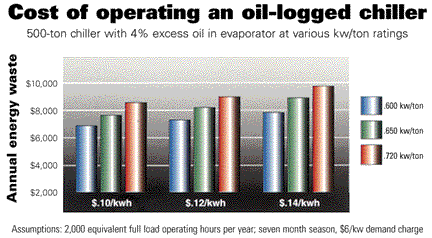
Service contractors typically remove excess oil from refrigerant during routine maintenance, and this is a time-consuming process. But when excess oil is present in an operating process chiller, the reduced efficiency that results can cost a small fortune in higher operating costs (see Table 1).
Particulates — especially rust in systems that have been shut down for some time — cause serious damage when chillers are brought back online. It plugs openings and gets into bearings, creating excess wear.
Repeated filter replacement only helps to a degree, because rust clings to surfaces and flakes off over time. Rust contamination results in reduced performance, increased energy use, and mechanical failure.
Secondary cooling agent leaks in a shell-and-tube heat exchanger are a common problem in process chillers. Chemicals can:
- Pit and corrode metal copper and brass chiller parts;
- Attack motor windings;
- Reduce chiller efficiency; and
- Create expensive disposal costs for contaminated refrigerant.
Analysis in Action
Refrigerant-side contractors now offer comprehensive, cost-effective refrigerant analysis programs that enable service contractors to monitor the condition of refrigerant in chillers and refrigeration systems, spot increasing contamination before it becomes a serious problem, have the refrigerant-side contractor perform remedial decon-tamination, and schedule maintenance for a convenient time.As part of their programs, refrigerant-side contractors provide special kits consisting of sample cylinders, detailed instructions for their use, and return packaging.
The service contractor uses the kits to draw samples from the chillers and return it for analysis. The results are stored in an analytical database; increases in any type of contamination are thus tracked.
The refrigerant-side contractor issues reports on each sample. When contamination is detected, he/she recommends remedial action using new, portable decontamination equipment. The refrigerant-side contractor performs the lion’s share of the work and the service contractor bills the client.
For example, the area service manager for a major chiller manufacturer recently asked a refrigerant-side contractor to analyze the refrigerant in two underperforming chillers. Analysis revealed the presence of both excess moisture and oil in one large chiller and high moisture in the receiver of another. He made proposals to the client based on his subcontractor’s recommendations, justifying the expense through reduced energy usage.
The client accepted. The refrigerant-side contractor performed onsite remedial decontamination. And the service contractor billed $28,000 in additional service work with little investment of his time.
Turning Water Leaks Into Profits
Because moisture in refrigerant can cause so many problems in a chiller, it is relatively easy to justify solutions to the client.In the case of a slow leak, the new decontamination technology can often be used to remove moisture from the chiller while the chiller continues to operate. This online process removes most of the troublesome moisture and restores energy efficiency. Complete dehydration can then be performed when the chiller is shut down to repair the water leak.
In both the online moisture decontamination and dehydration of the system, the refrigerant-side contractor performs virtually all of the work with oversight from the service contractor’s technical staff.
In the case of a major leak, the high speed of the new decontamination systems permits the removal of standing water, decontamination of the refrigerant, and dehydration of the chiller in a fraction of the time usually required.
Excess Oil Costs Customers a Fortune
Oil typically enters the refrigerant side when chillers operate at low loads, decreasing refrigerant pressure around seals and permitting lubricating oil to seep out.Once there, it fouls evaporator tube surfaces, reduces cooling capacity, and wastes energy.
Fortunately, the new decon-tamination technology makes oil removal easy and presents a new profit opportunity for the service contractor.
With some preparation work by service technicians, the refrigerant contractor circulates the refrigerant through the portable decontamination system at high speeds, removing all traces of oil in hours. The operation can be performed offline while the chiller is down for repairs, or online if uptime is critical.
Rust, Particulates Can Be Easily Removed
Today’s decontamination technology has also provided a new profit opportunity in particulate removal.The old method of constantly replacing filters was time-consuming for the contractor and expensive for the client. It also left particulates in the refrigerant too long, creating irreversible damage.
The new technology uses the refrigerant itself to scrub rust flakes from the inside of the chiller and remove loose particles in one process. The result is a clean chiller with no residual particles.
The refrigerant-side contractor again performs the majority of the work. The service contractor and the client both benefit.
While conversions to alternative refrigerants have become fairly routine, one area exists where the new decontamination technologies provide new service opportunities.
Removal of mineral oil lubricants has traditionally been done with repeated ester oil flushes. The speed of the new decontamination systems permits them to use the old refrigerant to perform the same procedure with no use of ester oil.
After draining the mineral oil from the sump, the refrigerant-side contractor connects his portable system to the chiller and circulates the original refrigerant through it, removing all traces of excess mineral oil from the system.
When the process is complete, the original refrigerant has been repurified and stored. The chiller is ready for installation of the new refrigerant. The client saves the expense of repeated ester oil flushes. The service contractor saves time, frees his technicians for more important work, and bills for oil removal.
How Contaminants Offer Opportunities
The procedures for removing chemical contamination vary with the contaminant.High-speed, portable decontamination systems can remove some chemicals in the same manner they decontaminate refrigerants of oil and water. But until recently, other chemicals defied decontamination solutions and caused disposal problems.
Lately, refrigerant-side contractors have formed alliances with major refrigerant manufacturers to develop new decontamination technology. These alliances have resulted in several innovative methods for dealing with difficult problems through separation technology.
Originally developed as a method of separating different refrigerants that had become mixed together, separation technology is now applied to chemically contaminated refrigerants with dramatic results.
Service contractors who offer this service can save their clients disposal fees while adding to their own bottom line.
Walter A. Phillips is vice president of marketing, Hudson Technologies Co. For more information, contact the company at 800-501-4376; 914-512-6070 (fax); www.hudsontech.com (website).
Looking for a reprint of this article?
From high-res PDFs to custom plaques, order your copy today!