Need for Humidity Control Continues to Evolve
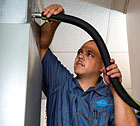
Alberto Rodriguez of Deljo Heating & Cooling (Chicago) installs a steam humidifier.
Contractors have traditionally focused on selling humidity control systems to customers based on their location and climate. This approach continues to be the norm in many regions where homeowners have long struggled with too dry/too humid air. Yet the new trends to build tighter homes and weatherize existing structures are resulting in an across-the-board, across-the-country need for humidity control. The traditional approach to selling humidity control equipment based solely on a customer’s climate is now shifting.
TRADITIONAL CLIMATE APPROACH
The conventional formula for successfully selling humidification and dehumidification equipment focuses on the customer’s location. Based on the climate of that location and - more specifically - its seasonal dew point, it was easy to predict which types of systems and equipment would be needed.Typically, dehumidifiers are sold in wetter parts of the country. According to Paul Stewart, sales/marketing/service director for Desert Aire Corp., “The popularity of dehumidification equipment is very interdependent upon the climate. For example, we expect to see higher sales in a much more humid area such as Florida as compared to a drier area like Colorado.”
In fact, the snow birds of Florida have historically been easy targets for selling dehumidifiers. “In the Southern climates, where people temporarily move from the North to the South to avoid the cold weather, the dehumidifier is extremely popular,” said Mike Rimrodt, director of marketing for Aprilaire. “These people fit the ideal consumer demographics for dehumidifiers: They enjoy warm temperatures but are sensitive to humidity. If the dehumidifier is presented properly, close rates can exceed 50 percent.”
In addition to Florida, the states in the Southeast where dehumidification equipment is prevalent include Georgia, South Carolina, North Carolina, Tennessee, Mississippi, Louisiana, and the southern regions of Texas, according to Barbara Dean-Hendricks, senior product marketing manager for IAQ products at Honeywell.
But it’s not just the South that suffers from humidity, Dean-Hendricks said. “The Northeast part of the United States also has great need for dehumidifiers. During the summer months, the humidity levels in this region are quite high, and infiltration into the home is common.”
She continued, “In the Midwest and many regions of Canada, dehumidifiers are often needed due to poor temperature control in the home. Many of these homes have basements which tend to be much cooler than the rest of the home during the hotter summer months. When the warmer air from the upstairs mixes with the cooler air of the basement, 100 percent dew point can be reached, leading to mold and odor problems in the home. Dehumidifiers are a great way of handling this issue.”
On the flipside, homes and structures may also need to add humidity when the air inside becomes too dry. According to Phil McConnell, sales consultant with Therma-Stor LLC, “In the drier parts of the country, it may be necessary to add moisture with whole-house humidifiers to maintain comfortable humidity levels.”
But according to Dean-Hendricks, the need for humidification equipment extends beyond dry areas and desert regions. “For humidification, only a select few coastal states and provinces can state that they do not need to add indoor humidity to their home,” she said, noting that the Midwest and Canada have traditionally been the primary markets for whole-house humidifiers, due to larger amounts of space to install within, as well as the longer durations of cold weather.
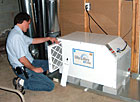
Jeff Bolton of J.R. Bolton Services (Atlanta) installs an Ultra-Aire XT 150 whole-house ventilating dehumidifier. Whole-house dehumidifiers are increasing in popularity because newer, tightly constructed homes lock in moisture.
CONSTRUCTION AND RENOVATION TRENDS
Not only are new homes and facilities being built tighter, but the increasing emphasis on retrofits and weatherization are making older structures tighter, as well.And that new tightness locks moisture into the home or building.
According to McConnell, “As homes are built tighter, they tend to trap in moisture and other contaminants that are generated in the home. This leads to poor air quality, or ‘stuffy air,’ and uncomfortable conditions.
“In addition, many ‘improvements’ made in other areas of the home may cause moisture issues where they never existed before.”
Of course, that’s not the type of thing customers want to hear. But it’s a simple fact that the trend to weatherize older structures may result in unintended consequences to their humidity level.

The popularity of dehumidification equipment has traditionally been dependent on climate. Desert Aire’s VerticalAire™ is a dedicated outdoor air system that fits within a confined mechanical room.
Dean-Hendricks added, “High relative humidity is generally created by the residents living in the home, taking showers and cooking. When a home is built tight, often there is no way for this humidity to escape, and a dehumidifier is needed.”
And that’s not all. According to Rimrodt, tight structures may alternately require humidification. “Tighter homes require humidification because of the additional ventilation required. It’s a simple fact that when cold air is warmed it requires moisture. If a humidifier is not installed, the air will take this moisture from other sources, people (dry skin), walls or floors (asset protection), and that can lead to unhealthy conditions for families and their homes and furnishings.”
The trend to make structures more airtight, therefore, presents a new and evolving market for contractors to install both dehumidification and humidification equipment.

Customer needs can best be met by matching the right technology to the application and climate. Honeywell’s TrueSTEAM humidifier can be remotely piped from a conditioned space to deliver humidity to the home without risk of the water freezing.
FINDING THE RIGHT TECHNOLOGY FIT
While selling humidifiers and dehumidifiers may now expand beyond climate-based need, contractors need to remember it is still important to match the right type of technology to the application and location. Manufacturers have created a range of products that contractors can install based on the consumer’s needs and preferences.“In both the humidification and air cleaner market, different residential building styles as well as historical buying habits at the contractor level dictate preferences,” said John Duke Riley, vice president of sales and marketing for Skuttle IAQ Products. He noted that Skuttle builds 18 different humidifier models to accommodate the range of preferences, adding that its steam series provides exceptional quality of humidification for residential applications. “Essentially the unit provides a constant supply of humidification based on the need, as opposed to bypass, drum, or spray units that rely on the furnace heat source for part of the evaporation process,” he explained.
Rimrodt said that Aprilaire recently expanded its residential humidifier offering to include steam technology. Although the company notes that evaporative humidification is still the best technology for many applications, it claims: “Steam products are ideal to fill application gaps where evaporative products cannot be installed or do not offer enough capacity because of limited furnace run times. These gaps include lack of duct space on the plenum, installs in the attic or crawl space, or homes with in-floor heat, electric strip heat, boilers, or hydronic heat.”
Aprilaire’s new steam products were developed with technology from its sister company DriSteem. According to the company, an ideal market for steam products is the Southwest where the climate has mild winters and very little call for heat, but very dry air.

Alberto Rodriguez of Deljo Heating & Cooling (Chicago) installs the dispersion tube of the new Aprilaire steam humidifier. The dispersion tube is designed to allow for drip-free transfer of steam into the air stream.
According to Therma-Stor’s McConnell, “Newer, more insulated homes also have less air conditioning run time, resulting in less drying potential. As a result, whole-house ventilating dehumidifiers have increased in popularity.” He said that Ultra-Aire’s whole-house ventilating dehumidifier provides separate ventilation, dehumidification, and filtration functions. It can be programmed to introduce outside air, which provides air change and dilutes concentration levels of indoor pollutants.
As contractors evaluate the needs of their current and future customers, it will become increasingly important for them to take into account the tightness of the home or structure, in addition to local climate and seasonal dew point, then follow up by determining the product mix that provides the customers with the best solution for humidity control to ensure customers’ satisfaction.
Publication date: 08/09/2010
Looking for a reprint of this article?
From high-res PDFs to custom plaques, order your copy today!