ACHR News
search
Ask ACHR NEWS AI
cart
facebook twitter instagram linkedin youtube
  • Sign In
  • Subscribe
  • Sign Out
  • My Account
ACHR News
  • NEWS
    • Breaking News
    • New HVAC Products
    • Featured Products
    • Manufacturer Reports
    • HVAC Data
    • Legislation
    • ACHR NEWS Centennial
  • RESIDENTIAL
    • Air Conditioners
    • Furnaces
    • Residential Heat Pumps
    • Ductless
    • Residential IAQ
    • Testing, Monitoring, Tools
    • Components & Accessories
  • COMMERCIAL
    • Air Handlers
    • Rooftop Units
    • Chillers and Cooling Towers
    • Commercial Heat Pumps
    • Boilers and Hydronics
    • VRF/Ductless
    • Commercial IAQ
  • REFRIGERATION
    • Refrigerants
    • Refrigerant Regulations
    • Leak Management
  • CONTRACTOR PRO
    • Geothermal
    • Homeowner Study
    • VRF and VRV Ductless
    • Unitary Trends
  • EDUCATION
    • Training and Education
    • Business Management
    • Service and Maintenance
    • Continuing Education
    • Market Research >
      • HVAC Brand Awareness Report
      • VRV, VRF, VRVZ Report
      • Unitary Trends Report
      • Water Heat Professionals Report
    • Webinars
    • Sponsor Insights
    • eProducts Info
    • White Papers
  • EVENTS
    • HVAC Contractor Forum
    • Industry Events and Webinars
  • MEDIA
    • Videos
    • AHR Expo 2025 Videos
    • Podcasts >
      • ACHR News Podcast
      • HARDI Podcasts
      • AHR Expo Podcasts
      • ACCA Podcasts
    • Interactive Spotlights
    • Quizzes
    • eBooks
    • HVAC Talkback
  • HVAC GROUP
    • ACHR NEWS >
      • Current Issue
      • Digital Edition
      • Subscribe
    • Distribution Trends
    • SNIPS NEWS >
      • Join SNIPS NEWS
    • Engineered Systems News >
      • Join ES News
    • HVACR Directory
    • Contests
    • Newsletters
    • Contact
    • Advertise
    • My Account

Modern VFDs Optimize Motor Operation

By Michael Burghardt
April 5, 2010
Schematic diagram of a modern drive.

Electronic speed control is increasingly being adopted for heating and ventilation systems. There is hardly a market sector that does not attempt to optimize its processes with the use of variable-frequency drives (VFDs) to operate its systems efficiently.

It was VFDs that made speed control of the inexpensive, robust, and low-maintenance three-phase induction motor standard in many applications. The availability of simple electronic speed control made possible improved product quality and better utilization of production lines.

Over the years, advances in solid-state transistors, miniaturization of components, and the advent of the microprocessor have contributed to the evolution of more compact VFDs with powerful control features, offering sophisticated motor control and high reliability.

MODERN VFD STRUCTURE

The speed of an AC induction motor is directly related to the frequency of its electrical supply and the number of electrical poles within the motor. On a 60-Hz main supply, a four-pole motor will rotate at a speed of 1,800 rpm unless some slight slip is caused by the load.

By controlling the motor with a VFD, the motor will run at a speed proportional to the input frequency provided by the drive. However, in order to generate full shaft torque, the motor input voltage must also be regulated in proportion to the frequency. For example, for a motor rated at 460V/60Hz to be run at half speed, it should be supplied at 230V/30Hz. This type of VFD, where the V/Hz ratio is maintained, is known as a voltage source inverter.

Earlier types, particularly in the high-power area, maintained the current/frequency (i/f) ratio constant and were known as current source inverters. These have largely been superseded and now, even in large-megawatt power VFDs, voltage source is state of the art.

In the VFD, the incoming AC line is first rectified to DC, which is then smoothed by an inductor/capacitor circuit and maintained at a constant level. Early VFDs affected output voltage control through controlled rectification and the DC bus was variable, but the VFD output waveform was somewhat crude.

Since the early 1990s, digital control of fast-output transistors in the power inverter section has been delivering a smooth, controlled variable voltage and variable-frequency supply to the motor, enabling smooth speed control over a wide speed range.
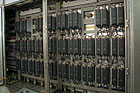
Many large factories use hundreds of VFDs for smooth control of their production lines.

CONSTANT-AMPLITUDE DC VOLTAGE

The intermediate circuit smoothes the DC voltage and compensates for load surges, such as during start-up or during sudden load changes, and acts as a buffer circuit for the energy the VFD supplies the motor. Modern drives use a DC voltage of constant amplitude. For energy storage, they typically use electrolytic capacitors that also smooth the pulsating DC voltage.

In practice, under no-load conditions, the VFD DC link voltage is typically about √2 x mains voltage. The DC link voltage drops under load but in motor regenerative operation, such as during fast deceleration of high-inertia loads, the motor feeds energy back into the intermediate circuit and the DC link voltage increases. If the voltage attempts to exceed the intermediate critical value, the VFD will either back off the deceleration ramp, or cut the supply to the motor to prevent damage.

In contrast to a purely resistive load, the capacitive smoothing of the DC link results in a non-sinusoidal voltage. This creates network effects or harmonics. In a three-phase supply, these harmonics range in frequency up to about 2 kHz. As a countermeasure, inductive chokes are fitted in series in the intermediate circuit to limit these harmonics. Another advantage of chokes in the DC link is that they smooth the charging of the capacitor and thereby extend its life.

To minimize system disturbance, some manufacturers reduce the capacitance of the intermediate circuit, or even eliminate the DC link capacitors entirely. This does not completely eliminate the line-side disturbances, but moves them to other frequency ranges (up to 10 kHz). This, however, causes problems through the reduced or lack of smoothing of the DC link voltage. Thus, only a reduced motor voltage is available at the drive output, resulting in higher currents for full-load motor operation at the same duty point, with increased motor heating.
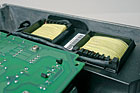
Built-in chokes reduce the line harmonic distortion and protect the dc link capacitors.

POWER INVERTER - OPTIMAL FREQUENCY CONTROL

The inverter section is the final stage in the VFD before the motor, and it is within the inverter section that the rectified DC is switched to provide an AC supply controlling both the voltage and frequency to the motor. Equally, the drive must also ensure optimum supply conditions throughout the operating range by adjusting the output voltage and frequency to meet load conditions. Controlling the ratio of output voltage to output frequency (v/f ratio) ensures optimal magnetization of the motor at all times.

The main components of the VFD are typically six insulated gate bi-polar transistors (IGBTs), arranged in pairs on three branches similar to the structure of the rectifier. These fast-operating devices switch positive and negative voltage pulses of variable width to generate a variable frequency and voltage supply.

Early VFDs used a simpler alternating method with single voltage pulses of varying amplitude, but this design required a controlled rectifier front end, generating a variable DC link, and it provided only the most basic motor speed control over a limited range.

Output voltage of sine-wave pulse-width modulation inverter.

Most modern drives operate with a diode front end and a fixed voltage DC link. Motor voltage is controlled by the length of time the DC link is connected to the motor (pulse width ratio). At the same time, the frequency is controlled by the length of time the positive and negative pulses are fed to the motor. This principle is known as pulse-width modulation.

The quality of the output waveform determines the quality of motor control and differentiates one manufacturer’s VFD from another’s. The greater the degree of motor control required, the greater the sophistication and design of the control processors and software required. Simple control will limit the performance and also increase negative aspects, such as motor heating.

Generating optimum performance requires a high degree of control complexity. Methods vary but basically break down into two groups: voltage vector control, where the voltages in the motor stator are monitored, calculated, and thus controlled; and current vector, where the rotor current is monitored and controlled.
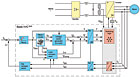
Simplified diagram of VVC+ Control.

CONTROL BOARD ENSURES RELIABILITY

The control circuit provides the intelligence to the VFD and has the following main tasks: control of the switching of the output semiconductors; data exchange between the drive and external controls; monitoring of the drive and displaying messages and relevant data; and managing protective functions for the drive and motor.

With the advent of more powerful digital processors, drives are incorporating increased control functions such as integrated power management, multiple PID controllers, and programmable logic functionality. The primary function of the control circuit, however, remains the control of motor speed and torque. The control philosophy provides for fast, accurate control of the amplitude and frequency of the voltage vector, to ensure that the motor’s magnetizing flux is optimized under all running conditions.

Publication date: 04/05/2010

Share This Story

Looking for a reprint of this article?
From high-res PDFs to custom plaques, order your copy today!


Michael Burghardt is the product manager for Danfoss GmbH.

Recommended Content

JOIN TODAY
To unlock your recommendations.

Already have an account? Sign In

  • HVAC-enrollment

    The Trades Are Back: HVACR Programs See Nearly 30% Enrollment Spike

    A new wave of future technicians is entering the pipeline.  
    Training and Education
    By: Matt Jachman
  • 2025 Top 40 Under 40

    2025 Top 40 Under 40 HVACR Professionals List

    The 11th annual Top 40 Under 40 list highlights those...
    HVAC Commercial Market
    By: Hannah Belloli-Oster
  • LG Ductless Mini-Split Systems

    The 9 Types of Heat Pumps

    As the U.S. moves toward electrification, heat pumps are...
    HVAC Commercial Market
    By: Joanna R. Turpin
Subscription Center
  • Create an Account
  • Start a Subscription
  • Manage My Account
  • Sign Up for Newsletters
  • Visit Customer Service
  • Update Preferences

More Videos

Sponsored Content

Sponsored Content is a special paid section where industry companies provide high quality, objective, non-commercial content around topics of interest to The News audience. All Sponsored Content is supplied by the advertising company and any opinions expressed in this article are those of the author and not necessarily reflect the views of The News or its parent company, BNP Media. Interested in participating in our Sponsored Content section? Contact your local rep!

close
  • Piggy Bank
    Sponsored byWatercress Financial

    Energy Prices, Inflation, and HVAC: What Today’s Homeowners Care About

  • Refrigerated Food
    Sponsored bySolstice Advanced Materials

    R-455A Refrigeration: A Cold Storage Solution for the Future

  • Airex Rooftop Units
    Sponsored byAirex Manufacturing Inc

    Consolidating Roof Penetrations: A Growing Trend in Multifamily HVAC Design

Popular Stories

HVAC-Price-Increase-graphic

HVAC Price Increase List: June 2026

Trump-Section-232.jpg

Trump Reduces Section 232 Tariffs on HVAC Equipment to 15%

Refrigerants-and-gauge.jpg

HVAC Industry Warns of Counterfeit Refrigerants Entering U.S. Supply Chain

Midea-training.jpg

HVAC Workforce Crisis Expands Beyond Technicians to Instructor Shortages

U.S. Supreme Court building

95% Furnace Efficiency Rule to Get New Hearing

View The ACHR NEWS
Centennial Anniversary Timeline

The ACHR News Timeline Chart
Submit a Letter
Submit a letter to our editors.

Events

November 6, 2025

Next-Gen Data Center Cooling: HVAC Innovation and Real-World Solutions

On Demand As AI workloads and high-density computing push traditional cooling methods to their limits, the data center industry is accelerating the adoption of next-generation HVAC technologies.

June 17, 2026

Decarbonization Without Disruption

This webinar will explore practical HVAC decarbonization strategies that minimize disruption while maximizing long-term performance and ROI.

View All Submit An Event

Poll

Summer Staff

Are you fully staffed for the summer season?
View Results Poll Archive

Products

BNI Mechanical/Electrical Square Foot Costbook, 2026 Edition

BNI Mechanical/Electrical Square Foot Costbook, 2026 Edition

See More Products
Decarbonization Without Disruption - Free Webinar - 6/17/2026

Related Articles

  • A.O.Smith to acquire MagneTek motor operation

    See More
  • Challenges With Modern VFDs

    Challenges With Modern VFDs

    See More
  • Footnote 4

    Motor Control Techniques: VFDs, ECMs, and More, Part 1

    See More

Related Products

See More Products
  • new cover.jpg

    Profit is An Attitude: The Strategies You Need to Optimize Profits

  • Modern Geothermal HVAC Engineering and Control Applications

  • HPOIS.png

    Heat Pump Operation, Installation, Service

See More Products

Events

View AllSubmit An Event
  • October 8, 2025

    Heat Rejection Solutions: Leverage Data to Optimize Design

    On Demand This webinar will present real performance data for evaporative cooling towers, closed circuit coolers, hybrids, dry, and adiabatic coolers, clarifying tradeoffs and utility impacts.
View AllSubmit An Event
×

Sign Up. Stay Informed.

The #1 trusted source for the HVACR industry since 1926

SUBSCRIBE
  • RESOURCES
    • Advertise
    • Contact Us
    • Advisory Board
    • Classifieds
    • Submit a Letter
    • Directories
    • Store
  • ACCOUNT CENTER
    • Create an Account
    • Start a Subscription
    • Manage My Account
    • Sign Up for Newsletters
    • Visit Customer Service
    • Update Preferences
  • SERVICES
    • Marketing Services
    • Reprints
    • Market Research
    • List Rental
    • Survey/Respondent Access
  • STAY CONNECTED
    • LinkedIn
    • Facebook
    • Instagram
    • YouTube
    • X (Twitter)
  • PRIVACY
    • PRIVACY POLICY
    • TERMS & CONDITIONS
    • DO NOT SELL MY PERSONAL INFORMATION
    • PRIVACY REQUEST
    • ACCESSIBILITY

Copyright ©2026. All Rights Reserved BNP Media, Inc. and BNP Media II, LLC.

Design, CMS, Hosting & Web Development :: ePublishing