ACHR News
search
Ask ACHR NEWS AI
cart
facebook twitter instagram linkedin youtube
  • Sign In
  • Subscribe
  • Sign Out
  • My Account
ACHR News
  • NEWS
    • Breaking News
    • New HVAC Products
    • Featured Products
    • Manufacturer Reports
    • HVAC Data
    • Legislation
    • ACHR NEWS Centennial
  • RESIDENTIAL
    • Air Conditioners
    • Furnaces
    • Residential Heat Pumps
    • Ductless
    • Residential IAQ
    • Testing, Monitoring, Tools
    • Components & Accessories
  • COMMERCIAL
    • Air Handlers
    • Rooftop Units
    • Chillers and Cooling Towers
    • Commercial Heat Pumps
    • Boilers and Hydronics
    • VRF/Ductless
    • Commercial IAQ
  • REFRIGERATION
    • Refrigerants
    • Refrigerant Regulations
    • Leak Management
  • CONTRACTOR PRO
    • Geothermal
    • Homeowner Study
    • VRF and VRV Ductless
    • Unitary Trends
  • EDUCATION
    • Training and Education
    • Business Management
    • Service and Maintenance
    • Continuing Education
    • Market Research >
      • HVAC Brand Awareness Report
      • VRV, VRF, VRVZ Report
      • Unitary Trends Report
      • Water Heat Professionals Report
    • Webinars
    • Sponsor Insights
    • eProducts Info
    • White Papers
  • EVENTS
    • HVAC Contractor Forum
    • Industry Events and Webinars
  • MEDIA
    • Videos
    • AHR Expo 2025 Videos
    • Podcasts >
      • ACHR News Podcast
      • HARDI Podcasts
      • AHR Expo Podcasts
      • ACCA Podcasts
    • Interactive Spotlights
    • Quizzes
    • eBooks
    • HVAC Talkback
  • HVAC GROUP
    • ACHR NEWS >
      • Current Issue
      • Digital Edition
      • Subscribe
    • Distribution Trends
    • SNIPS NEWS >
      • Join SNIPS NEWS
    • Engineered Systems News >
      • Join ES News
    • HVACR Directory
    • Contests
    • Newsletters
    • Contact
    • Advertise
    • My Account
HVAC ContractingTechnical

Laying Out Rectangular Duct Transitions

August 30, 2005
Figure 1. Transition – flat on top. (Courtesy of LAMA Books / Leo Meyer)

Transitions are needed in almost every duct run to change the size or shape of the ductwork. This article explains how to lay out rectangular transitions.


Two-Piece Transition

A duct run is often kept flat on the top to keep it against the overhead. A transition is also likely to be flat on top. If the duct is relatively small and the change is only in the height of the duct, such as a 12- x 12-inch duct changing to a 12- x 6-inch duct (Figure 1), the transition is often made in two pieces. A two-piece transition can be cut out of a sheet economically and has only two seams.


Figure 2. Patterns for two-piece transition – flat on top, shown in Figure 1. (Courtesy of LAMA Books / Leo Meyer)

Figure 2 shows the layout for the two-piece transition shown in Figure 1. The finished fitting is 14 inches long, but the bottom piece is longer than this. This is because it must be long enough to fit the slanted side of the fitting. Use dividers or a rule to transfer dimension X from the slanted side of the pattern to the straight bottom piece pattern.

Of course, allowances for seams and connections have to be added to make a complete pattern.
 

Figure 3. Four-piece transition. (Courtesy of LAMA Books / Leo Meyer)

Four-Piece Transition

More often, transitions are made in four pieces in order to save both time and sheet metal. Figure 3 shows the plan and elevation of a typical four-piece transition. Each side of this transition is different. You must learn how to lay out these transitions and how to check your layouts by matching sides.

Always lay out the patterns for each side so that the inside is the side you see. This is so the marking instructions for forming will be on the inside of the fitting when it is finished. Also, it is less confusing if you see all the patterns from the same side. To lay out the patterns with the inside up, picture yourself as being inside the fitting and looking at the side. You can then visualize whether an edge slants to the left or to the right.

The length of the finished fitting in Figure 3 is 6-1/2 inches, but none of the patterns will be 6-1/2 inches long. Because each side slants, the length of each pattern piece will be determined by the true length of the centerline of that side.

Figure 4 shows a plan view of the fitting marked to explain the layout. Each side is identified by a number. The corners are identified with letters.
 

Figure 4. Plan view used for layout for four-piece transition. (Courtesy of LAMA Books / Leo Meyer)

Lay Out Side 1

To lay out side 1:

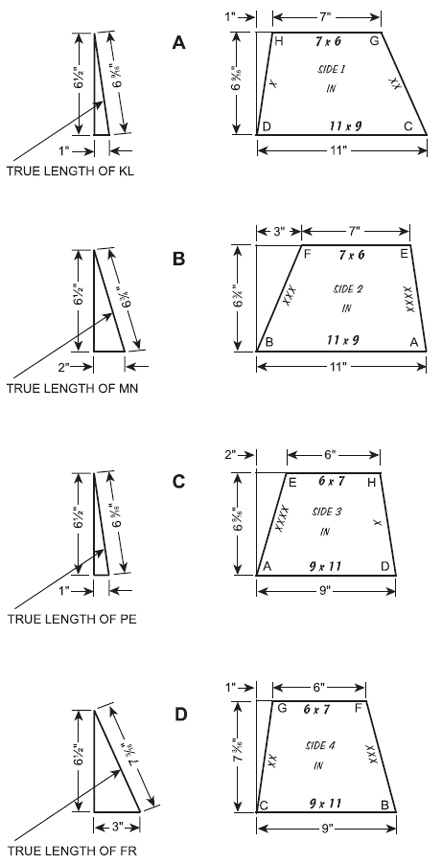
  • Draw a true length triangle (Figure 5A) to determine the true length of the centerline (KL) of Side 1 in Figure 4. Since the fitting is 6-1/2 inches (Figure 3), the true length triangle is 6-1/2 inches high. Since this side slants in 1 inch, draw a 1 inch side on the true length triangle (A in Figure 5). The third side of the triangle is the true length of line KL. By measurement on the triangle the true length is found to be 6-9/16 inches.
  • To start the layout, draw the bottom of side 1 at 11 inches (Figure 5A). This is line DC in the plan view (Figure 4). Note that D is marked on the left end of the line, since you want to see the inside of the pattern.

    Figure 5. Patterns for four-piece transition in Figure 3. (Courtesy of LAMA Books / Leo Meyer)
  • Square up a line from point D to provide a line to measure from.


  • Draw a line parallel to line DC and 6-9/16 inches above it (the true length of side 1).


  • Measure over 1 inch from the square line to establish point H, because side 3 slants in 1 inch.


  • From point H, measure 7 inches to establish point G, because the top opening is 7 inches on Side 1.


  • Draw lines DH and CG to complete the layout of Side 1.

    To complete the pattern, add allowances for seams and connectors. Mark the pattern as shown to help you keep everything straight in your head. Mark the following:


  • SIDE 1


  • IN


  • The dimensions of the top and bottom openings.


  • Any bending instructions required.


  • An X near line DH and an XX near line CG. (You will see in a bit how they are helpful in matching up corners.)

    In actual shop work, you usually won't have a plan view to work from. And once you learn the method, you won't need the letters. They are only part of the learning process. What you will generally have is a shop ticket or a sketch to work from like the one in Figure 6. As you gain experience, this is all you will need. If you have trouble visualizing the fitting, make a freehand sketch of the plan view and letter the corners.
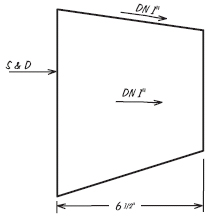
     

    Figure 6. Shop ticket for Figure 3 transition. (Courtesy of LAMA Books / Leo Meyer)

    Lay Out Side 2

    Lay out side 2 (Figure 5B) as you laid out side 1:


  • Draw a true length triangle to determine the true length of the centerline MN. Calculation shows that side 2 slants in 2 inches:

    9 - (6 + 1) = 2 inches

    The third side of the triangle is the true length of MN (by measurement, 6-3/4 inches) (Figure 5B).


  • To start the layout, draw the bottom of side 2 at 11 inches (line BA). B is on the left end to make the inside of the pattern up.


  • Square up a line from point B to provide a line to measure from.


  • Draw a line parallel to line BA and 6-3/4 inches above it (the true length of side 2).


  • Measure over 3 inches from the square line to establish point F, because side 4 slants in 3 inches:

    11 - (7 + 1) = 3 inches


  • From point F, measure 7 inches to establish point E, because the top opening is 7 inches.


  • Draw lines BF and AE to complete the layout (Figure 5B).

    Add allowances for seams and connections. Mark the pattern. Add XXX near edge BF and XXXX near edge AE.
     

    Lay Out Sides 3 And 4

    The patterns for sides 3 (Figure 5C) and 4 (Figure 5D) are laid out in the same way. Add the X marks as shown.

    Check The Patterns

    You won't have the corner letters on your pattern (they are just for explanation), so use the X marks on the edges to check the patterns and make sure the mating edges will fit together:


  • A single X was marked on edge DH on side 1 and edge DH on side 3. These two edges must fit together, so they must be the same length. If they are not, one of the patterns is wrong.


  • Edge CG on side 1 and CG on side 4 are marked XX. Check to see if these are the same length.


  • Check edges BF and AE in the same way.

    The X marks can also be used to avoid confusion when the fitting is assembled. The two edges with XXXX must be assembled together, the two edges with XXX must be assembled together, and so on.

    Excerpted and reprinted from Layout for Duct Fittings by Leo A. Meyer, one of the books in the Indoor Environment Technician's Library series published by LAMA Books. For over 30 years, Meyer has been writing and publishing training materials for the HVAC industry. His books cover a wide range of topics, including heating and cooling, indoor air quality, sheet metal work, electricity basics, safety, and others. For more information, visit www.lamabooks.com.

    Publication date: 09/05/2005

  • Looking for quick answers on air conditioning, heating and refrigeration topics? Try Ask ACHR NEWS, our new smart AI search tool. Ask ACHR NEWS →

    Share This Story

    Looking for a reprint of this article?
    From high-res PDFs to custom plaques, order your copy today!


    Recommended Content

    JOIN TODAY
    To unlock your recommendations.

    Already have an account? Sign In

    • HVAC-enrollment

      The Trades Are Back: HVACR Programs See Nearly 30% Enrollment Spike

      A new wave of future technicians is entering the pipeline.  
      News
      By: Matt Jachman
    • 2025 Top 40 Under 40

      2025 Top 40 Under 40 HVACR Professionals List

      The 11th annual Top 40 Under 40 list highlights those...
      HVAC Commercial Market
      By: Hannah Belloli-Oster
    • LG Ductless Mini-Split Systems

      The 9 Types of Heat Pumps

      As the U.S. moves toward electrification, heat pumps are...
      Air Source Heat Pumps
      By: Joanna R. Turpin
    Subscription Center
    • Create an Account
    • Start a Subscription
    • Manage My Account
    • Sign Up for Newsletters
    • Visit Customer Service
    • Update Preferences

    More Videos

    Sponsored Content

    Sponsored Content is a special paid section where industry companies provide high quality, objective, non-commercial content around topics of interest to The News audience. All Sponsored Content is supplied by the advertising company and any opinions expressed in this article are those of the author and not necessarily reflect the views of The News or its parent company, BNP Media. Interested in participating in our Sponsored Content section? Contact your local rep!

    close
    • Piggy Bank
      Sponsored byWatercress Financial

      Energy Prices, Inflation, and HVAC: What Today’s Homeowners Care About

    • Refrigerated Food
      Sponsored bySolstice Advanced Materials

      R-455A Refrigeration: A Cold Storage Solution for the Future

    • Airex Rooftop Units
      Sponsored byAirex Manufacturing Inc

      Consolidating Roof Penetrations: A Growing Trend in Multifamily HVAC Design

    Popular Stories

    HVAC-Price-Increase-graphic

    HVAC Price Increase List: June 2026

    Trump-Section-232.jpg

    Trump Reduces Section 232 Tariffs on HVAC Equipment to 15%

    R410A-Refrigerant-Cylinder.jpg

    Refrigerant Recovery is a Revenue Opportunity

    Heat-pump-cutaway.jpg

    PFAS Rules and A2L Building Codes Continue to Evolve

    Midea-training.jpg

    HVAC Workforce Crisis Expands Beyond Technicians to Instructor Shortages

    View The ACHR NEWS
    Centennial Anniversary Timeline

    The ACHR News Timeline Chart
    Submit a Letter
    Submit a letter to our editors.

    Events

    November 6, 2025

    Next-Gen Data Center Cooling: HVAC Innovation and Real-World Solutions

    On Demand As AI workloads and high-density computing push traditional cooling methods to their limits, the data center industry is accelerating the adoption of next-generation HVAC technologies.

    June 17, 2026

    Decarbonization Without Disruption

    This webinar will explore practical HVAC decarbonization strategies that minimize disruption while maximizing long-term performance and ROI.

    View All Submit An Event

    Poll

    Summer Staff

    Are you fully staffed for the summer season?
    View Results Poll Archive

    Products

    BNI Mechanical/Electrical Square Foot Costbook, 2026 Edition

    BNI Mechanical/Electrical Square Foot Costbook, 2026 Edition

    See More Products
    Decarbonization Without Disruption - Free Webinar - 6/17/2026

    Related Articles

    • Jan. 24, 2005: SMACNA Publishes New Edition Of Rectangular Duct Standards

      See More
    • Duro Dyne: Rectangular Duct Suspension System

      See More
    • Weighing the advantages of spiral vs. rectangular duct

      See More

    Related Products

    See More Products
    • 978-0-88069-028-7-228x228.jpg

      Layout for Duct Fittings

    • 1966.gif

      HVAC Duct Construction Standards - Metal and Flexible

    • 1987.gif

      HVAC Duct Systems Inspection Guide

    See More Products

    Events

    View AllSubmit An Event
    • May 21, 2026

      The A2L Genie is Out of the Refrigerant Canister – What Now?

      On Demand Join this webinar to learn about key updates to refrigerant regulations. We will cover practical installation and servicing content gathered from thousands of our interactions with contractors across the US and Canada.
    View AllSubmit An Event

    Related Directories

    • Prihoda Fabric Duct

      Prihoda fabric duct diffusers are custom UL/ULC approved air diffusion devices. Lay-in laminar flow diffusers, custom graphics/colors, hold open tensioning, nozzles, antimicrobial and spot heating/cooling.
    • EHG Duct

      EHG is a spiral duct and fitting manufacturer with representatives across the country. In addition to our superior G-3 gasketed duct system, EHG offers project management, special packaging, racking, online submittals and much more.
    ×

    Sign Up. Stay Informed.

    The #1 trusted source for the HVACR industry since 1926

    SUBSCRIBE
    • RESOURCES
      • Advertise
      • Contact Us
      • Advisory Board
      • Classifieds
      • Submit a Letter
      • Directories
      • Store
    • ACCOUNT CENTER
      • Create an Account
      • Start a Subscription
      • Manage My Account
      • Sign Up for Newsletters
      • Visit Customer Service
      • Update Preferences
    • SERVICES
      • Marketing Services
      • Reprints
      • Market Research
      • List Rental
      • Survey/Respondent Access
    • STAY CONNECTED
      • LinkedIn
      • Facebook
      • Instagram
      • YouTube
      • X (Twitter)
    • PRIVACY
      • PRIVACY POLICY
      • TERMS & CONDITIONS
      • DO NOT SELL MY PERSONAL INFORMATION
      • PRIVACY REQUEST
      • ACCESSIBILITY

    Copyright ©2026. All Rights Reserved BNP Media, Inc. and BNP Media II, LLC.

    Design, CMS, Hosting & Web Development :: ePublishing