ACHR News
search
Ask ACHR NEWS AI
cart
facebook twitter instagram linkedin youtube
  • Sign In
  • Subscribe
  • Sign Out
  • My Account
ACHR News
  • NEWS
    • Breaking News
    • New HVAC Products
    • Featured Products
    • Manufacturer Reports
    • HVAC Data
    • Legislation
    • ACHR NEWS Centennial
  • RESIDENTIAL
    • Air Conditioners
    • Furnaces
    • Residential Heat Pumps
    • Ductless
    • Residential IAQ
    • Testing, Monitoring, Tools
    • Components & Accessories
  • COMMERCIAL
    • Air Handlers
    • Rooftop Units
    • Chillers and Cooling Towers
    • Commercial Heat Pumps
    • Boilers and Hydronics
    • VRF/Ductless
    • Commercial IAQ
  • REFRIGERATION
    • Refrigerants
    • Refrigerant Regulations
    • Leak Management
  • CONTRACTOR PRO
    • Geothermal
    • Homeowner Study
    • VRF and VRV Ductless
    • Unitary Trends
  • EDUCATION
    • Training and Education
    • Business Management
    • Service and Maintenance
    • Continuing Education
    • Market Research >
      • HVAC Brand Awareness Report
      • VRV, VRF, VRVZ Report
      • Unitary Trends Report
      • Water Heat Professionals Report
    • Webinars
    • Sponsor Insights
    • eProducts Info
    • White Papers
  • EVENTS
    • HVAC Contractor Forum
    • Industry Events and Webinars
  • MEDIA
    • Videos
    • AHR Expo 2025 Videos
    • Podcasts >
      • ACHR News Podcast
      • HARDI Podcasts
      • AHR Expo Podcasts
      • ACCA Podcasts
    • Interactive Spotlights
    • Quizzes
    • eBooks
    • HVAC Talkback
  • HVAC GROUP
    • ACHR NEWS >
      • Current Issue
      • Digital Edition
      • Subscribe
    • Distribution Trends
    • SNIPS NEWS >
      • Join SNIPS NEWS
    • Engineered Systems News >
      • Join ES News
    • HVACR Directory
    • Contests
    • Newsletters
    • Contact
    • Advertise
    • My Account

Industry Sees RTUs Continue to Evolve

By Cherie Preville
June 14, 2010
George Miller checks the voltage on a newly installed rooftop unit.


Things have greatly changed in technology over the last 10 years. And while rooftop units (RTUs) and commercial air handling units (AHUs) have been around much longer than a decade, they too, continue to change. The units persist in executing their original duties, but some of the features and benefits those units provide have altered over time.

One of the biggest changes in RTUs and AHUs over the last several years is the increase in efficiency of the units. “Because of rising energy costs, there has been interest in units with higher efficiencies. Manufacturers have responded by offering construction and components that raise efficiency levels,” said Robert G. Tanner, marketing manager for air-handling systems at Johnson Controls Inc.

A variety of features contribute to making units energy efficient, such as “air handlers with lower leakage rates, various types of energy recovery, and direct-drive air foil fans,” said Skip Ernst, applied air handling marketing manager for McQuay International.

Denise Ernst, director of commercial marketing for Lennox Industries Inc., remarked on other types of equipment that add to efficiency. “Motors are much more efficient, which has made an impact on energy usage, along with the introduction of multistaged equipment.”

INSTALLING, SERVICING MADE SIMPLE

Manufacturers have not only added more-efficient components, but have made RTU and AHU equipment easier to install and service, thus more efficient for contractors.

Ted Cherubin, product marketing manager for Carrier Corp.’s Light Commercial Division, indicated that more is being added to RTUs and AHUs at the factory than previously. “There has been a trend toward integrating more factory options that are pre-engineered and certified. Air management and energy-saving devices like economizers, energy recovery wheels, smoke detectors, and ‘change filter’ switches are some of the most popular options. Essentially, the industry has taken the packaged principle to the next level.”

“Many of the features that make the systems easier to install and service also makes the systems more reliable,” said Mike Ray, manager of light commercial development for Trane Residential Solutions, a division of Ingersoll Rand.

And reliability saves time and money for the contractors through a reduction in callbacks.

Saving contractors time on a jobsite makes a project more efficient for them as well.
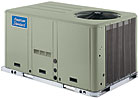
A commercial rooftop unit by American Standard Heating & Air Conditioning.

“The number of factory-installed options is probably the biggest change [in the last several years]. In many cases, we can factory-install options such as economizers and smoke detectors faster and at a lower cost than a contractor in the field. This saves them both time and money,” said Steve Spires, commercial business leader for American Standard Heating & Air Conditioning.

Denise Ernst agrees. “We [manufacturers] are improving the energy efficiency of rooftop units, simplifying installation and providing proof of system performance with features that verify the units were installed correctly and are providing the benefits they’re designed to achieve.”

Ray pointed out that a faster installation not only benefits the contractor but the end user as well. By improving “the speed of the installation of a system, then the end user will be without air conditioning or heating for a shorter amount of time,” he said. “The same is true for serviceability: make it easier to service, and the service technicians will spend less time performing their job. This in turn could reduce the service cost to the end user.”

One concrete way manufacturers have done this is to produce units that can directly replace older units. Cherubin said, “Contractors have become increasingly concerned with the amount of time and the range of expertise required when installing replacements involving add-ons.” He commented that Carrier makes sure it offers packaged products that still fit on roof curbs from the late 1980s.
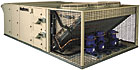
The Maverick II and RoofPak rooftop systems by McQuay can be used for 100 percent make-up air applications. The units can be equipped with 100° temperature-rise furnaces for cold-weather climates and modulating hot gas reheat to increase occupant comfort and avoid overcooling.

COMMERCIAL GREEN

The rise in perceiving value in installing green units is making headway in the RTU and AHU sector. Skip Ernst said that greener rooftop units, ones “with better efficiency and LEED-friendly features,” are trending upward right now.

Leeanne Perkins, national advertising manager for Heat Controller Inc., also observed a growth in units that are more green. “The emphasis that we’ve seen in the residential sector on energy efficiency and indoor air quality will continue to expand into the commercial equipment market. This parallels increased awareness of and interest in sustainability and LEED-rated buildings.”

Various components contribute to green equipment even by being simple to clean thereby saving energy by running properly. An example is condensing coils which are “easier for the servicer to clean. Because the [Hybrid Coil™] coil is easier to clean, the unit maintains capacity and energy efficiency - which reduces energy use in comparison to a coil that does not get as thoroughly cleaned,” Ray said.

Manufacturers are looking to fans and motors to propel their RTUs and AHUs to even greater efficiencies and greening over the next few years than the units provide today. “The greener rooftops have better EER, often use microchannel condensers due to their superior heat transfer and robust construction, and [utilize] air foil indoor fans,” said Skip Ernst.

IAQ is another attribute that manufacturers see as one of the latest developments in commercial equipment. Tanner remarked that commercial air-handling units now have “tighter casing construction to reduce air leaking out, which hurts energy efficiency, or air leaking in, which hurts air cleanliness.”

Heat Controller’s Miller installs a filter into a new rooftop unit.

WHAT THE FUTURE HOLDS

The rise in components that offer variability in speed, frequency, or the like also provide flexibility to applications. Among the current trends that Chuck Perry, commercial sales manager, Allied Air, Columbia, S.C., sees in RTUs and AHUs right now are variable-speed motors, variable-frequency drives, demand control ventilation, and IAQ.

Other features the industry will see inserted into more commercial units, according to Perkins, are “greater usage of ECM motors in HVAC equipment of all types, as well as variable-speed compressors. Microchannel coils may begin to replace the more traditional copper tube/aluminum fin coils.”

Perkins further stated that inverter technology will continue to spread from use in ductless mini-splits to other kinds of HVAC units. The technology “is proving so effective in reducing energy usage, while maintaining a high degree of comfort that we expect broader residential use, and then migration to other types of equipment, including commercial.”

Spires also foresees the increase in newer technologies in RTUs and AHUs. “I think we will continue to see increased focus on energy efficiency and indoor air quality. Variable-refrigerant flow and innovative fan motor technologies will play a large role in this,” he said.

A Trane Precedent packaged rooftop unit.

The challenge for manufacturers is to be able to achieve efficiency without the associated bigger components, thus bigger equipment. Think of the concern a few years ago over increasing the coil size (thus the equipment size) to achieve the minimum 13 SEER ratings for residential air conditioning units.

The larger, weightier packaged equipment, according to Spires, will necessitate “expensive structural changes to the roof. This creates a need for innovation which will require new materials that can reduce the weight and maintain the current footprint of these units as efficiency requirements continue to increase.”

Perry also foresees RTUs and AHUs coming on the market in the next few years that have “smaller physical dimensions and [are] more efficient.”

“Overall, the story is efficiency, reliability, flexibility, and ease of use,” summed up Denise Ernst.

Publication date: 06/14/2010

Share This Story

Looking for a reprint of this article?
From high-res PDFs to custom plaques, order your copy today!


Cherie Preville is Education and Products Editor. She can be contacted at 248-244-6496 or cheriepreville@achrnews.com.

Recommended Content

JOIN TODAY
To unlock your recommendations.

Already have an account? Sign In

  • HVAC-enrollment

    The Trades Are Back: HVACR Programs See Nearly 30% Enrollment Spike

    A new wave of future technicians is entering the pipeline.  
    News
    By: Matt Jachman
  • 2025 Top 40 Under 40

    2025 Top 40 Under 40 HVACR Professionals List

    The 11th annual Top 40 Under 40 list highlights those...
    HVAC Contracting
    By: Hannah Belloli-Oster
  • LG Ductless Mini-Split Systems

    The 9 Types of Heat Pumps

    As the U.S. moves toward electrification, heat pumps are...
    News
    By: Joanna R. Turpin
Subscription Center
  • Create an Account
  • Start a Subscription
  • Manage My Account
  • Sign Up for Newsletters
  • Visit Customer Service
  • Update Preferences

More Videos

Sponsored Content

Sponsored Content is a special paid section where industry companies provide high quality, objective, non-commercial content around topics of interest to The News audience. All Sponsored Content is supplied by the advertising company and any opinions expressed in this article are those of the author and not necessarily reflect the views of The News or its parent company, BNP Media. Interested in participating in our Sponsored Content section? Contact your local rep!

close
  • Piggy Bank
    Sponsored byWatercress Financial

    Energy Prices, Inflation, and HVAC: What Today’s Homeowners Care About

  • Refrigerated Food
    Sponsored bySolstice Advanced Materials

    R-455A Refrigeration: A Cold Storage Solution for the Future

  • Airex Rooftop Units
    Sponsored byAirex Manufacturing Inc

    Consolidating Roof Penetrations: A Growing Trend in Multifamily HVAC Design

Popular Stories

HVAC-Price-Increase-graphic

HVAC Price Increase List: June 2026

Trump-Section-232.jpg

Trump Reduces Section 232 Tariffs on HVAC Equipment to 15%

Refrigerants-and-gauge.jpg

HVAC Industry Warns of Counterfeit Refrigerants Entering U.S. Supply Chain

U.S. Supreme Court building

95% Furnace Efficiency Rule to Get New Hearing

Midea-training.jpg

HVAC Workforce Crisis Expands Beyond Technicians to Instructor Shortages

View The ACHR NEWS
Centennial Anniversary Timeline

The ACHR News Timeline Chart
Submit a Letter
Submit a letter to our editors.

Events

November 6, 2025

Next-Gen Data Center Cooling: HVAC Innovation and Real-World Solutions

On Demand As AI workloads and high-density computing push traditional cooling methods to their limits, the data center industry is accelerating the adoption of next-generation HVAC technologies.

June 17, 2026

Decarbonization Without Disruption

This webinar will explore practical HVAC decarbonization strategies that minimize disruption while maximizing long-term performance and ROI.

View All Submit An Event

Poll

Summer Staff

Are you fully staffed for the summer season?
View Results Poll Archive

Products

BNI Mechanical/Electrical Square Foot Costbook, 2026 Edition

BNI Mechanical/Electrical Square Foot Costbook, 2026 Edition

See More Products
Decarbonization Without Disruption - Free Webinar - 6/17/2026

Related Articles

  • 217-P-20097856_2.jpg

    Refrigerant Regulations Continue To Evolve

    See More
  • Ductless Systems Continue To Evolve

    See More
  • Heat-pump-cutaway.jpg

    PFAS Rules and A2L Building Codes Continue to Evolve

    See More

Related Products

See More Products
  • SMACNA-logo8.gif

    Accepted Industry Practices for Sheet Metal Lagging

See More Products

Related Directories

  • AccuraSEE Mechanical

    We develop and manufacture niche products for decentralized ventilation and air purification. Our handcrafted products are energy efficient, easily self-installed, and affordable.
  • Alliance to Save Energy

    Coalition of business, government, environmental, consumer leaders promoting the efficient and clean use of energy worldwide to benefit consumers, the environment, the economy, national security.
  • RTU Lift Systems Inc.

    RTU Lift Systems Inc. specializes in the lifting, transportation and setting of commercial rooftop HVAC systems. Simple and easy to use. Components fit through any roof hatch.
×

Sign Up. Stay Informed.

The #1 trusted source for the HVACR industry since 1926

SUBSCRIBE
  • RESOURCES
    • Advertise
    • Contact Us
    • Advisory Board
    • Classifieds
    • Submit a Letter
    • Directories
    • Store
  • ACCOUNT CENTER
    • Create an Account
    • Start a Subscription
    • Manage My Account
    • Sign Up for Newsletters
    • Visit Customer Service
    • Update Preferences
  • SERVICES
    • Marketing Services
    • Reprints
    • Market Research
    • List Rental
    • Survey/Respondent Access
  • STAY CONNECTED
    • LinkedIn
    • Facebook
    • Instagram
    • YouTube
    • X (Twitter)
  • PRIVACY
    • PRIVACY POLICY
    • TERMS & CONDITIONS
    • DO NOT SELL MY PERSONAL INFORMATION
    • PRIVACY REQUEST
    • ACCESSIBILITY

Copyright ©2026. All Rights Reserved BNP Media, Inc. and BNP Media II, LLC.

Design, CMS, Hosting & Web Development :: ePublishing