Explaining the Federal Tax Credit
While I think the new federal tax credit is being underutilized, I also feel it is a lot more complicated than what it has been portrayed in some articles. Below is my understanding of the tax credit as well as some of the pitfalls that contractors need to avoid.
The purpose of this article is to review the basics of the credit as it applies to central air conditioning and geothermal systems, review and explain the advanced main air fan, and to explain the tax credit as it applies to the consumer. It should be noted that I’m not a tax professional and that a tax professional should be consulted prior to making tax-related decisions that are not 100 percent understood.
 • Is it a tax deduction?
• Is it a refundable credit?
• Are the tax credits applicable for a new home?
• Does the tax credit carry forward?
• How does the advanced main air fan option apply?
• How does this tax credit impact a consumer’s taxes?
• Are geothermal systems treated differently, and if so, how?
As an industry, we have not done a good job explaining these issues for the consumer. Additionally, there is conflicting information posted on manufacturer, industry, and government Websites; it’s no wonder many contractors, distributors, and consumers are confused.
As defined in Internal Revenue Service (IRS) Code Section 25C, the tax credit is 30 percent of the installed cost of qualifying equipment up to a maximum of $1,500. For central air conditioners, heat pumps, and gas furnaces, the qualifying equipment must be installed between Jan. 1, 2009 and Dec. 31, 2010. These requirements are generally well understood by the industry and are not a point of controversy or misunderstanding.
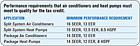
To qualify for the tax credit, central air conditioners and heat pumps must meet the highest efficiency tier established by the Consortium for Energy Efficiency (CEE), as in effect on Jan. 1, 2009. Therefore, as defined by CEE tier 3, the performance requirements are outlined in Figure 1.
For natural gas, propane, and oil furnaces, the tax code explicitly defines the requirement at an AFUE of not less than 95 percent. Additionally, the IRS code defines an advanced main air fan as qualified equipment if the fan has an annual electricity use of no more than 2 percent of the total annual site energy use of the furnace (as determined in the standard Department of Energy test procedure).
Is this a tax deduction? The short answer is no. A tax deduction is reduction in a taxpayer’s gross income resulting in a lower adjusted gross income which ultimately results in a lower tax obligation. A tax credit is quite different relative to a tax deduction.
In general, there are two types of tax credits which are refundable and nonrefundable. A refundable tax credit can reduce the amount of taxes owed by a taxpayer to below zero which essentially creates a refund for the taxpayer. Examples of refundable tax credits include the earned income credit and the additional child tax credit. A nonrefundable tax credit cannot reduce the tax owed to below zero. Therefore, a taxpayer cannot receive a refund that exceeds their tax liability.
Is it a refundable credit? For the answer to this question, we refer to the IRS Website (www.irs.gov). Below is an excerpt from this Website:
“The residential energy property tax credit is nonrefundable. A nonrefundable tax credit allows taxpayers to lower their tax liability to zero.”
Are the tax credits applicable for a new home? Referring to the IRS tax code (Section 25C) we find the following:
“The item is installed in or on a dwelling unit located in the United States and, at the time of installation, the dwelling unit is owned and used by the taxpayer as the taxpayer’s principal residence. Thus, the credit is only available for existing homes.”
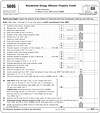
Does the tax credit carry forward? This is a good question. I was unable to find a definitive answer in the tax code or on the IRS Website. However, the 2008 IRS form 5695 (see line 28 in Figure 2), the Residential Energy Efficient Property Credit form, has a carry forward provision in the event a credit was not fully utilized in the relevant tax year. Assuming the IRS maintains this position in 2009, which I think is likely, then this credit will carry forward. However, it will not be known for sure until the 2009 form 5695 is available.
How does the advanced main air fan option apply? Initially, the advanced main air fan was a point of debate and controversy within the industry. The source of the controversy was relative to one perplexing question: Does the installed cost of an 80 percent AFUE furnace with an advanced main air fan qualify or does just the installed cost of the fan qualify? Some manufacturers’ certification statements either implied or indicated that the total cost of the furnace was applicable if a main air fan was part of the equipment. Fortunately, the IRS revised the tax code to better define this element of the tax credit. The below excerpt from IRS Section 25C clearly defines this point of controversy.
“If a natural gas, propane, or oil furnace is qualified energy property, the entire amount paid or incurred to purchase and install the furnace, including any costs attributable to the furnace’s main air circulating fan, are taken into account in determining the amount of the credit under 25C. If the furnace is not qualified energy property, but the furnace’s main air circulating fan is qualified property, only the amount paid or incurred to purchase and install the fan are taken into account in determining the amount of the credit under 25C.”
In other words, only the installation costs attributable to the advanced main air fan can be used with a furnace that is less than 95 percent AFUE. Manufacturers that interpreted this incorrectly had to backtrack and correct their certification statements. So, the million dollar question becomes, how much is the installed cost of the fan? The IRS attempted to provide some guidance with this question. Below are additional excerpts from the IRS code:
1. The amount paid or incurred to purchase and install the main air circulating fan may be determined by any method that reasonably allocates costs between the fan and other components of the furnace.
2. The manufacturer of the furnace may determine, using any reasonable method, the percentage of the cost of the furnace that is allocable to the fan and inform taxpayers of the percentage in the certification it provides under section 6 of this notice; and
3. A taxpayer may treat this percentage of the total amount paid or incurred to purchase and install the furnace as the amount paid or incurred to purchase and install the advanced main air fan.
In other words, the IRS didn’t assign a percentage or a dollar amount. They left it up to the manufacturers to define a percentage - this is unfortunate and will lead to inconsistency and confusion in the industry. It would have been better if the IRS provided more definition. Fortunately, the DOE conducted a study on this very topic. The DOE data indicates that the advanced main air fan is 31 percent of the cost of a 80 percent AFUE furnace, 23 percent of the cost of a 90 percent AFUE furnace, and 20 percent of the cost of a 92-plus percent AFUE furnace.
Utilizing this data, one can conclude the credit for an 80 percent AFUE furnace is 9.3 percent of the installed cost of the furnace (30 percent of 31 percent is 9.3 percent). And, the credit is equal to 6.9 percent and 6.0 percent of the installed cost for a 90 percent and 92.1-plus percent furnaces respectively. However, it’s up to individual manufacturers to adopt this data, which to date is occurring with some manufacturers.
 How does this tax credit impact a consumer’s taxes? As we discussed, the tax credit reduces your tax liability. The channel and consumers are confused as to what this really means. Some dealers are incorrectly informing the consumer by indicating that the credit reduces the amount owed to the IRS - this is technically not correct.
Referring to the 2008 IRS tax form 1040, line 53 is where the credit is entered from IRS form 5695 (see Figure 3). Notice that line 53 is totaled with other credits on line 55. And, line 55 is subtracted from line 46 on line 56. Line 46 is the taxpayer’s tax liability based on their adjusted gross income, and Line 56 is the taxpayer’s new tax liability after the credit.
For example, let’s assume a taxpayer’s liability is $1,000 and the taxpayer paid in $500 through their employer. Without a credit, this taxpayer would pay the IRS $500. In my example below, the taxpayer’s tax liability is recorded on line 46 ($1,000). The credit is applied on line 53 ($1,500), and totaled on line 55 with any other credits, and subtracted from line 46 on line 56. So, for my example, the taxpayers new tax liability is $0. So, this taxpayer would now receive a $500 refund.
A common mistake would be to say the taxpayer would receive a $1,000 refund ($500 left over from the credit + the $500 paid in through the employer). If this taxpayer had paid in $1,000, they would have received a $1,000 refund. It doesn’t matter what the consumer gave to the IRS through their employer withholding via their W2. The credit is applied to your tax liability, which is based on income not what is owed the IRS after subtracting what is paid through withholdings. This is the most common area of confusion.
 Are geothermal systems treated differently, and if so, how? Yes, geothermal systems are considered alternative energy equipment and are treated quite differently. The biggest difference is the removal of the cap on the amount of the credit. In other words, the credit for geothermal systems is 30 percent of the installed cost of the equipment with no cap on the credit amount (central air systems are capped at a maximum of $1,500).
The timetable for installation is also different relative to central air systems. For geothermal systems, the equipment must be placed into service between Jan. 1, 2009 and Dec. 31, 2016 (central air systems must be installed between Jan. 1, 2009 and Dec. 31, 2010). And, the last significant difference is geothermal systems installed in new homes are eligible for the tax credit. For central air systems, the credit is only applicable for existing homes. Figure 4 summarizes the minimum performance requirements for geothermal systems.
In summary, the tax credits are a great opportunity for the channel to sell up and provide a better product for the consumer. However, the tax credits are nonrefundable and they only apply to existing homes; new construction is excluded, with the exception of geothermal systems. For the advanced main air fan, most of the controversy has been resolved; it’s up to the manufacturers to clearly communicate the percentage cost relative to their respective equipment.
Publication date: 10/12/2009
The purpose of this article is to review the basics of the credit as it applies to central air conditioning and geothermal systems, review and explain the advanced main air fan, and to explain the tax credit as it applies to the consumer. It should be noted that I’m not a tax professional and that a tax professional should be consulted prior to making tax-related decisions that are not 100 percent understood.
ACT AND REACTION
On February 17, the president signed into law the American Recovery and Reinvestment Act of 2009. This new legislation has had a significant impact on the HVAC industry, and much has been written on the benefits of the new tax credits for manufacturers, distributors, contractors, and consumers. Some of these benefits include the opportunity to upsell to more efficient equipment, which is generally more profitable for the entire channel. And, the consumer not only enjoys the benefits of greater energy savings and comfort, but also a reduced initial cost due to the impact of the tax credit. However, this new legislation has also created confusion, controversy, and unanswered questions. Most of the questions are relative to how the tax credit works for the consumer, but there has also been some controversy surrounding the interpretation of the advanced main air fan option. Some of the most common questions I’ve heard include:Figure 1.
• Is it a refundable credit?
• Are the tax credits applicable for a new home?
• Does the tax credit carry forward?
• How does the advanced main air fan option apply?
• How does this tax credit impact a consumer’s taxes?
• Are geothermal systems treated differently, and if so, how?
As an industry, we have not done a good job explaining these issues for the consumer. Additionally, there is conflicting information posted on manufacturer, industry, and government Websites; it’s no wonder many contractors, distributors, and consumers are confused.
As defined in Internal Revenue Service (IRS) Code Section 25C, the tax credit is 30 percent of the installed cost of qualifying equipment up to a maximum of $1,500. For central air conditioners, heat pumps, and gas furnaces, the qualifying equipment must be installed between Jan. 1, 2009 and Dec. 31, 2010. These requirements are generally well understood by the industry and are not a point of controversy or misunderstanding.
To qualify for the tax credit, central air conditioners and heat pumps must meet the highest efficiency tier established by the Consortium for Energy Efficiency (CEE), as in effect on Jan. 1, 2009. Therefore, as defined by CEE tier 3, the performance requirements are outlined in Figure 1.
For natural gas, propane, and oil furnaces, the tax code explicitly defines the requirement at an AFUE of not less than 95 percent. Additionally, the IRS code defines an advanced main air fan as qualified equipment if the fan has an annual electricity use of no more than 2 percent of the total annual site energy use of the furnace (as determined in the standard Department of Energy test procedure).
Figure 2.
UNDERSTANDING THE TAX CREDIT
Let’s look at some of the common questions concerning this tax credit and what the IRS says on these topics.Is this a tax deduction? The short answer is no. A tax deduction is reduction in a taxpayer’s gross income resulting in a lower adjusted gross income which ultimately results in a lower tax obligation. A tax credit is quite different relative to a tax deduction.
In general, there are two types of tax credits which are refundable and nonrefundable. A refundable tax credit can reduce the amount of taxes owed by a taxpayer to below zero which essentially creates a refund for the taxpayer. Examples of refundable tax credits include the earned income credit and the additional child tax credit. A nonrefundable tax credit cannot reduce the tax owed to below zero. Therefore, a taxpayer cannot receive a refund that exceeds their tax liability.
Is it a refundable credit? For the answer to this question, we refer to the IRS Website (www.irs.gov). Below is an excerpt from this Website:
“The residential energy property tax credit is nonrefundable. A nonrefundable tax credit allows taxpayers to lower their tax liability to zero.”
Are the tax credits applicable for a new home? Referring to the IRS tax code (Section 25C) we find the following:
“The item is installed in or on a dwelling unit located in the United States and, at the time of installation, the dwelling unit is owned and used by the taxpayer as the taxpayer’s principal residence. Thus, the credit is only available for existing homes.”
Does the tax credit carry forward? This is a good question. I was unable to find a definitive answer in the tax code or on the IRS Website. However, the 2008 IRS form 5695 (see line 28 in Figure 2), the Residential Energy Efficient Property Credit form, has a carry forward provision in the event a credit was not fully utilized in the relevant tax year. Assuming the IRS maintains this position in 2009, which I think is likely, then this credit will carry forward. However, it will not be known for sure until the 2009 form 5695 is available.
How does the advanced main air fan option apply? Initially, the advanced main air fan was a point of debate and controversy within the industry. The source of the controversy was relative to one perplexing question: Does the installed cost of an 80 percent AFUE furnace with an advanced main air fan qualify or does just the installed cost of the fan qualify? Some manufacturers’ certification statements either implied or indicated that the total cost of the furnace was applicable if a main air fan was part of the equipment. Fortunately, the IRS revised the tax code to better define this element of the tax credit. The below excerpt from IRS Section 25C clearly defines this point of controversy.
“If a natural gas, propane, or oil furnace is qualified energy property, the entire amount paid or incurred to purchase and install the furnace, including any costs attributable to the furnace’s main air circulating fan, are taken into account in determining the amount of the credit under 25C. If the furnace is not qualified energy property, but the furnace’s main air circulating fan is qualified property, only the amount paid or incurred to purchase and install the fan are taken into account in determining the amount of the credit under 25C.”
In other words, only the installation costs attributable to the advanced main air fan can be used with a furnace that is less than 95 percent AFUE. Manufacturers that interpreted this incorrectly had to backtrack and correct their certification statements. So, the million dollar question becomes, how much is the installed cost of the fan? The IRS attempted to provide some guidance with this question. Below are additional excerpts from the IRS code:
1. The amount paid or incurred to purchase and install the main air circulating fan may be determined by any method that reasonably allocates costs between the fan and other components of the furnace.
2. The manufacturer of the furnace may determine, using any reasonable method, the percentage of the cost of the furnace that is allocable to the fan and inform taxpayers of the percentage in the certification it provides under section 6 of this notice; and
3. A taxpayer may treat this percentage of the total amount paid or incurred to purchase and install the furnace as the amount paid or incurred to purchase and install the advanced main air fan.
In other words, the IRS didn’t assign a percentage or a dollar amount. They left it up to the manufacturers to define a percentage - this is unfortunate and will lead to inconsistency and confusion in the industry. It would have been better if the IRS provided more definition. Fortunately, the DOE conducted a study on this very topic. The DOE data indicates that the advanced main air fan is 31 percent of the cost of a 80 percent AFUE furnace, 23 percent of the cost of a 90 percent AFUE furnace, and 20 percent of the cost of a 92-plus percent AFUE furnace.
Utilizing this data, one can conclude the credit for an 80 percent AFUE furnace is 9.3 percent of the installed cost of the furnace (30 percent of 31 percent is 9.3 percent). And, the credit is equal to 6.9 percent and 6.0 percent of the installed cost for a 90 percent and 92.1-plus percent furnaces respectively. However, it’s up to individual manufacturers to adopt this data, which to date is occurring with some manufacturers.
Figure 3.
Referring to the 2008 IRS tax form 1040, line 53 is where the credit is entered from IRS form 5695 (see Figure 3). Notice that line 53 is totaled with other credits on line 55. And, line 55 is subtracted from line 46 on line 56. Line 46 is the taxpayer’s tax liability based on their adjusted gross income, and Line 56 is the taxpayer’s new tax liability after the credit.
For example, let’s assume a taxpayer’s liability is $1,000 and the taxpayer paid in $500 through their employer. Without a credit, this taxpayer would pay the IRS $500. In my example below, the taxpayer’s tax liability is recorded on line 46 ($1,000). The credit is applied on line 53 ($1,500), and totaled on line 55 with any other credits, and subtracted from line 46 on line 56. So, for my example, the taxpayers new tax liability is $0. So, this taxpayer would now receive a $500 refund.
A common mistake would be to say the taxpayer would receive a $1,000 refund ($500 left over from the credit + the $500 paid in through the employer). If this taxpayer had paid in $1,000, they would have received a $1,000 refund. It doesn’t matter what the consumer gave to the IRS through their employer withholding via their W2. The credit is applied to your tax liability, which is based on income not what is owed the IRS after subtracting what is paid through withholdings. This is the most common area of confusion.
Figure 4.
The timetable for installation is also different relative to central air systems. For geothermal systems, the equipment must be placed into service between Jan. 1, 2009 and Dec. 31, 2016 (central air systems must be installed between Jan. 1, 2009 and Dec. 31, 2010). And, the last significant difference is geothermal systems installed in new homes are eligible for the tax credit. For central air systems, the credit is only applicable for existing homes. Figure 4 summarizes the minimum performance requirements for geothermal systems.
In summary, the tax credits are a great opportunity for the channel to sell up and provide a better product for the consumer. However, the tax credits are nonrefundable and they only apply to existing homes; new construction is excluded, with the exception of geothermal systems. For the advanced main air fan, most of the controversy has been resolved; it’s up to the manufacturers to clearly communicate the percentage cost relative to their respective equipment.
Publication date: 10/12/2009
Looking for a reprint of this article?
From high-res PDFs to custom plaques, order your copy today!


