ACHR News
search
Ask ACHR NEWS AI
cart
facebook twitter instagram linkedin youtube
  • Sign In
  • Subscribe
  • Sign Out
  • My Account
ACHR News
  • NEWS
    • Breaking News
    • New HVAC Products
    • Featured Products
    • Manufacturer Reports
    • HVAC Data
    • Legislation
    • ACHR NEWS Centennial
  • RESIDENTIAL
    • Air Conditioners
    • Furnaces
    • Residential Heat Pumps
    • Ductless
    • Residential IAQ
    • Testing, Monitoring, Tools
    • Components & Accessories
  • COMMERCIAL
    • Air Handlers
    • Rooftop Units
    • Chillers and Cooling Towers
    • Commercial Heat Pumps
    • Boilers and Hydronics
    • VRF/Ductless
    • Commercial IAQ
  • REFRIGERATION
    • Refrigerants
    • Refrigerant Regulations
    • Leak Management
  • CONTRACTOR PRO
    • Geothermal
    • Homeowner Study
    • VRF and VRV Ductless
    • Unitary Trends
  • EDUCATION
    • Training and Education
    • Business Management
    • Service and Maintenance
    • Continuing Education
    • Market Research >
      • HVAC Brand Awareness Report
      • VRV, VRF, VRVZ Report
      • Unitary Trends Report
      • Water Heat Professionals Report
    • Webinars
    • Sponsor Insights
    • eProducts Info
    • White Papers
  • EVENTS
    • HVAC Contractor Forum
    • Industry Events and Webinars
  • MEDIA
    • Videos
    • AHR Expo 2025 Videos
    • Podcasts >
      • ACHR News Podcast
      • HARDI Podcasts
      • AHR Expo Podcasts
      • ACCA Podcasts
    • Interactive Spotlights
    • Quizzes
    • eBooks
    • HVAC Talkback
  • HVAC GROUP
    • ACHR NEWS >
      • Current Issue
      • Digital Edition
      • Subscribe
    • Distribution Trends
    • SNIPS NEWS >
      • Join SNIPS NEWS
    • Engineered Systems News >
      • Join ES News
    • HVACR Directory
    • Contests
    • Newsletters
    • Contact
    • Advertise
    • My Account

Evap Tube Results In Ammonia Leak
January 23, 2006
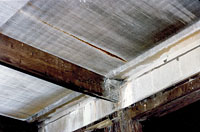
FIGURE 1. The discolored area shows the source of the evaporator’s leak.
As a mechanical system failure analyst, I recently came across a cold storage facility that suffered a major ammonia leak from its refrigeration system, destroying a large crop of bare root roses. The leak was isolated to an evaporator coil located in a 6,000-square-foot cold storage room identified as precooler room number 3 (P-3). The room has a total volume of 120,000 cubic feet, and is one of 12 such rooms in the building. The subject evaporator had been in service for about six years.

The refrigeration system's evaporators were located in small rooms, or annexes, adjacent to the storage rooms. The evaporators were manufactured from aluminum tubes, welded at their ends to form U-bends. Fans circulated cold air between the small evaporator annex rooms and the storage rooms.

The ammonia leak was observed to originate from the evaporator coils in the annex to room P-3. Figure 1 shows the evaporator that had been leaking; the discolored area had been indicated as the source of the leak. The evaporator in the P-3 annex had been in operation for about six years.

Other areas of discoloration on the evaporator coils and fins appeared to be less recent. These marks seem to have been caused by corrosion of steel components above the aluminum evaporator coils.

The operator of the cold storage facility said that a previous failure had occurred in this coil. The failure, he said, was caused by a fan separating from its housing, striking the coils. The repair consisted of plugging the damaged tubes. It is not known when this failure and repair occurred within the lifetime of the evaporator.

The general area of the ammonia leak was identified during an initial inspection of the coil in place; however, the faulty tube could not be identified. We recommended that the coil be removed from the system and leak tested.
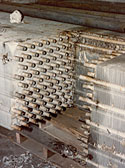
FIGURE 2. A 20- by 20-inch full-thickness section of the coil was removed for further disassembly to find the origin of the leak.

LEAK TESTING

The subject evaporator coil was removed from the annex of P-3. It measured 18 feet long by 8 feet wide by 2 feet high. The coil was made of 3/4 inch outside diameter aluminum tubes.

The wall thickness of the tubes measured 0.05 inches thick. Initial leak testing to a pressure of 250 psig revealed the presence of a leak four feet from the end. So, we removed a 20- by 20-inch full-thickness section of the coil for further disassembly to find the origin of the leak, (Figure 5). We disassembled the removed section and performed further testing of the individual tubes; that testing revealed no leak.

It did, however, reveal that five of the 80 aluminum tubes in the removed section were sleeved. The internal tubes measured 5/8 inch outside diameter, and were also made of aluminum. The sleeved tubes appeared to be discontinuous; they did not run the entire length of the evaporator, and it looked like they were made up of one or more shorter-length sections. The sleeve sections were neither sealed to each other nor to the inner tube, and a small gap existed between their ends.
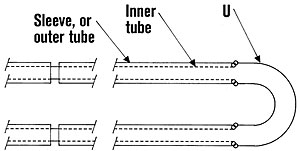
FIGURE 3. Schematic drawing of a typical sleeved tube; it consists of an outer tube or sleeve constructed in two or more sections.
The reported location of the leak matched one of these discontinuities where one section of sleeve tube ended and another one started.

Figure 3 shows a schematic drawing of a typical sleeved tube; it consists of an outer tube or sleeve constructed in two or more sections, as previously described. The inner tube is continuous and of a smaller diameter than the outer tube. The sleeve and inner tube are welded together only at each end of the evaporator to a U-shaped piece (Figure 4).

Looking for quick answers on air conditioning, heating and refrigeration topics? Try Ask ACHR NEWS, our new smart AI search tool. Ask ACHR NEWS →
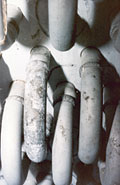
FIGURE 4. The sleeve and inner tube are welded together at each end of the evaporator to a U-shaped piece.
A field inspection of the remaining portion of the evaporator confirmed the locations of the sleeved tubes. A total of five such tubes were discovered in the area where the section had been removed.

We further examined the tubes, and found abnormal bulging of each outer tube at its intersection with the U-bend at one end of the evaporator (Figure 7). We conducted on-site leak testing of the evaporator to determine the precise location of the leak. This required repairing the previously cut section, and ultimately proved to be difficult and inconclusive.

We needed to remove a second section of the evaporator containing the U-bends and bulged tubes. This section was taken to the lab for further examination and testing. Figure 5 shows the location of the second removed section.

FIGURE 5. The location of the second removed section.

LAB TESTING

The second removed section, as mentioned, included the U-bends. The bulged tubes were numbered for identification.
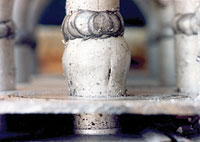
  • Examination of Tube 3 revealed a crack on the outer tube (Figure 6). This crack would not affect the integrity of the system.

  • We leak tested each tube, which revealed a leak in Tube 4; none of the other deformed tubes exhibited a leak that would compromise the system integrity. Tube 3 is joined to the same U-bend as Tube 4. Sectioning of Tube 4 revealed a crack in the weld between the sleeved tube and the mating U-bend, as well as severe radial deformation of the inner tube.

    FIGURE 6. A crack on the outer tube was found on Tube 3.
    Figure 7 shows the sectioning of Tubes 3 and 4 and their associated U-bend. Figure 8 shows the weld fracture and leak.

    The weld fracture in the subject tube and U-bend does violate the integrity of the system, and would permit an ammonia leak at this location. The leak however would not be evident at the location of the fracture because of the surrounding outer tube or sleeve. The ammonia would find its way to the gap between the outer tubes, and appear as a leak here, four feet away from the actual fracture.

    The leak rate for the fracture was measured, then plotted versus pressure. At 250 psig, the predicted leak rate is 4.3 cfm. This is a significant leak rate, and is consistent with the reported damage.

    FIGURE 7. Sections of Tubes 3 and 4 and their associated U-bends.

    THE FRACTURE SURFACE

    The fracture surface of the tube and U-bend was further sectioned and mounted for microscopic examination. Examination of the fracture surface with a scanning electron microscope revealed the presence of ductile dimples, suggesting that the fracture mode was mechanical overload and not progressive fatigue damage or corrosion. Further examination of the fracture also revealed the presence of minor porosity in the weld. The porosity likely did not contribute to the failure.

    The ammonia leak in the subject evaporator originated at a weld between a sleeved tube and its matching U-bend at the end of an evaporator unit. The leak was due to a weld fracture that showed evidence of mechanical overload.

    Based on the knowledge that the evaporator is used in a water vapor environment, water condensing on the tubes and turning to ice during normal operation melts during a refrigeration shutdown or defrost cycle. Reportedly the defrost cycle is conducted manually, and water is also sprayed on the evaporator tubes to accelerate the process. Water, either from melting ice or spray likely entered between the walls of the sleeved tubes at the sleeve junction, and migrated to the weld area. When the refrigeration cycle started over, the water collected near the weld, froze, and expanded in the restricted area.

    FIGURE 8. The weld fracture and leak.
    The adjacent weld suffered from the excessive load until it failed, allowing the refrigerant to leak and exit the evaporator at the junction between the outer sleeves - the same location where the water entered, causing the tube and weld damage.

    Did those rose roots have to die? Probably not. This condition was allowed to exist because of the gap between the two adjacent sleeve sections. The use of this two-section sleeve during the construction and fabrication of the evaporator was the initiating cause of the weld failure and subsequent ammonia leak.

    The use of the two-section sleeve for use in a water vapor environment is not appropriate. It promotes the trapping of water between the sleeves. When the trapped water freezes, it creates enough force to rupture the tubes and produce a refrigerant leak.

    Dirk H. Duffner, P.E., is a founder and one of the managing members of Principia Engineering Services, San Francisco, Calif. He specializes in failure analyses of materials and mechanical systems, focusing on determining the root cause of failures in a wide variety of products. He may be reached at dduffner@principia-eng.com.

    Publication date: 01/23/2006

  • Share This Story

    Looking for a reprint of this article?
    From high-res PDFs to custom plaques, order your copy today!


    Recommended Content

    JOIN TODAY
    To unlock your recommendations.

    Already have an account? Sign In

    • HVAC-enrollment

      The Trades Are Back: HVACR Programs See Nearly 30% Enrollment Spike

      A new wave of future technicians is entering the pipeline.  
      News
      By: Matt Jachman
    • 2025 Top 40 Under 40

      2025 Top 40 Under 40 HVACR Professionals List

      The 11th annual Top 40 Under 40 list highlights those...
      News
      By: Hannah Belloli-Oster
    • LG Ductless Mini-Split Systems

      The 9 Types of Heat Pumps

      As the U.S. moves toward electrification, heat pumps are...
      HVAC Residential Market
      By: Joanna R. Turpin
    Subscription Center
    • Create an Account
    • Start a Subscription
    • Manage My Account
    • Sign Up for Newsletters
    • Visit Customer Service
    • Update Preferences

    More Videos

    Sponsored Content

    Sponsored Content is a special paid section where industry companies provide high quality, objective, non-commercial content around topics of interest to The News audience. All Sponsored Content is supplied by the advertising company and any opinions expressed in this article are those of the author and not necessarily reflect the views of The News or its parent company, BNP Media. Interested in participating in our Sponsored Content section? Contact your local rep!

    close
    • Piggy Bank
      Sponsored byWatercress Financial

      Energy Prices, Inflation, and HVAC: What Today’s Homeowners Care About

    • Refrigerated Food
      Sponsored bySolstice Advanced Materials

      R-455A Refrigeration: A Cold Storage Solution for the Future

    • Airex Rooftop Units
      Sponsored byAirex Manufacturing Inc

      Consolidating Roof Penetrations: A Growing Trend in Multifamily HVAC Design

    Popular Stories

    Refrigerants-and-gauge.jpg

    HVAC Industry Warns of Counterfeit Refrigerants Entering U.S. Supply Chain

    Data_Center_facility.jpg

    HVAC Manufacturers Respond to Growing Data Center Backlash

    Lennox equipment

    Platinum Equity to Sell Heat Controller to Lennox

    HVAC Minute retail refrigeration system

    EPA Final Rule’s Impact on R-410A Deadlines

    HVAC-tech-van.jpg

    Report: Only 65% of HVAC Technician Time is Billable Hours

    View The ACHR NEWS
    Centennial Anniversary Timeline

    The ACHR News Timeline Chart
    Submit a Letter
    Submit a letter to our editors.

    Events

    November 6, 2025

    Next-Gen Data Center Cooling: HVAC Innovation and Real-World Solutions

    On Demand As AI workloads and high-density computing push traditional cooling methods to their limits, the data center industry is accelerating the adoption of next-generation HVAC technologies.

    July 28, 2026

    How Top Home Services Companies Turn Every Conversation Into Predictable Revenue

    In this webinar, we'll outline how top contractors are turning every conversation into predictable revenue by coaching every comfort advisor visit, not just the ones a manager rides along on.

    View All Submit An Event

    Poll

    Summer Staff

    Are you fully staffed for the summer season?
    View Results Poll Archive

    Products

    BNI Mechanical/Electrical Square Foot Costbook, 2026 Edition

    BNI Mechanical/Electrical Square Foot Costbook, 2026 Edition

    See More Products
    Designing Systems Using A2L Refrigerant - Free Webinar - 7/22/2026

    Related Articles

    • What caused the ammonia leak?

      See More
    • Ammonia Leak From Rail Car Puzzles Troubleshooters

      See More
    • Dec. 1, 2004: Ammonia Leak Contained At Iowa Food Plant

      See More

    Related Products

    See More Products
    • The ACHR News - July 28, 2025

      ACHR NEWS July 28, 2025, Issue

    • EHEP002028.jpg

      Principles of Heating, Ventilation, and Air Conditioning in Buildings, 1st Edition

    • 0880690186-228x228.jpg

      Airflow in Ducts

    See More Products

    Events

    View AllSubmit An Event
    • December 11, 2025

      HVAC Unitary Market Study Results

      On Demand In this webinar, we will do a deep dive into the trends that emerged from the 2025 HVAC Unitary Market Study.  
    View AllSubmit An Event

    Related Directories

    • Spectronics Corp./Spectroline Leak Detection

      Established in 1955, Spectronics Corporation is the inventor of UV fluorescent leak detection technology and manufacturer of leak detection tools for AC&R systems. Our fluorescent dyes and system additives are OEM-grade, universal (POE), co-solvent free, and NSF-certified.
    ×

    Sign Up. Stay Informed.

    The #1 trusted source for the HVACR industry since 1926

    SUBSCRIBE
    • RESOURCES
      • Advertise
      • Contact Us
      • Advisory Board
      • Classifieds
      • Submit a Letter
      • Directories
      • Store
    • ACCOUNT CENTER
      • Create an Account
      • Start a Subscription
      • Manage My Account
      • Sign Up for Newsletters
      • Visit Customer Service
      • Update Preferences
    • SERVICES
      • Marketing Services
      • Reprints
      • Market Research
      • List Rental
      • Survey/Respondent Access
    • STAY CONNECTED
      • LinkedIn
      • Facebook
      • Instagram
      • YouTube
      • X (Twitter)
    • PRIVACY
      • PRIVACY POLICY
      • TERMS & CONDITIONS
      • DO NOT SELL MY PERSONAL INFORMATION
      • PRIVACY REQUEST
      • ACCESSIBILITY

    Copyright ©2026. All Rights Reserved BNP Media, Inc. and BNP Media II, LLC.

    Design, CMS, Hosting & Web Development :: ePublishing