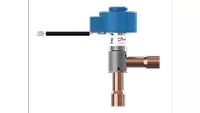
Electric Expansion Valve Control
The electric expansion valve (EXV) has the ability to follow load, in most cases, from about 5 to 115 percent of nominal load.
In addition, flash gas in the liquid line is less damaging to the operation of the system because the relatively large port and large stroke of the EXV allows them to open wide, purge the flash gas, and then re-establish the desired superheat. The advantages of the EXV are clear, but since the valve is an electric component, it requires some form of electric or electronic control.

Click on the schematic for an enlarged view.
ELECTRONICS
Controllers for EXVs are becoming common and generally work in similar ways. Although electric, the EXV is still an expansion valve. As such, it should be used to control superheat. Controllers allow the EXV to do this by measuring the two components of superheat: pressure and temperature.
Standard calculations of superheat are all the same, whether done by a technician in the field or an electronic controller. The pressure in the suction line, just after the evaporator, is measured. This pressure is converted to a saturation temperature by the use of a pressure-temperature chart for the refrigerant used. This saturated temperature is compared with the actual temperature measured on the suction line, also near the outlet of the evaporator. The difference between these two temperatures is the operating superheat.

Click on the chart for an enlarged view.
SENSORS
The electronic controller (shown in a common installation in Figure 1) fulfills this same function by using electronic sensors.The sensors involved are pressure transducers and temperature sensors. A pressure transducer is a small, sealed device that is often mounted onto a tap on the suction line. Most are supplied with a valve depressor feature so that they may be threaded onto a Schrader tap. They may then be removed for service without having to pump down and reclaim the system charge. The pressure transducer is normally a three-wire device, two for power and one for signal.
The controller supplies the necessary power and reads the signal. This electrical signal is converted back to pressure by the controller, which stores an equation to do so. The equation is effective only for a specific brand and model of transducer, so replacements must be obtained from the manufacturer of the controller. This equation is then combined with a reference table or pressure temperature table stored in the controller for the system refrigerant. (Sporlan controllers are often equipped with three to five refrigerant tables so that they may be selected in the field. This feature allows one controller to be used in a number of applications and to be reconfigured if the system refrigerant is changed.)
The temperature transducer, usually called a temperature sensor, is typically a device that varies resistance with temperature. There are a variety of types, NTC are negative temperature coefficient types and the resistance decreases with a rise in sensed temperature.
Another common type is the positive temperature coefficient type (PTC). In the PTC the resistance rises with temperature increases. The actual temperature to resistance characteristic is also unique to a manufacturer and model and sensors are not interchangeable; replacements must also be obtained from the controller supplier. The resistance of the temperature sensor is converted to a temperature inside the controller and this is compared to the temperature calculated from the pressure reading and refrigerant table (Figure 2).
Looking for quick answers on air conditioning, heating and refrigeration topics? Try Ask ACHR NEWS, our new smart AI search tool. Ask ACHR NEWS
Although complex to describe, the preceding calculations are straightforward and relatively easy to program into the controller. The difficult part of programming has to do with using this superheat information to modulate the valve position. (Although a number of EXV technologies have been used, step motors are being recognized as the most precise and reliable means of valve operation. The balance of this article is based on that type.)
The instructions the controller uses to arrive at valve position and modulation are called the "algorithm" and are generally proprietary information to the controller manufacturer. However, each algorithm looks at operating superheat and compares it to the superheat set point chosen by the user. If the superheat is higher than desired, the controller steps the valve open by the number of steps calculated by the algorithm. If the superheat is low or flood back occurs, the valve is rapidly driven shut by the algorithm.
Since the pressure and temperature sensors can react almost immediately to changes, the controller can follow, and in some cases predict changes in superheat quickly and react. This speed and accuracy allows the EXV-controller-sensor system to precisely, quickly, and reliably control superheat to the most efficient setting under a wide set of loads and system conditions. The EXVs have no diaphragms and therefore no "gradient" or unpredictable variation in operation.
Historically, when EXVs were applied, they were on stand-alone systems, they did not communicate with other parts of the system or attempt to control other functions. They have performed the duty well and, as time went on, more economically. The power of microprocessors or computer "chips" double every 18 months and most of our industry has been slow to take advantage of these possibilities. While standalone EXV systems now approach the installed cost of a mechanically-based TXV system, to only consider this type of control is shortsighted and wasteful.
POTENTIAL BENEFITS
Most current applications at worst ignore and at best under-utilize the potential benefits that electronic control can bring. Our industry is one of temperature control and most aspects of design and service are based on, or strongly require, measurements of pressure and temperature.By its very nature, the EXV must have sensors that gather and interpret these measurements. Since that data exists and is captured by the controller, doesn't it make sense to use that information as much as possible? This not only simplifies the system but also spreads the cost of the electronics and sensors over a wider range of features and system needs. For instance, condenser fans may be cycled to maintain head pressure and liquid subcooling.
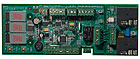
The need for subcooling affects system and expansion valve efficiency. What if the electronic controller (Figure 3) controls the condenser fans to ensure that the expansion valve is fed with the solid liquid it needs, while at the same time, allowing head pressure to float to the lowest possible level. Some controllers may be supplied with "stock" programs that offer a set group of features.
Other controllers may be supplied with customer-specific programming tailored to the precise need of the customer. The technology of electronics allows for economical program updates and the addition of features even after system installation. The gains in system efficiency due to floating head pressure are well documented. The incremental cost of adding this feature to an EXV controller is low. Efficiency of refrigeration applications, particularly low-temperature installations, benefit from both lower head pressures and higher suction pressures. Since EXVs may be oversized without sacrificing control at low loads, extremely rapid pull downs after defrost or at startup may be realized by using large EXVs to saturate the evaporator when the load is highest.
A further benefit of the electronic controllers is the possibility to incorporate system diagnostics and remote communication. The controllers are equipped with a number of sensors, and algorithms that are under development that will use this information to signal, or even predict, system problems. Users may then be alerted to potential failures.
In the near future we will likely see controllers that are Web-enabled. These devices can be monitored by the homeowner, contractor or electric utility to ensure efficiency and accuracy.
For more information, go to www.sporlan.com.
Publication date: 11/06/2006
Looking for a reprint of this article?
From high-res PDFs to custom plaques, order your copy today!