ACHR News
search
Ask ACHR NEWS AI
cart
facebook twitter instagram linkedin youtube
  • Sign In
  • Subscribe
  • Sign Out
  • My Account
ACHR News
  • NEWS
    • Breaking News
    • New HVAC Products
    • Featured Products
    • Manufacturer Reports
    • HVAC Data
    • Legislation
    • ACHR NEWS Centennial
  • RESIDENTIAL
    • Air Conditioners
    • Furnaces
    • Residential Heat Pumps
    • Ductless
    • Residential IAQ
    • Testing, Monitoring, Tools
    • Components & Accessories
  • COMMERCIAL
    • Air Handlers
    • Rooftop Units
    • Chillers and Cooling Towers
    • Commercial Heat Pumps
    • Boilers and Hydronics
    • VRF/Ductless
    • Commercial IAQ
  • REFRIGERATION
    • Refrigerants
    • Refrigerant Regulations
    • Leak Management
  • CONTRACTOR PRO
    • Geothermal
    • Homeowner Study
    • VRF and VRV Ductless
    • Unitary Trends
  • EDUCATION
    • Training and Education
    • Business Management
    • Service and Maintenance
    • Continuing Education
    • Market Research >
      • HVAC Brand Awareness Report
      • VRV, VRF, VRVZ Report
      • Unitary Trends Report
      • Water Heat Professionals Report
    • Webinars
    • Sponsor Insights
    • eProducts Info
    • White Papers
  • EVENTS
    • HVAC Contractor Forum
    • Industry Events and Webinars
  • MEDIA
    • Videos
    • AHR Expo 2025 Videos
    • Podcasts >
      • ACHR News Podcast
      • HARDI Podcasts
      • AHR Expo Podcasts
      • ACCA Podcasts
    • Interactive Spotlights
    • Quizzes
    • eBooks
    • HVAC Talkback
  • HVAC GROUP
    • ACHR NEWS >
      • Current Issue
      • Digital Edition
      • Subscribe
    • Distribution Trends
    • SNIPS NEWS >
      • Join SNIPS NEWS
    • Engineered Systems News >
      • Join ES News
    • HVACR Directory
    • Contests
    • Newsletters
    • Contact
    • Advertise
    • My Account

Ductwork Problems Cause Issues With Airflow

By Joanna R. Turpin
July 21, 2005
There's no question that flexible duct has revolutionized the HVAC industry. The advent of flex duct meant that contractors could dramatically reduce the amount of time and skill it takes to install a duct system. Not to mention that flex duct costs significantly less than other types of duct systems and is easier to store and transport.

As with any great product, however, the key to its optimum performance is proper installation. Too often, flex ducts are not installed properly, and they end up kinked, bunched up, undersized, or sagging.

These issues can cause increased resistance in the duct system, resulting in too little airflow reaching a building's heating and cooling equipment. Too little airflow reduces the system's capacity and efficiency and means that some rooms may not get enough warm or cool air, leaving occupants feeling uncomfortable.

There are many resources available that show contractors how to properly install flex duct. Manufacturers have their guidelines, and the Air Diffusion Council (www.flexibleduct.org) publishes a manual titled Flexible Duct Performance and Installation Standards, which is commonly referred to as the "Green Book." The manual shows exactly how flexible ducts should be installed. Reading the instructions isn't everyone's strong suit, but in this case, it should be mandatory for all installers, as it is the only way to ensure the end user's heating and cooling equipment will perform as promised.

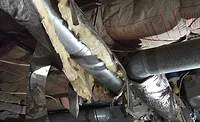
Flex duct should be installed in tight, straight runs and properly supported to eliminate sagging. Too often, though, the end result looks more like the images above and below, and the system suffers from lack of airflow.

Why There Are Problems

With the prevalence of flexible duct in the HVAC world, it would seem that everyone would know how to install it properly. So why are there so many problems with improperly installed flex duct?

"It's a combination of things," said Rick Young, vice president of sales and marketing, QuietFlex, Houston (www.quietflex.com). "I think people look to shave costs, and they're pushed for time, so they rush through a job instead of taking the time to do a good job. And people are not taking the time to get properly trained on installation procedures. They need to study the installation guidelines in the Green Book and make sure they know them well and follow them."

Young noted that one of the most common errors contractors make regarding flex duct is installing ducts that are too small. "Contractors often put in 6-inch duct, when ACCA's Manual J might call for 8-inch duct. Another problem is that ducts are not always properly joined together, which results in leakage. Only tape that meets UL181 standards should be used, but some contractors still use duct tape, and they shouldn't."

Randy Hoag, director of operations, S & M Heating Sales Co., Southfield, Mich., and a member of the Sheet Metal and Air Conditioning Contractors' National Association (SMACNA), believes that flex duct is a valuable tool if used properly. "When using flex in a proper way, such as tight, straight runs, gradual turns, and correct hanging techniques, it can be one way to increase profit margins," he said.

When the decision is made to use flex duct on a job, Hoag recommends that contractors keep the following tips in mind:

  • Use care when running it through trusses and joists to avoid tears.

  • Join sections together so they will not separate by using approved methods.

  • Use elbows or gradual turns to avoid kinks.

    There are also products available that are intended to make flex duct installation easier, so that there aren't as many problems. One of those products is the Paramount Jâ„¢ duct hanging system.

    In a typical application, installers must wrap strap around the flex duct, cut the strap to the appropriate length, nail or staple the strap to the joists, and then repeat this process along the entire length of the flex duct. Using the Paramount J system, installers can preinstall the hangers on joists, then simply place the flex duct into each hanger.

    The manufacturer states that using the Paramount J also reduces the problems associated with airflow. "Support straps typically fold over on the sides and can slide in between the support wires inside the flex duct," stated Michael Pratt, president, Paramount Concepts, Springboro, Ohio (www.paramountconceptsltd.com).

    "This leads to crimps, and once the structural integrity of the flex duct is changed, airflow is compromised. The saddle portion of the Paramount J hanger is designed to provide solid support to the flex duct, eliminating crimps and preserving airflow."
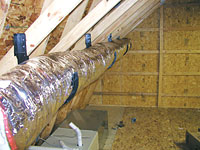
    The Paramount J duct hanging system is designed to shorten installation time and help prevent kinks during flex duct installation, eliminating airflow problems.

    What Can Happen

    While improperly installed flex duct can have the short-term result of not providing enough heating and cooling to a space, there are long-term problems to watch out for as well. According to Jack Bartell, manager - training services, York International, Norman, Okla. (www.yorkupg.com), when an air conditioner (or heat pump in cooling mode) operates at less than expected airflow across the evaporator, it will result in a lower coil temperature.

    "This, in turn, leads to frost on the coil, which causes more restriction to the flow of air and leads to more frost," stated Bartell. "This snowball of cause and effect leads to a loss of capacity, so the thermostat cannot satisfy the demand for cooling. This results in a long-run cycle with little or no effect on comfort, along with an enormous waste of energy."

    The most serious result of low airflow in cooling mode is how it affects the compressor. Low airflow means less heat is delivered to boil off the refrigerant flowing through the evaporator, resulting in liquid refrigerant getting to the compressor. This dramatically reduces the life of the compressor and is considered the major cause of compressor failure.
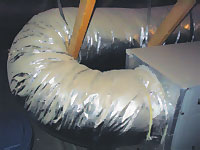
    The installer on this job (left) used 16-inch return duct, which was too small, and didn’t bother to include a return plenum, a practice that is all too common in tract homes. Both issues can lead to airflow problems.
    "When a heat pump operates in heating mode with low airflow, it results in higher discharge temperature and pressure. Short-term effects are compressors that shut down and/or lockout on safety devices. Longer-term effects are compressor failures due to running too hot," noted Bartell.

    Furnaces can also experience problems when flex duct is installed improperly. "If many of the heat runs are kinked or crushed, it could possibly cause the furnace to overheat and cut out on limit. Over time, the furnace could suffer cracks to the heat exchanger," stated Hoag.

    It's best to install flex duct properly right from the get-go, because once the drywall is up, it can be very difficult to repair problems. "A tear in the flex duct that may have been overlooked by the installer, builder, or inspector can be nearly impossible to fix or find," Hoag pointed out. Houses in which very long duct runs have been installed may also be difficult to fix, as access to the further reaches of the flex duct may be impossible.

    There's really no reason why flex duct should ever be installed improperly, as the resources are there for everyone to learn proper installation techniques. If care is taken on every job, the flex duct system should operate well for many years, resulting in fewer callbacks and happier customers.

    Publication date: 07/25/2005

  • Looking for quick answers on air conditioning, heating and refrigeration topics? Try Ask ACHR NEWS, our new smart AI search tool. Ask ACHR NEWS →

    Share This Story

    Looking for a reprint of this article?
    From high-res PDFs to custom plaques, order your copy today!


    Tn joanna 2017
    Joanna Turpin is a Senior Editor at The ACHR NEWS. She can be contacted at 248-786-1707 or joannaturpin@achrnews.com. Joanna has been with BNP Media since 1991, first heading up the company’s technical book division before moving over to The ACHR NEWS, where she frequently writes about refrigerants and commercial refrigeration. She obtained her bachelor’s degree in English from the University of Washington and worked on her master’s degree in technical communication at Eastern Michigan University.

    Recommended Content

    JOIN TODAY
    To unlock your recommendations.

    Already have an account? Sign In

    • HVAC-enrollment

      The Trades Are Back: HVACR Programs See Nearly 30% Enrollment Spike

      A new wave of future technicians is entering the pipeline.  
      News
      By: Matt Jachman
    • 2025 Top 40 Under 40

      2025 Top 40 Under 40 HVACR Professionals List

      The 11th annual Top 40 Under 40 list highlights those...
      HVAC Residential Market
      By: Hannah Belloli-Oster
    • LG Ductless Mini-Split Systems

      The 9 Types of Heat Pumps

      As the U.S. moves toward electrification, heat pumps are...
      Air Source Heat Pumps
      By: Joanna R. Turpin
    Subscription Center
    • Create an Account
    • Start a Subscription
    • Manage My Account
    • Sign Up for Newsletters
    • Visit Customer Service
    • Update Preferences

    More Videos

    Sponsored Content

    Sponsored Content is a special paid section where industry companies provide high quality, objective, non-commercial content around topics of interest to The News audience. All Sponsored Content is supplied by the advertising company and any opinions expressed in this article are those of the author and not necessarily reflect the views of The News or its parent company, BNP Media. Interested in participating in our Sponsored Content section? Contact your local rep!

    close
    • Piggy Bank
      Sponsored byWatercress Financial

      Energy Prices, Inflation, and HVAC: What Today’s Homeowners Care About

    • Refrigerated Food
      Sponsored bySolstice Advanced Materials

      R-455A Refrigeration: A Cold Storage Solution for the Future

    • Airex Rooftop Units
      Sponsored byAirex Manufacturing Inc

      Consolidating Roof Penetrations: A Growing Trend in Multifamily HVAC Design

    Popular Stories

    HVAC-Price-Increase-graphic

    HVAC Price Increase List: June 2026

    Trump-Section-232.jpg

    Trump Reduces Section 232 Tariffs on HVAC Equipment to 15%

    R410A-Refrigerant-Cylinder.jpg

    Refrigerant Recovery is a Revenue Opportunity

    Heat-pump-cutaway.jpg

    PFAS Rules and A2L Building Codes Continue to Evolve

    Kroger.jpg

    Kroger to Spend $100 Million to Reduce Refrigerant Leaks

    View The ACHR NEWS
    Centennial Anniversary Timeline

    The ACHR News Timeline Chart
    Submit a Letter
    Submit a letter to our editors.

    Events

    November 6, 2025

    Next-Gen Data Center Cooling: HVAC Innovation and Real-World Solutions

    On Demand As AI workloads and high-density computing push traditional cooling methods to their limits, the data center industry is accelerating the adoption of next-generation HVAC technologies.

    June 17, 2026

    Decarbonization Without Disruption

    This webinar will explore practical HVAC decarbonization strategies that minimize disruption while maximizing long-term performance and ROI.

    View All Submit An Event

    Poll

    Summer Staff

    Are you fully staffed for the summer season?
    View Results Poll Archive

    Products

    BNI Mechanical/Electrical Square Foot Costbook, 2026 Edition

    BNI Mechanical/Electrical Square Foot Costbook, 2026 Edition

    See More Products
    Decarbonization Without Disruption - Free Webinar - 6/17/2026

    Related Articles

    • Hidden Problems Can Cause Carbon Monoxide

      See More
    • Troubling Pinhole Leaks in Evaporator Coils Cause Corrosion Issues

      See More
    • Airflow upgrades give reputable contractors an opportunity to profitably repair duct systems that we all often joke about.

      Duct Dynasty: Differentiate Your Company with Airflow Upgrades

      See More

    Related Products

    See More Products
    • Evaluating-and-Troubleshooting-Refrigeration-Systems-Video-Cover-210x300.jpg

      Evaluating Refrigeration Systems Troubleshooting & Identifying Problems CONTINUED

    • 0880690186-228x228.jpg

      Airflow in Ducts

    • Building Information Modeling: Planning and Managing Construction Projects with 4D CAD and Simulations

    See More Products

    Related Directories

    • McGill AirFlow LLC

      Manufacturer of round, flat oval, and rectangular HVAC ductwork and related products for commercial, institutional, and industrial applications.
    • Full Airflow Zone System LLC (Wholesaler)

      Full Airflow Zone System zone control boards open one zone at a time based on priority. Perfect for multi-story and "Capacity Deployment System" applications.
    ×

    Sign Up. Stay Informed.

    The #1 trusted source for the HVACR industry since 1926

    SUBSCRIBE
    • RESOURCES
      • Advertise
      • Contact Us
      • Advisory Board
      • Classifieds
      • Submit a Letter
      • Directories
      • Store
    • ACCOUNT CENTER
      • Create an Account
      • Start a Subscription
      • Manage My Account
      • Sign Up for Newsletters
      • Visit Customer Service
      • Update Preferences
    • SERVICES
      • Marketing Services
      • Reprints
      • Market Research
      • List Rental
      • Survey/Respondent Access
    • STAY CONNECTED
      • LinkedIn
      • Facebook
      • Instagram
      • YouTube
      • X (Twitter)
    • PRIVACY
      • PRIVACY POLICY
      • TERMS & CONDITIONS
      • DO NOT SELL MY PERSONAL INFORMATION
      • PRIVACY REQUEST
      • ACCESSIBILITY

    Copyright ©2026. All Rights Reserved BNP Media, Inc. and BNP Media II, LLC.

    Design, CMS, Hosting & Web Development :: ePublishing