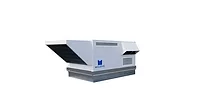
Digital Variable Multi A/C Technology Passes Test

That’s the motto Los Angeles Department of Water and Power (LA DWP) hvac supervisor Pat Breslin uses to give his job the right perspective. He oversees 86 of the LA DWP’s buildings and their 580 air conditioning units. Recommendations he makes regarding energy efficiency have the potential to save a great deal of power — power that can be sold to other utility companies.
In early 2001, when California’s first blackouts were just around the corner, Breslin met Samsung Air Conditioning’s technical rep Stu Taylor. Breslin wanted to safeguard the DWP’s critical operations from a complete cut-off of air conditioning during brown-outs. Taylor was looking for a test site for Samsung’s DVM (digital variable multi) variable refrigerant flow (VRF) technology.
The two realized a common purpose, and in March 2001, an energy-consumption comparison of a 6-ton DVM unit and an existing variable air volume (vav) unit began at the LA DWP’s 8,600-sq-ft Western District Water headquarters. Before the test, both sides of the building had been cooled with 7-ton vav units, one on each side. The one on the west side (the hottest side and with the most people) was turned off on alternate weeks, during which the DVM unit operated. On the east side, workers receive their assignments early in the morning, then spend most of the day in the field. This continued to be cooled by the other vav unit. Indoor fans for the tested units were kept running during the test.
This scenario gave a distinct advantage to the two-year-old vav unit on the east side. Taylor says he wanted it this way. “The energy efficiency of the DVM, even with these handicaps, is impressive,” he says.
Breslin agrees. “We’re saving at least 38% of kW usage,” he says. “The DVM exceeded all expectations I had for the unit.”
According to Breslin, though the vav units lost efficiency (as low as 30%) as load decreased, the DVM was 92% efficient at 18% load.
“Even when some parts of the building are at 100% load, others are not,” says Breslin. “Controlling a small amount of refrigerant uses a lot less energy than regulating large volumes of air.
Looking for quick answers on air conditioning, heating and refrigeration topics? Try Ask ACHR NEWS, our new smart AI search tool. Ask ACHR NEWS
“The current methods of measuring don’t tell the whole picture. It’s like miles per gallon. That doesn’t consider driving patterns, so they came up with mpg for city and freeway driving to give a more accurate picture.”
Says Taylor, “What I learned is that EER is not the only way to see energy savings, since air conditioning doesn’t run at 100% load all the time. What we need is another tool for measuring energy efficiency, one that takes partial load into account.”
Overall results show:

ROOM-BY-ROOM CLIMATE CONTROL
Initially, what appealed to Breslin was the room-by-room control he’d have with DVM. Rather than setting the temperature for the entire building with one thermostat, Breslin can turn everything off during a brownout, or decide which rooms remain air conditioned and which are nonessential and can do without.“If the entire DWP was cooled with DVM units,” he says, “we could monitor hundreds of buildings from a single computer and program temperatures and hours of operation for each work area with a couple of keystrokes.”
Faced with an all-or-nothing situation, Breslin could decide beforehand which rooms needed cooling no matter what and which did not, and program the computer accordingly. “That way, we wouldn’t risk frying a million bucks of PCs in the event of a brownout,” he says.
Given Internet or intranet access, Breslin and other key persons could modify temperatures from a remote site. “I could handle everything from my home, if need be,” he says.
“Most systems don’t want people touching them,” says office superintendent Leticia Lara, “but with DVM, I can completely turn off the air in rooms that aren’t occupied. And if I see someone dozing off, I can push a button and freeze ’em out!”
Like many of the DWP’s buildings, this test facility was built in the early part of the last century. Breslin sees DVM as ideal for places where a retrofit wouldn’t be possible. “All you have to do is drill a little hole and put it in,” he says. “You wouldn’t destroy the historical value of a building by putting in ductwork where it never existed.
“Right now, we’re looking at a building built in the late 30s. The ductwork alone would cost more than purchasing a new system.”
RESISTANCE TO CHANGE
DVM’s one, big disadvantage, Breslin and Taylor agree, is that it’s new — new at least in this country. “If you don’t know about it, you’re scared of it,” says Breslin. “Engineers are unfamiliar with this technology, so they keep going with what they know.”Although Samsung’s DVM technology has been installed at Dominican College in Orange-burg, NY, and Mitsubishi Climate Control has saved a 30,000-sq-ft commercial building in San Diego $15,000 in energy costs over six months with its VRF system, DVM and VRF are hardly household words with American hvac contractors.
“It can’t just be about saving energy,” says Taylor. “You have to consider the real world in which it’s going to be used. Installation, user friendliness, and simplicity in design and operation have to be considered too.
“In North America, the market is dominated by American systems. The mini-splits are much more common in Asia, where they’ve always needed energy-efficient systems. But this is the land of SUVs. In the 70s, when Japanese cars first came over, Ford and Chrysler didn’t start making small cars. It’s the same with air conditioners. But that’s changing. We’re seeing that we have to become more energy efficient.”
Sidebar: How The Technology Works
If you could provide air conditioning that required 35% to 45% less energy than existing units, would you do it? Most likely you would — provided you knew it existed.Although such energy-efficient technology was developed more than 10 years ago and is the predominant means of artificial cooling throughout Asia, most American hvac contractors have never heard of VRF (variable refrigerant flow) technology. And if you don’t know it exists, you can’t take advantage of its benefits.
DVM (digital variable multi), inverter-driven, and other VRF systems allow for one outdoor unit to serve multiple indoor units (up to 16 with DVM). Those who believe in this technology state this means far less ductwork, sometimes none at all. And less ductwork, they are quick to point out, means lower installation and maintenance costs, as well as a cleaner, healthier indoor environment (mold, fungi and bacteria can’t grow in ducts that aren’t there).
Moreover, DVM, inverter, and tri-stage VRF systems offer greater energy efficiency. Since systems rarely run at 100% — they only do that at peak load amperage — VRF backers contend that conventional systems are not as efficient. In their estimation, the conventional system works hard to bring the room to the desired temperature and then kicks off, then back on again when the room temperature cools below or raises above the desired mark.
Just like the person who grabs a candy bar or downs a triple espresso when he’s feeling worn out, then experiences a rush of energy, only to plummet soon afterwards, the energy swings of a conventional a/c unit take their toll, in terms of both operating efficiency and wear and tear on the system.
DVM and VRF systems run anywhere from 10% to 100% of load all the time — none of this on-off, on-off business. They run slower and constantly, therefore quieter and more efficiently. For the most part, a DVM system runs within a ±2 degree temperature range; a conventional vav system fluctuates over a 6 to 10 degree range.
According to manufacturer technical rep Stu Taylor, the outdoor configurations of Samsung DVM systems are designed for high-rise retrofits. Even when multiple units are stacked floor by floor, they won’t impact the performance of the units above, he said. In this way, said Taylor, existing buildings with older chiller systems can augment their current cooling capacity by adding multizone systems — and save money, too.
“You have a level of comfort that you’ve not had before with conventional systems,” said Taylor. “And you are only cooling what you need cooled, so that saves energy. These VRF systems, like the standard mini-split systems, condition differently than standard unitary systems. They use a colder evaporator temperature, a higher delta T across the indoor coil, and slower moving air.
“Just think about it: On an 80 or 90 degree F day with 100% humidity, you just want to take care of the humidity. DVM does that. And when you’re really comfortable, you don’t think about the a/c.”
Sidebar: The Key Players
Publication date: 01/14/2002
Looking for a reprint of this article?
From high-res PDFs to custom plaques, order your copy today!