Debating 12 vs. 13 SEER

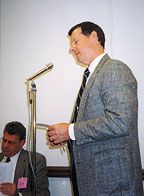
Marshall Hunt, Pacific Gas & Electric Co., presents his comments. (right)
The Department of Energy’s (DOE’s) hearing/workshop on the proposed 12-SEER standard for air conditioners and heat pumps, originally scheduled for September 13, finally proceeded on October 2. But it was not uneventful, starting off with a power outage that delayed the start of the proceedings. (See “Plenty of Surprises at DOE Hearing,” page 47.)
Once the speakers got under way, however, another unusual event occurred. Speaker after speaker arose in favor of 13 SEER.
A number of scheduled as well as unscheduled speakers voiced their support, including two veteran contractors.
Air-Conditioning and Refrigeration Institute (ARI) and DOE officials may have been outnumbered, but they held their position and responded to the challenge.
A coalition had been formed that included Goodman Global Holding Co., parent of Goodman Manufacturing, along with state government agencies, major utility Pacific Gas & Electric (PG&E), environmental groups, and low-income advocacy organizations. The scheduled speakers, in alphabetical order by organization, then arose to speak.
Bill Prindle of the Alliance to Save Energy (ASE) stated that in the last year, the U.S. has seen the highest electricity and natural gas prices ever, electric reliability problems, and the necessity to invoke the Federal Power Act.
He also pointed out that the Senate Foreign Relations Com-mittee voted unanimously for reduction of greenhouse gas emissions, and that the national energy policy notes the importance of energy efficiency.
Looking for quick answers on air conditioning, heating and refrigeration topics? Try Ask ACHR NEWS, our new smart AI search tool. Ask ACHR NEWS
He urged that the DOE withdraw its 12 SEER proposal and reinstate 13 SEER.
Harvey Sachs, American Coun-cil for an Energy Efficient Economy (ACEEE), said that instituting 12 SEER is “inconsistent with (Vice President) Cheney’s energy policy.” Because 13 SEER had already been established by the outgoing Clinton administration, he said that “efforts to overturn it are unlikely to withstand a legal challenge.”
He continued, “SEER 13 is not rocket science.” The technology is available, he stressed, and said that the DOE’s predictions are off the mark.

Market Forces
Chris Pamplin, currently sales and marketing manager for American Geothermal DX, then spoke from his prior experience as an hvacr contractor for 17 years.He pointed out that 13-SEER units are produced by the majority of manufacturers certified to ARI standards. He asserted that the ARI argument that the dynamics of the marketplace will make people defer purchases if higher cost 13-SEER equipment were the standard does not match his experience. When the 10-SEER standard was implemented, he said, he rarely experienced deferred purchases.
He also said that any cost difference due to a larger footprint “would be minimal.”
Mel Hall-Crawford of the Consumer Federation of America (CFA), representing consumer interests, said that it “has long supported higher efficiency standards.”
She stated that if 13 SEER would be implemented, competitive forces would bring lower costs. She concurred with Pamplin that cost concerns were “not borne out by actual experience,” when the 10 SEER standard went into effect.
Steve Rosenstock of the Edison Electric Institute (EEI) affirmed that “12 SEER is more likely to be cost effective” and expressed concern about moving from industry values.
He said 12 SEER is a 20% increase in efficiency and “not a rollback.” Since it is an increase and not a retreat, he urged attendees to refrain from the term rollback. He declared that advancing a 13 SEER standard would be likely to raise SEER while lowering EER values.
Doug Marty of Goodman Global Holding Co. stated that 13-SEER equipment would “not impose unreasonable costs” on manufacturers. He also said that, despite ARI arguments to the contrary, it “will not hurt the elderly.”
He continued that “virtually all manufacturers produce 13-SEER equipment” and that “moving to a higher SEER will produce more volume.” Once implemented, “The new standard will drive prices down.”
Charles Harak of the National Consumer Law Center (NCLC), representing the Massachusetts Union of Public Housing Tenants, remarked that the “DOE should not retreat.” Lower-income people will not suffer from a 13-SEER standard, he said.
Tenants incur no direct cost due to these standards, he noted. Fair market rents, which are set by supply and demand, he said, “are up 20% to 30% in the Northeast.” They are not affected by a change in air conditioning, he said.
Ralph Loomis of the National Grid, which supports 13 SEER, commented that it is rare for low-income families to have central air conditioning. They typically have room units.
He proclaimed that the proposed 12-SEER standard has not properly considered peak demand.
Kit Kennedy of the Natural Resources Defense Council (NRDC) stated, “The DOE’s continued attempts to roll back 13 SEER would be a grave mistake.” She said her organization has a long history of working with DOE and the industry and will “resort to litigation only when absolutely necessary.”
She added, “SEER 13 is a form of compromise itself.”

The Role of TXV’s
John Lynn of the Northeast Energy Efficiency Partnerships (NEEP) expressed his support of 13 SEER as well as supporting TXVs as a component of air conditioning systems. “TXVs are instrumental in achieving 13 SEER and improving EER.”Marshall Hunt of Pacific Gas & Electric (PG&E) explained the California Public Utilities Com-mission’s five-tiered surcharge structure for electricity. He noted that a family in the Central Valley that regularly sees temperatures over 105¿F will have billing periods with usage in the 4th and 5th tiers. Many consumers, he affirmed, will be in the 3rd through 5th tiers, paying higher energy costs that a 13 SEER standard could reduce.
In her statement, Carol Biedrzycki of the Texas Ratepayers’ Organization to Save Energy (TROSE) provided an analogy to the automotive industry. There were no seat belts in the past. There were no air bags in the past. They were resisted at first. We now accept and expect to see them in every car.
The representative for the last scheduled speaker, York Inter-national, was unable to attend. His comments were presented by Karim Amrane of ARI.
He noted a lack of 13-SEER equipment and pointed out that ARI numbers show that most consumers would not see a cost payback. The cost of doing business, including the major refrigerant changes and other costs, has been driven up.
Many manufacturers would have to retool to produce 13-SEER air conditioners. Also, very few 13-SEER units will fit manufactured homes, he said.
Deborah Miller of ARI, a former senior policy advisor at the DOE, then followed with a more complete presentation of the manufacturers’ consensus viewpoint.
She said that at the end of the Clinton administration the DOE, in its own words, “rushed” to publish a proposed new rule. It cut short the comment period; new analyses were injected into the record with only nine days left in this abbreviated period; it ignored its statutory mandate to balance economic interests in the rulemaking; failed to consult the Depart-ment of Justice on the impact 13 SEER would have on competition; and published a new rule of 13 SEER “literally in the final minutes of the last administration.”
She noted, “If ever a rulemaking was tailor-made for reconsideration, review, and correction, it is this one.”

We all like higher-SEER products, she said, “but they cost a lot more to make.” The impact of a 13 SEER standard, she stated, would have a disproportionate effect on lower-income and senior citizens; provide no economic payback for most Americans; be anticompetitive toward small manufacturers; save less energy when those who cannot afford the equipment repair their older, inefficient units; and result in a potentially large loss of jobs in a weakening economy.
Andrew deLaski of the Appliance Standards Awareness Project then remarked that more than a hundred organizations are on the record as supporting 13 SEER. With the need now for secure resources, he added, “No resource is more secure than energy efficiency.”
Ed Meyers of the National Association of Regulatory Utility Commissioners, Tom Eckman of the Northwest Power Planning Council, Michael Martin of the California Energy Commission, and Charlie Stephens of the Oregon Department of Energy also supported 13 SEER. Martin said that when he first started working on this issue more than 20 years ago, the air conditioning didn’t work. This time the air conditioning worked, but the lights went out.
The final speaker was another former contractor, Maurice Jacobson, also a former president of the Air Conditioning Contractors of America (ACCA). Referring to himself as a “vintage human being,” he stressed the need to “raise the bars of performance.” He concluded, “Please don’t lower the bar, raise the bar.”
Publication date: 10/08/2001
Looking for a reprint of this article?
From high-res PDFs to custom plaques, order your copy today!


