ACHR News
search
Ask ACHR NEWS AI
cart
facebook twitter instagram linkedin youtube
  • Sign In
  • Subscribe
  • Sign Out
  • My Account
ACHR News
  • NEWS
    • Breaking News
    • New HVAC Products
    • Featured Products
    • Manufacturer Reports
    • HVAC Data
    • Legislation
    • ACHR NEWS Centennial
  • RESIDENTIAL
    • Air Conditioners
    • Furnaces
    • Residential Heat Pumps
    • Ductless
    • Residential IAQ
    • Testing, Monitoring, Tools
    • Components & Accessories
  • COMMERCIAL
    • Air Handlers
    • Rooftop Units
    • Chillers and Cooling Towers
    • Commercial Heat Pumps
    • Boilers and Hydronics
    • VRF/Ductless
    • Commercial IAQ
  • REFRIGERATION
    • Refrigerants
    • Refrigerant Regulations
    • Leak Management
  • CONTRACTOR PRO
    • Geothermal
    • Homeowner Study
    • VRF and VRV Ductless
    • Unitary Trends
  • EDUCATION
    • Training and Education
    • Business Management
    • Service and Maintenance
    • Continuing Education
    • Market Research >
      • HVAC Brand Awareness Report
      • VRV, VRF, VRVZ Report
      • Unitary Trends Report
      • Water Heat Professionals Report
    • Webinars
    • Sponsor Insights
    • eProducts Info
    • White Papers
  • EVENTS
    • HVAC Contractor Forum
    • Industry Events and Webinars
  • MEDIA
    • Videos
    • AHR Expo 2025 Videos
    • Podcasts >
      • ACHR News Podcast
      • HARDI Podcasts
      • AHR Expo Podcasts
      • ACCA Podcasts
    • Interactive Spotlights
    • Quizzes
    • eBooks
    • HVAC Talkback
  • HVAC GROUP
    • ACHR NEWS >
      • Current Issue
      • Digital Edition
      • Subscribe
    • Distribution Trends
    • SNIPS NEWS >
      • Join SNIPS NEWS
    • Engineered Systems News >
      • Join ES News
    • HVACR Directory
    • Contests
    • Newsletters
    • Contact
    • Advertise
    • My Account
TechnicalRefrigerationRefrigerants

CO2 As Refrigerant: The Transcritical Cycle

January 20, 2004
In three previous articles, we have presented an overview of CO2 (R-744) as a refrigerant, its applications in industrial refrigeration, and a case study of a CO2 cascade system in a European supermarket. (See "CO2 in Refrigeration Applications," Oct. 6, 2003; "CO2 in Industrial Refrigeration," Nov. 3, 2003; and "CO2 is Keeping Supermarkets Cool," Dec. 8, 2003.) The systems presented were all subcritical - that is, the refrigeration cycles were entirely below the critical point of CO2. Now, after a brief review of CO2 characteristics, comparing subcritical and transcritical cycles, we will present a functioning transcritical system with a hermetic CO2 compressor and discuss design considerations.

CO2 is a component of our atmosphere that is essential to life. It has no ozone depletion potential and insignificant global warming potential, so CO2 has no regulatory liability, as do HFCs. There is no need to account for the amount used, and it does not need to be reclaimed. (Characteristics of CO2, compared with those of R-134a and R-404A, are shown in Table 1.)
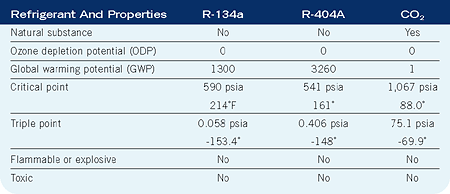
Table 1. Properties of CO2 (R-744) compared with those of R-134a and R-404A.
Other principal benefits of CO2 are that it is a natural substance, it is cheap, readily available, not poisonous in any common concentration, and nonflammable. At prices a bit over $1 per pound, it is truly an inexpensive refrigerant. The grade used must be dry, but it can presently be obtained in 99.9-percent purity from companies that supply welding gases, with a 20-pound tank selling for about $21.

Refrigeration Applications

CO2 is not new to refrigeration. Its use began in the mid-nineteenth century and steadily increased, reaching a peak in the 1920s. Its use declined with the introduction of chlorofluorocarbons (CFCs) that operated at much lower pressures. Use of CO2 continued, but chiefly in cascade systems for industrial and process applications. Recently, strong interest has been shown in CO2 as a refrigerant by vending machine manufacturers. There are also possibilities for other light commercial refrigeration applications, as well as for residential air conditioning.

The major challenges in CO2 refrigeration involve the relatively high working pressures. The supercritical portion of the transcritical cycle takes place above 1,067 psia. The phase diagram for CO2 is shown in Figure 1.

Figure 1. The phase diagram for CO2. The critical point is at 1,067 psia and 88 degrees F.


Pressure-enthalpy diagrams for a subcritical cycle with R-134a and a transcritical cycle with CO2 are shown in Figures 2 and 3. It is important to understand the differences between these two cycles.

Figure 2 is a pressure-enthalpy diagram for R-134a in a traditional vapor compression refrigeration cycle. Starting at the lower left of the figure and moving to the right, the bottom line represents the evaporation process. Refrigerant pressure (the y axis) remains constant in the evaporator, and heat gain during the evaporation process is represented by the in-creasing specific enthalpy (which can be interpreted as specific "energy content" of the refrigerant, measured along the x axis).

On the right side of the figure, the line slanting upward to the right as pressure rises sharply and steadily is the compression process, where we add power to the system to run the compressor.

In the top horizontal line of the figure, moving from right to left, the condensing process occurs. Here the heat absorbed during evaporation - and the heat added during compression - is rejected out of the system.

During the condensing process, the quality of the refrigerant changes until it is 100 percent liquid. A further cooling of the liquid often occurs so that the refrigerant is subcooled when leaving the condenser. There is no change in pressure or temperature during the phase change.

The final process in the cycle is expansion, represented by the drop in refrigerant pressure along the left side of the figure. The pressure drop occurs as the refrigerant passes through a metering device (expansion valve or capillary tube).

Looking for quick answers on air conditioning, heating and refrigeration topics? Try Ask ACHR NEWS, our new smart AI search tool. Ask ACHR NEWS →

During the expansion process, refrigerant condition changes from subcooled liquid to a mixture of liquid and vapor. No heat or work is transferred to or from the refrigerant during this process, so the line representing the process is vertical. There is no change in specific enthalpy.

So in the cycle for R-134a, and for other subcritical refrigeration cycles, the four processes are evaporation, compression, condensation, and expansion. Note that the entire cycle takes place below the green dot at the critical point. Things are just a bit different in transcritical cycles.

Figure 3 represents a transcritical cycle with CO2. The cycle diagram looks the same; the only difference is that the heat rejection process occurs above the critical point. Unlike the subcritical condensing process, where temperature stays constant, temperature decreases during the entire transcritical heat rejection process. There is no condensation in a transcritical cycle, and we call the process gas cooling. In low ambient conditions, the process might occur below the critical point, and condensation, rather than gas cooling, would occur. This is the fundamental difference between subcritical and transcritical cycles.
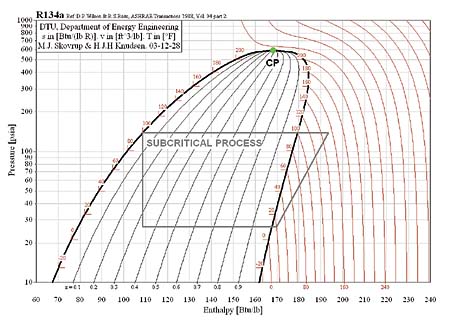
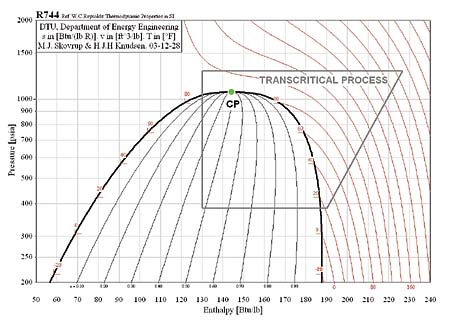
Figure 2. The refrigeration cycle for R-134a. This represents a typical subcritical refrigeration cycle.


Figure 3. The transcritical refrigeration cycle for CO2 (R-744). Note that the cycle occurs on both sides of the critical point (shown as a green dot at the crest of the vapor dome).


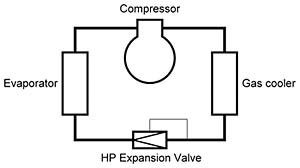
Figure 4. A simple CO2 transcritical system block diagram.

A Hermetic CO2 System

Figure 4 shows a simple CO2 transcritical system block diagram. There are two differences from the traditional system. One is the gas cooler that takes the place of the condenser, and the other is the expansion device.

In subcritical applications, refrigerant is metered by a capillary tube or thermostatic expansion valve, the control strategy being to inject liquid into the evaporator and maintain a given superheat entering the compressor. The metering device is selected or designed to ensure that there is complete evaporation ahead of the compressor.

Superheat is maintained to ensure that evaporator efficiency is optimal, and that liquid refrigerant does not enter the compressor. Excessive superheat may lead to overheating of the compressor.

In systems where a thermostatic expansion valve is used rather than a capillary tube, superheat is maintained by placement of a sensing bulb at the outlet of the evaporator. The modulation of the valve is then controlled by the temperature transmitted to it from the bulb and the pressure at an internal or external equalization port.

A different control strategy is needed in transcritical cycles.
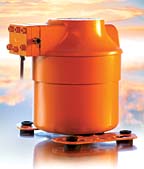
The Danfoss type TN compressor for CO2 is designed for small commercial applications. For development of this compressor, the company received this year’s AHR Exposition Innovation Award for Refrigeration.

Transcritical Expansion Device

A system based on the transcritical CO2 cycle uses a high pressure expansion valve (HPEV). Rather than controlling refrigerant metering from the low-pressure side of the system, modulation control comes from the high side of the system. A mechanical HPEV will control refrigerant injection into the evaporator by opening and closing based on the increase or decrease in gas cooler pressure.

In the HPEV, spring force is a closing force that acts on the top of a diaphragm. Increasing spring force throttles the valve, causing a backpressure in the gas cooler; the valve will not open until that back pressure, opposing spring force, increases to the point where it can overcome spring force and open the valve. The valve set point for the inlet pressure can be adjusted manually by compressing a spring in the valve.

Unlike a TEV, an HPEV does not control evaporator superheat. The HPEV injects refrigerant into the evaporator, but superheat is not directly controlled - instead it is indirectly regulated by system design.

The system charge, its distribution between the components, evaporator design, and the heat load, along with other external operating conditions, determines system superheat. By controlling the gas cooler pressure, the HPEV will indirectly influence system superheat, but the system must be designed so that liquid refrigerant in the evaporator outlet is not allowed to return to the compressor.

The HPEV was designed to control gas cooler pressure rather than suction line superheat as does a TEV. An HPEV, therefore, must withstand high-side CO2 pressures that can reach 1500 psia, at the same time accurately controlling gas cooler pressure. Slight changes in gas cooler pressure will have significant influence on the system cooling capacity and energy efficiency (COP).
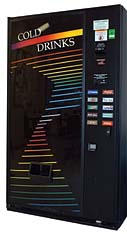
Vending machines are a typical refrigeration application for transcritical CO2.

The Type TN Compressor For CO2

The function of the compressor in a transcritical application is the same as in a subcritical one. The compressor creates refrigerant flow, increasing discharge pressure and therefore raising refrigerant temperature to a level high enough that heat absorbed in the evaporator will be rejected in the condenser or gas cooler.

Due principally to the higher CO2 working pressures, several challenges were presented during design of the TN compressor. Some of the major challenges were the shell construction, internal leakage across the piston, piston and bearing loading, and bearing lubrication, all due to the higher pressures. At the same time, to keep costs down, a simple design was chosen.

Outer shell construction had to be of increased robustness to handle the higher pressures. Piston rings had to be added to prevent internal cylinder leakage. The piston connecting rod bearing design was modified due to a smaller piston diameter and higher specific forces on the bearing.

The volumetric refrigeration capacity of CO2 is much higher than that of traditional refrigerants, allowing system designs with smaller volumes. This also holds true for other components. Smaller cylinder displacement still provides adequate system capacity.
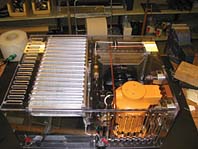
A functioning CO2 refrigeration system using the Danfoss type TN compressor.
Compression ratio is a major factor contributing to CO2 compressor performance. Current HFC compressors for MBP-operation with R-134a are designed for compression ratios of approximately 8 to 1, and become inefficient at higher ratios.

CO2 systems operate at higher pressures, but the compression ratio is only 3 or 4 to 1. The lower compression ratio will give the compressor the capability to operate with less of a refrigerant re-expansion effect in the cylinder during operation.

Now that there are functional designs for compressors, heat exchangers, and high pressure expansion devices, the transcritical cycle with CO2 becomes a viable alternative for users seeking a solution that is acceptable worldwide. It is a natural refrigerant that will allow users to be identified as environmentally proactive. These facts will continue to fuel development of CO2 components and system designs.

Jeff Staub is manager of application engineering at Danfoss Inc., Baltimore. Bjarne Dindler Rasmussen is research engineer, Danfoss A/S, Nordborg, Denmark. Max Robinson is in Technical Communications at Danfoss Inc.

Publication date: 01/26/2004

Share This Story

Looking for a reprint of this article?
From high-res PDFs to custom plaques, order your copy today!


Recommended Content

JOIN TODAY
To unlock your recommendations.

Already have an account? Sign In

  • HVAC-enrollment

    The Trades Are Back: HVACR Programs See Nearly 30% Enrollment Spike

    A new wave of future technicians is entering the pipeline.  
    Training and Education
    By: Matt Jachman
  • 2025 Top 40 Under 40

    2025 Top 40 Under 40 HVACR Professionals List

    The 11th annual Top 40 Under 40 list highlights those...
    News
    By: Hannah Belloli-Oster
  • LG Ductless Mini-Split Systems

    The 9 Types of Heat Pumps

    As the U.S. moves toward electrification, heat pumps are...
    HVAC Residential Market
    By: Joanna R. Turpin
Subscription Center
  • Create an Account
  • Start a Subscription
  • Manage My Account
  • Sign Up for Newsletters
  • Visit Customer Service
  • Update Preferences

More Videos

Sponsored Content

Sponsored Content is a special paid section where industry companies provide high quality, objective, non-commercial content around topics of interest to The News audience. All Sponsored Content is supplied by the advertising company and any opinions expressed in this article are those of the author and not necessarily reflect the views of The News or its parent company, BNP Media. Interested in participating in our Sponsored Content section? Contact your local rep!

close
  • Piggy Bank
    Sponsored byWatercress Financial

    Energy Prices, Inflation, and HVAC: What Today’s Homeowners Care About

  • Refrigerated Food
    Sponsored bySolstice Advanced Materials

    R-455A Refrigeration: A Cold Storage Solution for the Future

  • Airex Rooftop Units
    Sponsored byAirex Manufacturing Inc

    Consolidating Roof Penetrations: A Growing Trend in Multifamily HVAC Design

Popular Stories

HVAC-Price-Increase-graphic

HVAC Price Increase List: June 2026

Trump-Section-232.jpg

Trump Reduces Section 232 Tariffs on HVAC Equipment to 15%

R410A-Refrigerant-Cylinder.jpg

Refrigerant Recovery is a Revenue Opportunity

Heat-pump-cutaway.jpg

PFAS Rules and A2L Building Codes Continue to Evolve

Kroger.jpg

Kroger to Spend $100 Million to Reduce Refrigerant Leaks

View The ACHR NEWS
Centennial Anniversary Timeline

The ACHR News Timeline Chart
Submit a Letter
Submit a letter to our editors.

Events

November 6, 2025

Next-Gen Data Center Cooling: HVAC Innovation and Real-World Solutions

On Demand As AI workloads and high-density computing push traditional cooling methods to their limits, the data center industry is accelerating the adoption of next-generation HVAC technologies.

June 17, 2026

Decarbonization Without Disruption

This webinar will explore practical HVAC decarbonization strategies that minimize disruption while maximizing long-term performance and ROI.

View All Submit An Event

Poll

Summer Staff

Are you fully staffed for the summer season?
View Results Poll Archive

Products

BNI Mechanical/Electrical Square Foot Costbook, 2026 Edition

BNI Mechanical/Electrical Square Foot Costbook, 2026 Edition

See More Products
A2L Refrigerants - Free Webinar - May 21, 2026

Related Articles

  • CO2 as refrigerant tops talk

    See More
  • IIAR Draws Attention to CO2 as Refrigerant

    See More
  • Learning About CO2 as a Refrigerant

    See More

Related Products

See More Products
  • quick guide.png

    Quick Guide to Refrig Cycle, Refrigerants, Components

  • low grade.png

    Low GWP Refrigerant Safety: Flammable & Mildly Flammable Refrigerants Manual

See More Products

Events

View AllSubmit An Event
  • May 21, 2026

    The A2L Genie is Out of the Refrigerant Canister – What Now?

    On Demand Join this webinar to learn about key updates to refrigerant regulations. We will cover practical installation and servicing content gathered from thousands of our interactions with contractors across the US and Canada.
View AllSubmit An Event

Related Directories

  • Perfect Cycle

    Perfect Cycle specializes in the purchase & sale of refrigerant gas, chiller recovery, reclamation, plus manufactures a complete line of recovery & reclaim processing machinery.
  • Dynatemp Refrigerants Co.

    Dynatemp Refrigerant Co. specializes in providing high-quality refrigerants, refrigerant management solutions, and industry innovation.
  • The Chemours Co., Refrigerants by Chemours

    Trade NamesFreon™ RefrigerantsISCEON™ RefrigerantsOpteon™ RefrigerantsRefrigetants by Chemours™Suva™ Refrigerants
×

Sign Up. Stay Informed.

The #1 trusted source for the HVACR industry since 1926

SUBSCRIBE
  • RESOURCES
    • Advertise
    • Contact Us
    • Advisory Board
    • Classifieds
    • Submit a Letter
    • Directories
    • Store
  • ACCOUNT CENTER
    • Create an Account
    • Start a Subscription
    • Manage My Account
    • Sign Up for Newsletters
    • Visit Customer Service
    • Update Preferences
  • SERVICES
    • Marketing Services
    • Reprints
    • Market Research
    • List Rental
    • Survey/Respondent Access
  • STAY CONNECTED
    • LinkedIn
    • Facebook
    • Instagram
    • YouTube
    • X (Twitter)
  • PRIVACY
    • PRIVACY POLICY
    • TERMS & CONDITIONS
    • DO NOT SELL MY PERSONAL INFORMATION
    • PRIVACY REQUEST
    • ACCESSIBILITY

Copyright ©2026. All Rights Reserved BNP Media, Inc. and BNP Media II, LLC.

Design, CMS, Hosting & Web Development :: ePublishing