ACHR News
search
Ask ACHR NEWS AI
cart
facebook twitter instagram linkedin youtube
  • Sign In
  • Subscribe
  • Sign Out
  • My Account
ACHR News
  • NEWS
    • Breaking News
    • New HVAC Products
    • Featured Products
    • Manufacturer Reports
    • HVAC Data
    • Legislation
    • ACHR NEWS Centennial
  • RESIDENTIAL
    • Air Conditioners
    • Furnaces
    • Residential Heat Pumps
    • Ductless
    • Residential IAQ
    • Testing, Monitoring, Tools
    • Components & Accessories
  • COMMERCIAL
    • Air Handlers
    • Rooftop Units
    • Chillers and Cooling Towers
    • Commercial Heat Pumps
    • Boilers and Hydronics
    • VRF/Ductless
    • Commercial IAQ
  • REFRIGERATION
    • Refrigerants
    • Refrigerant Regulations
    • Leak Management
  • CONTRACTOR PRO
    • Geothermal
    • Homeowner Study
    • VRF and VRV Ductless
    • Unitary Trends
  • EDUCATION
    • Training and Education
    • Business Management
    • Service and Maintenance
    • Continuing Education
    • Market Research >
      • HVAC Brand Awareness Report
      • VRV, VRF, VRVZ Report
      • Unitary Trends Report
      • Water Heat Professionals Report
    • Webinars
    • Sponsor Insights
    • eProducts Info
    • White Papers
  • EVENTS
    • HVAC Contractor Forum
    • Industry Events and Webinars
  • MEDIA
    • Videos
    • AHR Expo 2025 Videos
    • Podcasts >
      • ACHR News Podcast
      • HARDI Podcasts
      • AHR Expo Podcasts
      • ACCA Podcasts
    • Interactive Spotlights
    • Quizzes
    • eBooks
    • HVAC Talkback
  • HVAC GROUP
    • ACHR NEWS >
      • Current Issue
      • Digital Edition
      • Subscribe
    • Distribution Trends
    • SNIPS NEWS >
      • Join SNIPS NEWS
    • Engineered Systems News >
      • Join ES News
    • HVACR Directory
    • Contests
    • Newsletters
    • Contact
    • Advertise
    • My Account
HVAC ContractingService and Maintenance

Applying The Predictive Approach To Maintenance

May 30, 2003
Definition of Predictive Maintenance: Predictive maintenance (PDM) compares the trend of measured physical parameters against known engineering limits for the purpose of detecting, analyzing, and correcting problems before failure occurs.

A predictive approach can be applied to any equipment problem if, first, a physical parameter like vibration, temperature, pressure, voltage, current, or resistance can be measured. An engineering limit for the measured physical parameter must be established so a problem can be detected during routine monitoring. Also, the limit should be low enough to detect the problem before destructive damage occurs. Correcting the root problem is the key to most predictive efforts.

By helping your customers apply the predictive approach to maintenance, downtime can be avoided and costs can be reduced. The advantage to the service contractor is that maintenance work can be planned and performed on a regular schedule.
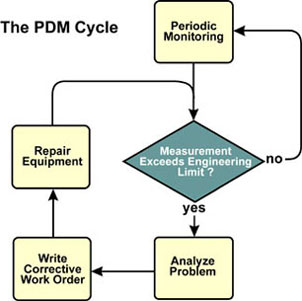
The PDM Cycle

Once a new piece of critical equipment has been added to the program and baselined, it enters the PDM cycle, graphically shown at right.

The established parameters are measured periodically (weekly, biweekly, monthly, etc.). If the measurement exceeds the established engineering limit, it must be analyzed further.

Analysis can take many forms. For example, a vibration signature can be taken on rotating equipment, such as a motor or blower. A trained analyst may review the signature for common problems, such as misalignment and imbalance, as well as for not-so-common problems, like resonance.

Once the source of the problem is determined, the best repair activity can be chosen. If the engineering limit is set low enough, there will still be plenty of time to correct the problem before further damage occurs.

Correction of the root problem allows the equipment to re-enter the periodic monitoring program.

The Spectrum Of PDM

There has been a historical misconception that equipment failures cannot be predicted. However, with predictive technology, a vast number of equipment failures can be predicted. Vibration measurement on rotating equipment is probably the best known of current predictive applications, but other categories of commercial and industrial equipment also benefit from a predictive approach. (See Table 1.)
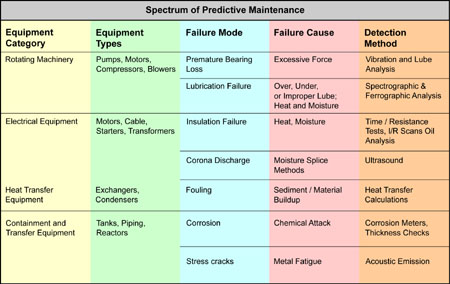
Table 1. The spectrum of predictive maintenance.


The Mortality Of Machinery

Researchers into the reliability of equipment recognize that within a collection of machines there is a definite pattern of life spans. In practice, this pattern manifests itself when a collection of machinery is subjected to rigorous operation. The plot of typical life spans is shown in the so-called bathtub curve.
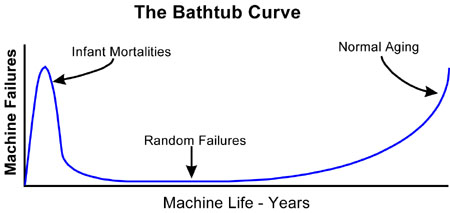


Among collections of equipment, there is a rather high incidence of early failures, called infant mortalities. Most equipment that survives infancy will continue to perform with few failures occurring. In time, however, the failures begin to increase until the last of the group succumbs.

Finding The Parameters

The failures that form the latter part of the curve are caused by identifiable physical phenomena. Depending upon the complexity of the machine, there may be several aging processes at work in a single piece of equipment, any of which may cause the ultimate failure. These processes are usually related to the basic physics of the materials and how the machine is used.

Knowledge of the physical properties of materials comes from either theoretically or empirically derived conclusions. To understand how failures can be predicted, the mortality of machinery and the finding of parameters need to be understood.

Looking for quick answers on air conditioning, heating and refrigeration topics? Try Ask ACHR NEWS, our new smart AI search tool. Ask ACHR NEWS →

For example, Ohm's law and the theory of potential difference follow theoretically from Maxwell's equations for electromagnetic fields and define the nature of electrical current in conductors and insulators. By contrast, many parameters used to predict failures follow from empirical studies and the application of statistical analysis to actual failures. For example, experiments in the 1930s showed that measurement of forces on bearings can be accomplished by measuring the total movement of the machine during operation along with the speed of this movement. Of course, this movement is vibration. Thus, forces on bearings can be determined by measuring vibration at or near the bearings.

Table 2. Rotating machinery ratings.

Defining Limits

The measurement of a physical parameter in itself is not enough to detect the destructive effects on a machine or process. As noted, it is important to establish a limit or rate of change in the parameter that may be excessive or damaging.

One method of developing a limit requires that a number of failures be observed before a safe limit is established. This method is understandably objectionable to people operating a facility. Prudent management of a PDM program requires that limits be tested at the same time as the monitoring of other factors on a device. Whenever time permits, the device in question is taken out of service and thoroughly inspected for the defect or failure mode in question. Ideally the limit will be set at a measurement value just below the point corresponding to the first discovery of irreparable or costly defects.

Many engineered limits have already been established for equipment by manufacturers, professional societies, and industrial groups. For example, the Vibration Institute, a not-for-profit professional organization, and other organizations have established levels of equipment health as a function of vibration velocity based on experiments. A simplification of this equipment health data is shown in Table 2. This table is useful for categorizing vibration levels on most commercial/industrial equipment operating between 600 rpm and 3,600 rpm.

By applying these existing limits, service contractors and facility managers can readily apply PDM to critical equipment and begin experiencing the cost efficiencies of the predictive approach.

Michael V. Brown is president of New Standard Institute Inc., Milford, Conn. New Standard Institute provides seminars, computer-based training programs, and consultations in the field of maintenance management and improvement. For more information, call 888-783-1582, e-mail nsi@newstandardinstitute.com, or visit www.newstandardinstitute.com.

Publication date: 06/02/2003

Share This Story

Looking for a reprint of this article?
From high-res PDFs to custom plaques, order your copy today!


Recommended Content

JOIN TODAY
To unlock your recommendations.

Already have an account? Sign In

  • HVAC-enrollment

    The Trades Are Back: HVACR Programs See Nearly 30% Enrollment Spike

    A new wave of future technicians is entering the pipeline.  
    News
    By: Matt Jachman
  • 2025 Top 40 Under 40

    2025 Top 40 Under 40 HVACR Professionals List

    The 11th annual Top 40 Under 40 list highlights those...
    News
    By: Hannah Belloli-Oster
  • LG Ductless Mini-Split Systems

    The 9 Types of Heat Pumps

    As the U.S. moves toward electrification, heat pumps are...
    News
    By: Joanna R. Turpin
Subscription Center
  • Create an Account
  • Start a Subscription
  • Manage My Account
  • Sign Up for Newsletters
  • Visit Customer Service
  • Update Preferences

More Videos

Sponsored Content

Sponsored Content is a special paid section where industry companies provide high quality, objective, non-commercial content around topics of interest to The News audience. All Sponsored Content is supplied by the advertising company and any opinions expressed in this article are those of the author and not necessarily reflect the views of The News or its parent company, BNP Media. Interested in participating in our Sponsored Content section? Contact your local rep!

close
  • Piggy Bank
    Sponsored byWatercress Financial

    Energy Prices, Inflation, and HVAC: What Today’s Homeowners Care About

  • Refrigerated Food
    Sponsored bySolstice Advanced Materials

    R-455A Refrigeration: A Cold Storage Solution for the Future

  • Airex Rooftop Units
    Sponsored byAirex Manufacturing Inc

    Consolidating Roof Penetrations: A Growing Trend in Multifamily HVAC Design

Popular Stories

HVAC-Price-Increase-graphic

HVAC Price Increase List: June 2026

Trump-Section-232.jpg

Trump Reduces Section 232 Tariffs on HVAC Equipment to 15%

R410A-Refrigerant-Cylinder.jpg

Refrigerant Recovery is a Revenue Opportunity

Heat-pump-cutaway.jpg

PFAS Rules and A2L Building Codes Continue to Evolve

Midea-training.jpg

HVAC Workforce Crisis Expands Beyond Technicians to Instructor Shortages

View The ACHR NEWS
Centennial Anniversary Timeline

The ACHR News Timeline Chart
Submit a Letter
Submit a letter to our editors.

Events

November 6, 2025

Next-Gen Data Center Cooling: HVAC Innovation and Real-World Solutions

On Demand As AI workloads and high-density computing push traditional cooling methods to their limits, the data center industry is accelerating the adoption of next-generation HVAC technologies.

June 17, 2026

Decarbonization Without Disruption

This webinar will explore practical HVAC decarbonization strategies that minimize disruption while maximizing long-term performance and ROI.

View All Submit An Event

Poll

Summer Staff

Are you fully staffed for the summer season?
View Results Poll Archive

Products

BNI Mechanical/Electrical Square Foot Costbook, 2026 Edition

BNI Mechanical/Electrical Square Foot Costbook, 2026 Edition

See More Products
Decarbonization Without Disruption - Free Webinar - 6/17/2026

Related Articles

  • Isothermal humidifier

    A Proactive Approach to Humidifier Performance

    See More
  • Building automation

    Applying the Building Automation Systems of the Future

    See More
  • troubleshoot refrigeration system

    Properly Applying the Touch Test

    See More

Related Products

See More Products
  • Lessons Learned in a Boiler Room: A common sense approach to servicing and installing commercial boilers

  • Green Tips for Building Maintenance Engineers

  • Tech_CommRef_Guide_Small.jpg

    Technician’s Guide & Workbook for Quality Maintenance on Commercial Refrigeration Equipment

See More Products

Events

View AllSubmit An Event
  • September 9, 2025

    How Maintenance Plays into the HVAC Decarbonization Trend

    On Demand This webinar will explore maintenance strategies for advanced HVAC systems, including VAVs and demand-controlled ventilation.
View AllSubmit An Event

Related Directories

  • Alliance to Save Energy

    Coalition of business, government, environmental, consumer leaders promoting the efficient and clean use of energy worldwide to benefit consumers, the environment, the economy, national security.
  • Daikin Applied

    A wholly owned subsidiary of Daikin Industries Ltd., Daikin Applied delivers engineered advanced HVAC technology for commercial, industrial and institutional customers with knowledgeable application expertise.
×

Sign Up. Stay Informed.

The #1 trusted source for the HVACR industry since 1926

SUBSCRIBE
  • RESOURCES
    • Advertise
    • Contact Us
    • Advisory Board
    • Classifieds
    • Submit a Letter
    • Directories
    • Store
  • ACCOUNT CENTER
    • Create an Account
    • Start a Subscription
    • Manage My Account
    • Sign Up for Newsletters
    • Visit Customer Service
    • Update Preferences
  • SERVICES
    • Marketing Services
    • Reprints
    • Market Research
    • List Rental
    • Survey/Respondent Access
  • STAY CONNECTED
    • LinkedIn
    • Facebook
    • Instagram
    • YouTube
    • X (Twitter)
  • PRIVACY
    • PRIVACY POLICY
    • TERMS & CONDITIONS
    • DO NOT SELL MY PERSONAL INFORMATION
    • PRIVACY REQUEST
    • ACCESSIBILITY

Copyright ©2026. All Rights Reserved BNP Media, Inc. and BNP Media II, LLC.

Design, CMS, Hosting & Web Development :: ePublishing