Alternatives For Dehumidification In Commercial Buildings
Market Drivers
The commercial building market for dehumidification systems has been largely driven by concerns over indoor air quality (IAQ) and energy usage. Ironically, one of the major causes of IAQ problems has been revised code requirements that have necessitated more outdoor air be introduced into buildings. As a result, outdoor air today can account for up to 80 percent of the dehumidification load in a building and can tax the ability of existing A/C systems to handle this increased latent load.Applications
Schools: A comfortable, healthy environment is required for proper teaching and learning to take place. Concerns over illnesses caused by air-borne bacteria are another motivating factor. To satisfy these concerns outside air must be continuously introduced during occupied periods. Libraries require moisture control to prevent the growth of mold. Gymnasiums require floor protection. Locker rooms, showers, and swimming pools need protection from mold, corrosion, and condensation.Restaurants: As a result of kitchen exhausts and latent loads created by cooking and customers, restaurants require the introduction of large amounts of outdoor air. Without proper dehumidification, mold and mildew can contaminate kitchen areas, dining areas can become cold and clammy, condensation can drip from supply diffusers onto customers and tables, and floors can become slippery. All of this could add up to health concerns, customer dissatisfaction, and potential lawsuits.
Hotels: Mold and mildew caused by excess humidity is a constant concern for hotels, particularly those in warm, moist climates. In addition to customer dissatisfaction, mold and mildew can increase maintenance costs by shortening the time between room remodels.
Food stores: High humidity can create havoc in supermarkets as reach-in glass doors fog up, the duration and frequency of defrost cycles is increased, and cooling-related energy use goes up. Defrost issues create additional problems as product temperatures can rise above the recommended U.S. Food and Drug Administration levels and product life can be shortened.
The Economic Benefits Of Humidity Control
Proper dehumidification can provide economic benefits through reduced operating costs, better IAQ, increased comfort levels, and better product quality. For example, in manufacturing facilities dependent on maintaining proper humidity levels, better humidity control means increased productivity through less downtime and product loss. In hotels, the elimination of mold and mildew can prolong the life of room furnishings, reducing the need for capital expenditures. Controlling humidity can also extend the life of the physical plant equipment by eliminating corrosion.
Types Of Dehumidification Systems And Their Benefits
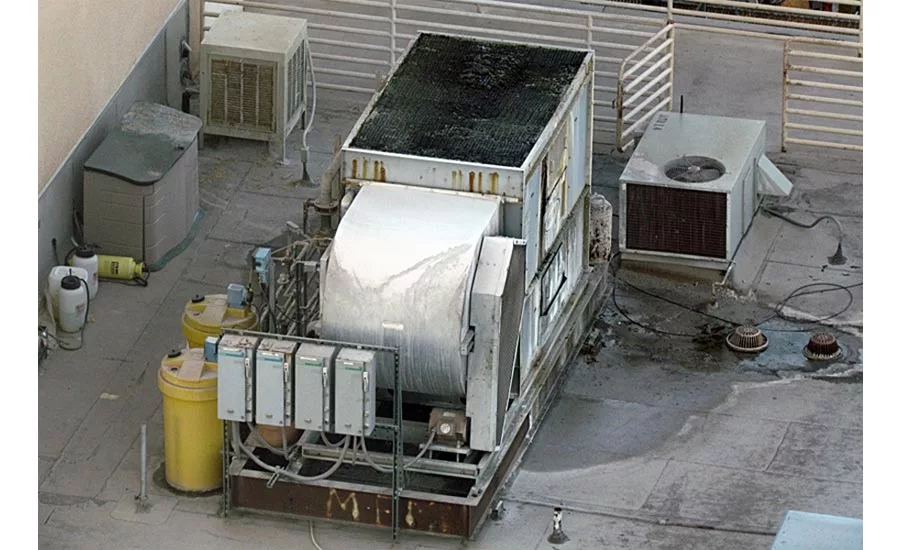
Desiccant systems: These have become increasingly popular in recent years because of lower equipment costs achieved through economies of scale, modular designs, and the use of silica gel wheels. In desiccant systems, a desiccant wheel is used to remove moisture from the air. The dry air is then cooled, and the moisture that has been absorbed in the wheel is removed by adding heat, thereby regenerating the desiccant and making it available to absorb more moisture.It should be noted that whereas the reactivation heat in the original desiccant systems was produced by burning natural gas, all-electric desiccant systems are now available. These new desiccant systems are extremely efficient and simple in that they use rejected heat from the condenser to regenerate the desiccant wheel.
The all-electric desiccant systems can be applied in two ways. First, they can be used as a dehumidifier to treat 100 percent makeup air and work in conjunction with existing A/C systems to provide operators with the ability to control temperature and humidity independently. Secondly, they can be applied as a stand-alone air conditioner with a built-in dehumidifier. In these applications, the system handles the cooling load and dehumidifies with the desiccant wheel to handle the latent load. When there is a call for cooling only, they can help lower energy costs by providing a coefficient of performance (COP) that is higher than a typical air conditioning system. The industry is quickly learning that by controlling the humidity to 50 percent rh or less, and independent of temperature, thermostats can be raised to 77-78 degrees F, yielding great energy savings. For every degree F the set points are raised, a 5 percent reduction in air conditioning energy is realized.
Enthalpy wheels: Enthalpy wheels use a desiccant-coated honeycomb to absorb moisture. They differ from desiccant systems in that the wheels contain very little desiccant, turn much faster, and use exhaust air rather than heated air to reactivate the desiccant. Enthalpy wheels extract moisture from incoming outside air and transfer it to exhaust air. However, this only works when the exhaust air is drier than the outside air. Furthermore, moisture removal is usually less than 70 percent of the difference between the two airstreams, and the exhaust air also must be free of oil and grease and brought to the same location as the incoming air. And since enthalpy wheels rely on the moisture differential between the opposing airstreams to work, when the differential is low, their performance drops off.
DX systems: The traditional DX approach to dehumidification is to overcool the supply air then reheat it. In doing so, additional moisture is removed and the air is delivered to the space at the desired temperature. While many facilities still use this method, in these days of increased energy awareness, it is falling out of favor. Furthermore, in some instances the overcool/reheat strategy still may not provide sufficient dehumidification to satisfy the requirements of the application.
Looking for quick answers on air conditioning, heating and refrigeration topics? Try Ask ACHR NEWS, our new smart AI search tool. Ask ACHR NEWS
Heat pipes: Heat pipes, which are sealed tubes containing refrigerant, are added to A/C units to increase their dehumidification capability. Heat is transferred through the evaporation of the refrigerant at one end of the tube as it absorbs heat, and the condensing of the refrigerant at the other end of the tube as the heat is dissipated. In the dehumidification application, heat pipes are arranged in a coil configuration. A pre-cooling coil is installed in the airstream prior to the evaporator, and piped to a reheat coil installed in the airstream after the evaporator. By passively removing sensible heat from the incoming airstream with the pre-cooling coil, the evaporator is able to extract more humidity without increasing energy use. The reheat coil then adds roughly the same amount of heat as the pre-cooling coil removed, so the air is delivered to the space at the desired temperature.
The application of heat pipes is limited by the availability of space within the A/C units for the pre-cooling and reheat coils. In addition, there is a finite limit to which they can increase the dehumidification capability of an existing system.
Dual path systems: These systems work by separately dehumidifying and cooling outdoor air, then mixing it with conditioned return air before ducting it into the space. Part load operation is very efficient as the system can be controlled by CO2 or occupancy sensors. A predetermined schedule can vary the ventilation airflow rate to meet changing ventilation air requirements while maintaining desired temperature and humidity levels under part load conditions. In most instances, though, dual path systems must be custom-manufactured so they can be relatively expensive and require a long wait.
Summary
Once a difficult and inefficient process, today's dehumidification technologies are more reliable, affordable, and efficient. While end users have a number of alternative solutions to choose from, not every technology will be appropriate for every application. Customers are advised to consult with experts who are familiar with these technologies before a selection is made.Marc Sandofsky, of Natick, Mass., is an internationally known writer on the subjects of refrigeration, air conditioning, energy conservation, and the electric utility industry. The former engineering editor of Store Equipment and Design magazine and former editor-in-chief of Refrigeration System and Store Design magazine, Sandofsky holds a B.S. degree in mechanical engineering and a B.A. degree in economics from Tufts University, and an M.B.A. in marketing from Babson College. He can be reached at sandofsky@aol.com.
For more information on dehumidification in commercial buildings, visit the Munters Web site at www.munters.com.
Publication date: 11/15/2004
Looking for a reprint of this article?
From high-res PDFs to custom plaques, order your copy today!