ACHR News
search
Ask ACHR NEWS AI
cart
facebook twitter instagram linkedin youtube
  • Sign In
  • Subscribe
  • Sign Out
  • My Account
ACHR News
  • NEWS
    • Breaking News
    • New HVAC Products
    • Featured Products
    • Manufacturer Reports
    • HVAC Data
    • Legislation
    • ACHR NEWS Centennial
  • RESIDENTIAL
    • Air Conditioners
    • Furnaces
    • Residential Heat Pumps
    • Ductless
    • Residential IAQ
    • Testing, Monitoring, Tools
    • Components & Accessories
  • COMMERCIAL
    • Air Handlers
    • Rooftop Units
    • Chillers and Cooling Towers
    • Commercial Heat Pumps
    • Boilers and Hydronics
    • VRF/Ductless
    • Commercial IAQ
  • REFRIGERATION
    • Refrigerants
    • Refrigerant Regulations
    • Leak Management
  • CONTRACTOR PRO
    • Geothermal
    • Homeowner Study
    • VRF and VRV Ductless
    • Unitary Trends
  • EDUCATION
    • Training and Education
    • Business Management
    • Service and Maintenance
    • Continuing Education
    • Market Research >
      • HVAC Brand Awareness Report
      • VRV, VRF, VRVZ Report
      • Unitary Trends Report
      • Water Heat Professionals Report
    • Webinars
    • Sponsor Insights
    • eProducts Info
    • White Papers
  • EVENTS
    • HVAC Contractor Forum
    • Industry Events and Webinars
  • MEDIA
    • Videos
    • AHR Expo 2025 Videos
    • Podcasts >
      • ACHR News Podcast
      • HARDI Podcasts
      • AHR Expo Podcasts
      • ACCA Podcasts
    • Interactive Spotlights
    • Quizzes
    • eBooks
    • HVAC Talkback
  • HVAC GROUP
    • ACHR NEWS >
      • Current Issue
      • Digital Edition
      • Subscribe
    • Distribution Trends
    • SNIPS NEWS >
      • Join SNIPS NEWS
    • Engineered Systems News >
      • Join ES News
    • HVACR Directory
    • Contests
    • Newsletters
    • Contact
    • Advertise
    • My Account
HVAC ContractingTechnical

A Primer On Energy Recovery Ventilators

April 29, 2003
This article provides the basics on energy recovery ventilators (ERVs): what they are, what they do, how they are installed, and service recommendations.

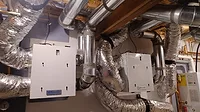
An Aprilaire energy recovery ventilator, from Research Products Corp., is shown installed.

What They Are

An energy recovery ventilator (ERV) moves fresh outdoor air into a home while at the same time moving stale indoor air out of the home, to improve indoor air quality. Like a heat recovery ventilator (HRV), the ERV recovers the sensible energy (temperature) of the outgoing air stream. Unlike an HRV, the ERV also transfers latent energy (moisture). The exchange of latent energy and sensible energy between the airstreams is achieved through the special material of a core or with a desiccant wheel.

Airflow (cfm) and apparent sensible effectiveness (ASE) are the major features of an ERV. Often units will also offer filters, controls, drain, defrost, etc. Don’t get too caught up in available options, though. An ERV works best when operated constantly. The moisture transfer keeps the core above dewpoint temperatures, preventing the core from freezing in all but the most extreme conditions. And filtering only a small amount of the air in the home will not replace a good whole house air cleaner.
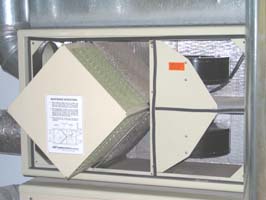
The Aprilaire energy recovery ventilator is shown with cover off. The ERV recovers the sensible energy (temperature) of the outgoing air stream and also transfers latent energy (moisture).

What They Do

An ERV is designed to provide constant ventilation. Since transferring both temperature and moisture is beneficial in both winter and summer, the ERV provides year-round fresh air.

During the heating season the outdoor air is colder and generally has less moisture than the indoor air. The moisture transfer core of an ERV allows the incoming air to be humidified by the outgoing airstream. Some dehumidification of the house does occur, but not the over-dehumidification that can be experienced with an HRV or a fresh air intake. This provides more control of humidity in all but the most northern climates.

During the cooling season the air conditioning coil removes energy from the air. This lowers the temperature of the air to its dewpoint. At dewpoint the coil must remove more energy to condense the water out of the air before a temperature drop will occur. This condensation represents a significant amount of energy, and cost, to cool the air. An ERV will transfer moisture from the outdoor airstream coming into the home to the outgoing airstream from inside the home, saving the energy required for an air conditioner to condense and remove the humidity.

How They Are Installed

An ERV can be installed in any space where an air exchange is desired. They are typically installed in conjunction with the HVAC system, but can be installed completely independent of it. Installations using existing ductwork save time and money by using the HVAC return duct to distribute the fresh air to the home.

In every application, the flow of the fresh air into and the exhaust out of the home should be properly measured and balanced. Balancing is important to maintain the optimum ASE as well as prevent pressurizing or depressurizing the home. When installing an ERV in a home, make sure that any ductwork to a grille in the home is insulated for sound. Sizing is exactly the same as an HRV. Take the cubic footage of the area or home (square footage times ceiling height), multiply by the desired or required air changes per hour (ACH), and divide by 60 minutes per hour. This will give you the required volume for the ERV (in cfm).

For example: In a 2,200-square-foot home with 8-foot ceilings you need 0.35 ACH.

2,000 square feet x 8 ft = 16,000 cubic feet
16,000 cubic feet x 0.35 ACH = 5,600 cubic feet per hour
5,600 cubic feet per hour/60 minutes per hour = 93.3 cubic feet per minute (cfm)

Service Recommendations

Every six months the units will need to be cleaned and inspected. Most units contain washable filters; clean and re-coat with filter adhesive as necessary. If the filters are disposable, replace them as recommended. Clogged filters will lead to airflow restriction.

The energy transfer core or wheel can be cleaned by lightly vacuuming with a soft brush attachment. Most manufacturers do not recommend washing or submerging the core or wheel.

Looking for quick answers on air conditioning, heating and refrigeration topics? Try Ask ACHR NEWS, our new smart AI search tool. Ask ACHR NEWS →

The most often overlooked service is to assure the fresh air intake and exhaust vents are clean. Outdoor grilles can become clogged with lawn debris, insects, and windblown material. Clogging of a grille reduces the transfer of energy and can put the home under negative or positive pressure.

Doug Dettlaff is product coordinator for Research Products Corp., Madison, Wis. For more information, call 800-334-6011, ext. 870, or visit www.aprilaire.com.

Publication date: 05/05/2003

Share This Story

Looking for a reprint of this article?
From high-res PDFs to custom plaques, order your copy today!


Recommended Content

JOIN TODAY
To unlock your recommendations.

Already have an account? Sign In

  • HVAC-enrollment

    The Trades Are Back: HVACR Programs See Nearly 30% Enrollment Spike

    A new wave of future technicians is entering the pipeline.  
    Training and Education
    By: Matt Jachman
  • 2025 Top 40 Under 40

    2025 Top 40 Under 40 HVACR Professionals List

    The 11th annual Top 40 Under 40 list highlights those...
    HVAC Light Commercial Market
    By: Hannah Belloli-Oster
  • LG Ductless Mini-Split Systems

    The 9 Types of Heat Pumps

    As the U.S. moves toward electrification, heat pumps are...
    Ground Source Heat Pumps
    By: Joanna R. Turpin
Subscription Center
  • Create an Account
  • Start a Subscription
  • Manage My Account
  • Sign Up for Newsletters
  • Visit Customer Service
  • Update Preferences

More Videos

Sponsored Content

Sponsored Content is a special paid section where industry companies provide high quality, objective, non-commercial content around topics of interest to The News audience. All Sponsored Content is supplied by the advertising company and any opinions expressed in this article are those of the author and not necessarily reflect the views of The News or its parent company, BNP Media. Interested in participating in our Sponsored Content section? Contact your local rep!

close
  • Piggy Bank
    Sponsored byWatercress Financial

    Energy Prices, Inflation, and HVAC: What Today’s Homeowners Care About

  • Refrigerated Food
    Sponsored bySolstice Advanced Materials

    R-455A Refrigeration: A Cold Storage Solution for the Future

  • Airex Rooftop Units
    Sponsored byAirex Manufacturing Inc

    Consolidating Roof Penetrations: A Growing Trend in Multifamily HVAC Design

Popular Stories

HVAC-Price-Increase-graphic

HVAC Price Increase List: June 2026

Trump-Section-232.jpg

Trump Reduces Section 232 Tariffs on HVAC Equipment to 15%

Refrigerants-and-gauge.jpg

HVAC Industry Warns of Counterfeit Refrigerants Entering U.S. Supply Chain

Midea-training.jpg

HVAC Workforce Crisis Expands Beyond Technicians to Instructor Shortages

U.S. Supreme Court building

95% Furnace Efficiency Rule to Get New Hearing

View The ACHR NEWS
Centennial Anniversary Timeline

The ACHR News Timeline Chart
Submit a Letter
Submit a letter to our editors.

Events

November 6, 2025

Next-Gen Data Center Cooling: HVAC Innovation and Real-World Solutions

On Demand As AI workloads and high-density computing push traditional cooling methods to their limits, the data center industry is accelerating the adoption of next-generation HVAC technologies.

June 17, 2026

Decarbonization Without Disruption

This webinar will explore practical HVAC decarbonization strategies that minimize disruption while maximizing long-term performance and ROI.

View All Submit An Event

Poll

Summer Staff

Are you fully staffed for the summer season?
View Results Poll Archive

Products

BNI Mechanical/Electrical Square Foot Costbook, 2026 Edition

BNI Mechanical/Electrical Square Foot Costbook, 2026 Edition

See More Products
Decarbonization Without Disruption - Free Webinar - 6/17/2026

Related Articles

  • Mitsubishi Electric, HVAC Advanced Products Div.: Energy Recovery Ventilators

    See More
  • SUNDAY - January 28, 2001: Energy Recovery Ventilators: Why or Why Not?

    See More
  • ERV

    Tips for Ducting Residential Energy Recovery Ventilators

    See More

Related Products

See More Products
  • srepm.png

    System Recovery & Evacuation

See More Products

Related Directories

  • Energy Recovery

    Energy Recovery's PX G1300 pressure exchanger for CO2 refrigeration systems lowers operating costs and energy consumption, increases efficiency, and reduces emissions.
  • Nu-Air Ventilation Systems Inc.

    Designs and manufactures high quality heat and energy recovery ventilators (H/ERV). Markets are commercial, residential, multi-unit residential and institutional, 40-4000 cfm.
  • A-Gas Rapid Recovery

    We provide refrigerant recovery services for HVAC, refrigeration, demolition, and marine industries. We are dedicated to delivering high-speed EPA-compliant recoveries to our customers.
×

Sign Up. Stay Informed.

The #1 trusted source for the HVACR industry since 1926

SUBSCRIBE
  • RESOURCES
    • Advertise
    • Contact Us
    • Advisory Board
    • Classifieds
    • Submit a Letter
    • Directories
    • Store
  • ACCOUNT CENTER
    • Create an Account
    • Start a Subscription
    • Manage My Account
    • Sign Up for Newsletters
    • Visit Customer Service
    • Update Preferences
  • SERVICES
    • Marketing Services
    • Reprints
    • Market Research
    • List Rental
    • Survey/Respondent Access
  • STAY CONNECTED
    • LinkedIn
    • Facebook
    • Instagram
    • YouTube
    • X (Twitter)
  • PRIVACY
    • PRIVACY POLICY
    • TERMS & CONDITIONS
    • DO NOT SELL MY PERSONAL INFORMATION
    • PRIVACY REQUEST
    • ACCESSIBILITY

Copyright ©2026. All Rights Reserved BNP Media, Inc. and BNP Media II, LLC.

Design, CMS, Hosting & Web Development :: ePublishing