Tips for Ducting Residential Energy Recovery Ventilators
Sizing, positioning and ducting an ERV to bathroom vents, not only circumvents traditional fans, but introduces clean outdoor air strategically balanced to the exhaust-CFMs.

Ducting energy recovery ventilators (ERV) can be challenging for HVAC contractors because no two installations are the same.
ERVs bring in outdoor air that’s energy-efficiently preheated or precooled through a thermal exchange with return air before exhausting. The most commonly-applied technologies that execute the thermal exchanges are static plate enthalpy core or enthalpy wheel-based equipment.
When they first appeared a couple of decades ago, ERVs were very simple components to install. Now however, after many newly innovated features, national code changes and other factors, contractors need to know all the variables to consider when installing and ducting a residential ERV system.
One major ducting change is that the International Residential Code (IRC) now allows ERVs to circumvent the expense, wiring and capital costs of traditional bathroom fans. Instead, ERVs can be ducted to bathrooms for balanced exhaust and supply, the latter which most traditional fan-based bathroom ventilation doesn’t offer. New bathroom ventilation strategies are garnering continual interest amid the current trend of indoor air quality (IAQ).
Most IRC-based state codes call for a paltry 20-CFM even though most manufacturers surpass that minimum requirement with 60 to 100-CFM models. Traditional bathroom fans at higher CFMs are significantly noisier. They also don’t directly supply tempered outdoor air, but instead draw it from other parts of the house.
Sizing, positioning and ducting an ERV to bathroom vents, not only circumvents traditional fans, but introduces clean outdoor air strategically balanced to the exhaust-CFMs. Since bathrooms are a potential habitat for mold, mildew and odors, bathroom ERVs with multiple fan speed staging, via electronically commutated (EC) motor fans, can be set for quiet, energy-efficient, 24/7 low speed ventilation. Furthermore, late ERV models now come with boost modes capable of more than doubling CFM ventilation during adverse IAQ events such as showering. Boost modes are activated with a push button switch, or automated by a variety of sensors, such as motion or humidity detectors. Timers and delays can be programmed to return to low continuous CFM operation.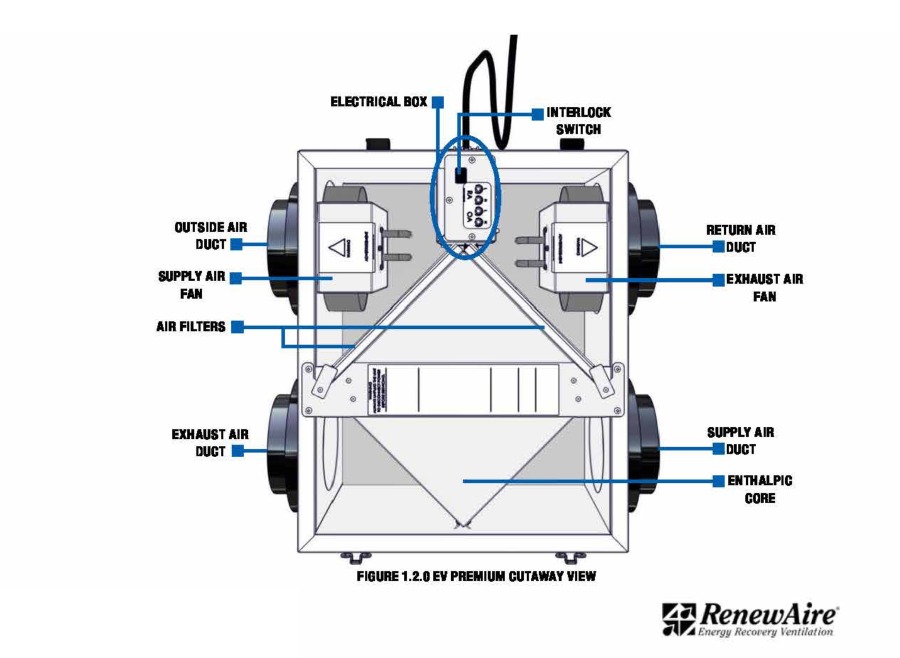
Ducting Tips
ERVs require four ducts: an outdoor supply and exhaust; and an interior supply and return. Six-inch flex or rigid duct is conventional, although units larger than 250-CFM may be designed for 8-inch duct. Most ERVs are designed with six-inch outlets/inlets, but also have 8-inch adaptor collars to help reduce static pressure on long runs over 30 feet.
As a bathroom fan substitute, the ERV pulls air from the bathrooms and uses it to preheat or precool incoming outdoor air. The outdoor air becomes a percentage of the air handler’s supply air to other rooms in the house. For the best potential duct static pressure differences, the ERV should be centrally located between the bathrooms, exterior walls and air handler so that all duct runs are of similar lengths.
The interior and external vapor barrier qualities of R-6 to R-8 flex duct helps eliminate condensation for the outdoor supply and exhaust. Rigid duct must be insulated and sealed from condensation-producing air leaks.
A common bathroom exhaust ducting mistake is reducing the 6-inch ERV take offs to the 4-inch duct that’s commonly used in bathroom fans. Reducing would cut the potential CFMs approximately 20 percent or more. Increasing velocity offsets the CFM loss, but creates more noise. Ideally, the bathroom exhaust vent collar/box should be able to accept the 6-inch round duct from the ERV.
Depending on the ERV methodology, some models may require condensate drains and piping. Most ERVs using static plate enthalpy cores don’t extract condensation from the air, however ERVs with enthalpy wheels do require condensate management. Therefore, core-based ERVs can be conveniently positioned (upright, sideways, upside down) anywhere in the residence, because of no condensate drain restrictions.
Another important tip is to separate the exterior supply and exhaust vents by at least 10 feet. This will prevent drawing in exhausted air into the supply air.
Hydronic heated or mini-split air conditioned homes with no air handler to connect an ERV, can use stand-alone ERVs in a crawlspace or attic to bring in outdoor air ventilation to any room.
ERVs are the wave of the future as more consumers demand better IAQ. Jurisdictions across the nation are already mandating their use for improved energy efficiency. However, IAQ and energy efficiency can only be optimized with proper ducting.
Looking for a reprint of this article?
From high-res PDFs to custom plaques, order your copy today!