Cooling Tower Technology: An Historical Perspective
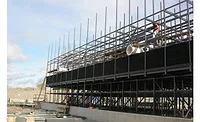
The cooling loads created by the generation of electric power led to the development of large, custom-built structures typically constructed of wood. Cooling tower development continued to be based on the needs of these power-and-process users until the emergence of the commercial air conditioning market, which led the development of the modular, independently certified cooling towers of today.
HVAC Requirements Spawn New Developments
The development of the commercial air conditioning industry defined new criteria for cooling tower development. Contrary to process cooling towers, equipment intended for air conditioning applications had to be compact enough to fit in the restricted spaces available on commercial buildings. Cooling towers also had to meet the construction schedules of the rapidly growing demand for air conditioned buildings that characterized post-World War II America.With most air conditioning installations located in heavily populated urban areas, sound became a very important application consideration, and many municipal building or fire codes discouraged the use of combustible materials, including wood, in cooling tower construction. The above criteria could not be easily met by many cooling tower designs of the day that traced their origins to industrial applications.
By the late 1950s, factory-assembled cooling towers, incorporating quiet centrifugal fans and constructed of galvanized steel, were developed for commercial air conditioning projects. Innovations during the 1960s combined the cold water basin and fan sections of these factory-assembled, forced-draft cooling towers into one piece.
This design innovation reduced space requirements and operating weights, facilitated cleaning of the cold water basin, provided protection for mechanical components, and simplified access to the fan-drive system. By the 1970s, the application of these cooling towers on commercial air conditioning systems accounted for approximately half of the hvac cooling tower installations.
Energy Crisis Fuels Change
The energy crisis of the mid-1970s placed increased awareness on energy efficiency in all aspects of American life, including commercial air conditioning systems. The operating characteristics of the centrifugal fan cooling tower began giving way to the energy reduction offered by the propeller fan units of industrial-style crossflow cooling towers. In the ensuing years, design strategies focused on incorporating the hvac cooling tower characteristics into the propeller fan, industrial crossflow cooling tower.As development progressed into the 1980s and 90s, designs continued to concentrate on increasing thermal efficiency, simplifying maintenance, and reducing installation costs.
The development of new, high-efficiency film fills, produced from lightweight, flame-retardant PVC, reduced the size and weight of crossflow cooling towers. Propeller fans, originally selected solely on air-handling considerations, incorporated sound characteristics as important selection criteria.
New, belt-driven fan-drive systems were developed to provide reliable unit operation and reduce maintenance costs associated with the gear-driven systems of industrial-style units. Internal piping systems that reduced field piping requirements and allowed service personnel to perform routine maintenance of the water distribution system without mounting the fan deck were developed for crossflow cooling towers.
Looking for quick answers on air conditioning, heating and refrigeration topics? Try Ask ACHR NEWS, our new smart AI search tool. Ask ACHR NEWS
Today, factory-assembled, crossflow cooling towers are considered to be the preferred configuration for air conditioning applications for their dependable, year-round operating reliability, accessible maintenance features, and low installation costs.
A significant milestone of the 1980s was the resurgence of a certification standard for the independent verification of cooling tower thermal performance. It had long been recognized that the thermal processes involved with cooling tower performance were not well understood, making the accurate prediction of thermal capabilities very difficult. Con-sequently, thermal ratings published by cooling tower manufacturers were only as reliable as the manufacturers’ best available technology.
In 1981, the Cooling Tower Institute (currently the Cooling Technology Institute or CTI) updated and revised its certification standard STD-201. STD-201 established a procedure for manufacturers to voluntarily obtain independent verification that a line of cooling towers performs in accordance with the manufacturers’ published thermal performance ratings.
CTI certification ensures that owners and operators receive full value for their investment because the cooling tower performs at full-rated capacity. Furthermore, it eliminates the potential for years of excessive operating costs due to deficient equipment, and can actually reduce first cost by eliminating the need to oversize equipment or to perform a field acceptance test to verify performance.
In 1996, STD-201 was expanded to include closed-circuit, as well as traditional open-circuit, cooling towers. Today, many manufacturers actively participate in the CTI Certification Program by voluntarily submitting their open- and closed-circuit cooling tower lines to the scrutiny of the certification process.
EPA Restrictions Bring Materials Advances
By the 1950s, galvanized steel had become the principal material of construction for factory-assembled cooling towers. The protective zinc layer of galvanized steel provided effective corrosion protection from the naturally corrosive environment found in service. Combined with an effective water treatment program, galvanized steel cooling towers are designed to provide exceptionally long service life for evaporative cooling equipment.In the 1970s, EPA regulations restricted the use of chromates, a widely used, highly reliable corrosion inhibitor in many cooling systems, including hvac systems. The resultant changes in water treatment programs were less effective at controlling corrosion rates, thereby increasing maintenance costs and potentially impacting the life of galvanized steel evaporative-cooling equipment.
In response, cooling tower manufacturers began using higher grades of galvanized steel for additional corrosion protection and incorporating non-metallic materials, where suitable. Stainless steel components became available as added-cost options for projects desiring extended equipment life.
The need for corrosion protection beyond that provided by galvanized steel alone, without the high cost of stainless steel, was answered in 1981 by the development of special hybrid polymer coating systems for galvanized steel. This cost-effective, additional corrosion protection for galvanized steel is still in widespread use today.
Today’s leading cooling towers combine the latest in advanced materials technology to achieve the optimum balance between corrosion resistance, product durability, long life, and cost. Based on their specific function, cooling tower components are designed using the materials with the best combination of corrosion resistance and physical properties.
Pugh has over 23 years experience in cooling tower application and operation for Baltimore Aircoil Co., Baltimore, MD. For more information, visit www.BaltimoreAircoil.com (website).
Publication date: 04/30/2001
Looking for a reprint of this article?
From high-res PDFs to custom plaques, order your copy today!