Is R-410A Here to Stay?
In a world of phaseouts and phasedowns, R-410A seems safe – for now
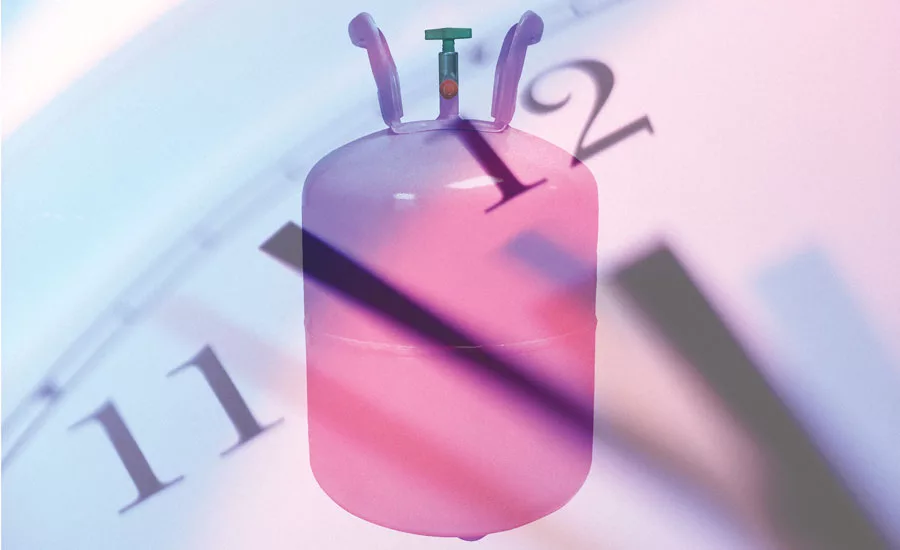
FORWARD THINKING: While many industry insiders anticipate R-410A will be available in new equipment and to service existing equipment for years to come, several are already preparing new technologies to overcome the hydrofluorocarbon’s elevated global warming potential.
What does the future hold for R-410A?
It may seem to be a simple — or even unnecessary — question, but the HVACR industry has seen a number of refrigerants go from being the “refrigerant of the future” to a mainstay in the marketplace to delisted in the span of one generation of equipment.
The U.S. Environmental Protection Agency (EPA) has not given any indication that it will target R-410A in residential applications, and under the Trump administration, the agency may perhaps be less aggressive than it was under the Obama administration and, therefore, less likely to push for additional refrigerant phasedowns. Those factors would seem to indicate that the future of R-410A in residential equipment is fairly secure.
However, one must consider that R-410A is a hydrofluorocarbon (HFC), and under the Kigali Amendment to the Montreal Protocol, developed countries — including the U.S. — have agreed to begin to reduce their usage of HFCs by 2019. Developing countries will begin reducing their usage in 2024 or 2028. The amendment, which needs to be ratified by the U.S. Congress, is designed to reduce HFC use by 85 percent between now and 2047.
Member companies of the Alliance for Responsible Atmospheric Policy, which represent more than 95 percent of U.S. HFC production and a majority of the manufacturing and other user industries, have pledged their commitment to the research, development, and commercialization of new technologies that concentrate on low climate impact. These businesses supported a global agreement under the Montreal Protocol to facilitate the orderly transition to such technologies.
Also consider that R-410A’s global-warming potential (GWP) is 2,088, and the refrigerant management program of the California Air Resources Board (CARB) defines any refrigerant with a GWP greater than or equal to 150 as a high-GWP refrigerant.
Finally, although R-410 has not been targeted by the EPA in residential applications, it will be delisted under the EPA’s Significant New Alternatives Policy (SNAP) program in new chiller applications, effective Jan. 1, 2024,
Looking for quick answers on air conditioning, heating and refrigeration topics? Try Ask ACHR NEWS, our new smart AI search tool. Ask ACHR NEWS
So where does R-410A go from here?
NOT TARGETED, BUT MOVING AHEAD
Ken Gayer, vice president and general manager, fluorine products, Honeywell Intl. Inc., said he is not aware of any EPA regulations that are targeting R-410A in residential applications.
“With respect to the HFC rules, which came out in 2015 [from the EPA] and 2016 [the second EPA rule and the Kigali Amendment], we’re not aware of any changes to those that would include R-410A used in residential air conditioning,” Gayer told The NEWS. “So, we’re going to continue providing that product to our customers.”
However, Gayer added that although R-410A has not been targeted in residential air conditioning to date, Honeywell is moving ahead in helping customers transition to next-generation products in other applications. The company is making large investments in low-GWP hydrofluoroolefins (HFOs) and thus brought new manufacturing plants on stream in 2014 and 2016. Another facility is due to open this year.
According to Gayer, investing makes the most sense, especially considering everything the industry has been through regarding refrigerants.
“Even though there have been no regulations targeting R-410A, anyone who’s not working on new technologies to address the GWP of R-410A would have to be crazy,” Gayer said. “We’re always working on development programs to provide new and better options for our customers.”
At Arkema, Matthew Ritter, global business director, fluorochemicals, noted that the largest use of R-410A is residential air conditioning and approximately two-thirds of all U.S. homes are air conditioned. In addition, approximately 6 million additional new units are being sold in the U.S. market every year.
“Arkema expects this trend to continue,” Ritter said. “R-410A will continue to be used in the new equipment and will be available to service existing equipment for many more years. Furthermore, both the OEM equipment and fluorochemical manufacturers have not yet recovered their investments made into R-410A technology and will not do so for quite some time.
“From a regulatory and environmental perspective, the U.S. EPA domestic program to manage the obligations under the Kigali Amendment has not been announced yet,” Ritter noted, adding that Arkema is committed to offering replacement products to meet the market’s needs for lower-GWP solutions.
PHASEDOWN VERSUS PHASEOUT
Stefanie Kopchick, North America marketing manager for refrigerants, The Chemours Co., pointed out the important distinction between a phaseout and a phasedown.
“Because R-410A is a non-ozone-depleting HFC refrigerant [non-chlorine containing], it is not subject to a phaseout at this time anywhere in the world in the way that R-11, R-12, R-502, or R-22 consumption and production are or have been,” Kopchick said. “However, in October 2016 in Kigali, Rwanda, 197 countries signed on to amend the Montreal Protocol to include a phasedown of consumption of HFC refrigerants, which includes the HFCs that are blended to produce R-410A.”
The Kigali Amendment includes a provision that each country has the right to determine how it will regulate HFCs to meet the required phasedown steps. Kopchick noted that this step-down process has always been used under the Montreal Protocol instead of product bans to provide countries flexibility in determining the most appropriate actions to take to meet society’s needs while still meeting the requirements of the treaty.
“We anticipate that certain sectors of the market that have low-GWP alternatives already available with low barriers to transition will transition to those alternatives earlier to enable countries, such as the U.S., to achieve their earlier step-downs,” Kopchick said. “This will allow other sectors, where alternatives are still under development, more time to identify, test, and adopt new products.”
In the U.S., the use of R-410A has not been restricted in any way for residential air conditioning, though in finalizing the SNAP Rule 21 in September 2016, the EPA did render R-410A unacceptable for use in new chiller applications beginning Jan. 1, 2024, Kopchick said. While the industry is actively testing low-GWP alternatives to R-410A, the leading candidates fall into the new ASHRAE’s low-flammability classification of A2L. As a result, updates to industry standards and codes are in progress and will be required prior to broad adoption in traditional residential and commercial split air conditioning systems, though earlier adoption in select applications, such as air-cooled chillers, is certainly a possibility.
“The date at which the U.S. industry will need to transition from R-410A to a different solution is by no means set, but given the work that is required to incorporate the new standards and codes and the timing of the step-down goals from the Kigali Agreement, it is likely that broad market transition from R-410A will not be required for some time,” Kopchick said.
She also added some clarification to the CARB classification.
“It’s important to note that CARB’s various proposals have differentiated GWP targets based on end-use applications, and the proposed GWP limit for air conditioning is not 150 GWP but rather less than or equal to 750 GWP,” she said. “The GWP of a particular refrigerant is only one consideration of the total climate impact of that choice, it’s the performance and energy efficiency of the refrigerants in the desired end-use application that’s of the utmost importance.”
WAIT FOR THE CODES
Bill Dietrich, product general manager, chillers, Daikin Applied Americas, noted there has been a great deal of work taking place to get A2L mildly flammable refrigerants recognized in the building codes. Until that hurdle is cleared, he’s advising customers to stick with R-410A and R-134a.
“We’ve been telling people that the best choices are R-410A and R-134a until we get the codes sorted out and can move to longer-term alternatives,” Dietrich said.
He added that despite the 2024 EPA SNAP program delisting of R-410A and R-134a for new chillers, he does not expect the EPA to target any other refrigerants for phaseouts until the industry has determined safety standards for A2L refrigerants.
“I don’t think we’re going to see a lot of movement on refrigerants until 2024,” Dietrich said. “By that time, if the A2Ls are in place, I think we will see the commercial market move first, like it did with R-22. The residential market would likely continue with R-410A.”
Therefore, the future of R-410A seems secure, at least as far as an EPA phasedown goes. The new administration in Washington — given its well-publicized objections to the Paris Agreement and ambivalence toward the Kigali Amendment — probably won’t make refrigerant phasedowns a priority.
The industry, however, will continue to move forward.
“The EPA rulings that have already happened are expected to remain in force. While the EPA may be less aggressive, the rest of the world is moving forward,” Dietrich said. “Daikin has committed to lower global warming products that have less impact on the climate, and we’ll continue down that path.”
ON SOLID GROUND
Gordon McKinney, vice president and COO, Icor Intl., said R-410A, HFCs in general, and the equipment HFCs are used in are less likely to be fast-tracked into obsolescence as a direct result of the Nov. 8 election.
“Pushing these products off the market would only lead to much higher costs for everyone,” McKinney said. “And even if they did completely phaseout HFCs worldwide, the impact on man-made climate change would be miniscule. There are many ways we can reduce emissions — if they actually need to be reduced — without the U.S. committing to another lopsided international treaty or more unenforceable regulations that would put even greater burdens on our people and businesses.”
McKinney believes the Trump administration will continue to push back on any and all agreements and/or proposed regulations that focus on carbon emissions.
“R-410A and the other HFCs — products that have proven to be safe, efficient, reliable, and economically practical for more than two decades — are on solid ground, as they should be.”
Publication date: 3/15/2017
Want more HVAC industry news and information? Join The NEWS on Facebook, Twitter, and LinkedIn today!
Looking for a reprint of this article?
From high-res PDFs to custom plaques, order your copy today!