Legionella, Your Customers, and ASHRAE 188P
Now is a good time for contractors — along with facility operators and engineering firms — to take a close look at ASHRAE’s pending Legionella standard. ASHRAE 188P, “Legionellosis: Risk Management for Building Water Systems,” could become a standard as early as July if the comments received on the latest draft are not deemed substantive enough to warrant another public review.
The Legionella risk reduction strategy set forth in 188P is to implement a water management plan for building water systems including cooling towers, evaporative condensers, whirlpool spas, ornamental fountains, misters, atomizers, air washers, humidifiers, and other devices that release water droplets. A management plan would be required for potable plumbing systems only in buildings that have any of the following: (a) multiple housing units with a centralized hot water system; (b) more than 10 stories; (c) housing for occupants over the age of 65; (d) health care for patients staying longer than 24 hours; or (e) an area housing or treating persons at especially high risk of contracting Legionnaires' disease.
ASHRAE 188P is consistent with the World Health Organization, Veterans Health Administration, and the U.S. Environmental Protection Agency (EPA) about the essential components each water management plan should include:
• A list of the water management plan team members. Teams typically consist of 10 or fewer people who oversee the program and make decisions about it. Many others are needed to implement the plan.
• A brief description of the building water systems, with flow diagrams. Salient information should be included for all of the building water systems, not just the ones prone to Legionella growth and transmission. Simple line flow diagrams should show where water is received, processed, and used.
• Analysis of the building water systems. Commonly referred to as hazard analysis, this is a brief explanation as to why each water system does or does not present a significant potential for Legionella growth and transmission and, for those that do, whether it is a location at which Legionella control measures can be applied.
• Control measures. Only what is actually done to water systems will reduce Legionnaires' disease, so control measures are the most important part of any Legionella water management plan. The team must come up with a specific list of control measures for each building water system. ASHRAE gives a framework for the team to fill in, stating that procedures must be included, as applicable, for new construction, equipment siting, start-up and shutdown, inspections, maintenance, cleaning, disinfection, monitoring (e.g., temperatures, disinfectant levels), and water treatment. The team must also write out steps for responding to Legionnaires’ disease should a case occur despite the prevention efforts.
Each control measure must be monitored to determine whether it is performed to the standard — called a control limit — designated in the plan. If the control limit is not met, then corrective action must be implemented. The monitoring procedure, monitoring frequency, control limit, and corrective action must be listed for each control measure.
• Documentation and communication procedures. Draft number five of 188P instructs the team to “establish documentation and communication procedures for all activities of the program.”
Looking for quick answers on air conditioning, heating and refrigeration topics? Try Ask ACHR NEWS, our new smart AI search tool. Ask ACHR NEWS
• Verification procedures. The team, or a designated “verification person,” must review documentation to ensure the plan is being implemented.
• Validation. The effectiveness of the plan in controlling Legionella must be validated. Testing water systems for Legionella provides the most direct feedback on Legionella control. Legionella testing is discussed as a validation option in 188P but is not required.
|
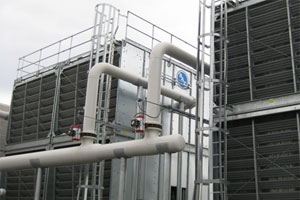
| HVAC contractors and others that provide services on or near cooling towers should take reasonable measures to protect themselves from Legionnaires’ disease. |
For new construction or renovations, designers and contractors have responsibilities as well. For water systems deemed to require Legionella control measures — which includes cooling towers — designers must provide documentation, diagrams, or instructions as needed for monitoring and control, code compliance, operation and maintenance, control system operation, calibration, installation and start-up, commissioning, filling and draining, equipment sizes, piping layout, system materials, pipe sizes, design flow rates, design temperatures, and the impact of heat loss or heat gain.
Designers must also note locations of equipment access (or note inadequate access), filling and draining, flushing, sampling, temperature monitoring, treatment, no flow and low flow areas, possible cross connections between potable and non-potable systems, and outside air intakes.
Preventive measures that have for years been recommended for cooling tower installations are reiterated in 188P: Locate cooling towers to minimize transmission of drift to people; for example, as far as reasonably possible from building openings, outside air intakes, parking lots, and sidewalks. Also, avoid locating cooling towers near sources of contamination such as kitchen exhausts that make water treatment for microbial control even more challenging.
Cooling tower shutdown and startup should include procedures to minimize Legionella. ASHRAE Guideline 12-2000 gives the details for both drained and un-drained systems.
HVAC contractors and others that provide services on or near cooling towers should take reasonable measures to protect themselves from Legionnaires’ disease. OSHA has recommended wearing a respirator while collecting samples from cooling towers. The same would apply to any work on operating cooling towers. Others have recommended gloves to protect skin from water treatment chemicals. Based on scientific literature, the best way for a contractor to reduce his risk of a Legionella infection — whether around cooling towers or elsewhere — is to stop smoking; smokers are at significantly higher risk than the general population of contracting Legionnaires' disease.
ASHRAE 188P could pack quite a punch if it becomes a standard. It would likely increase the demand for products and services related to Legionella control, including services HVAC contractors could provide such as cooling tower cleaning and maintenance. It will likely become the primary document by which standard of care is determined in litigation related to Legionnaires' disease, specifically regarding whether an owner properly implemented a comprehensive Legionella water management plan. It could even become part of plumbing and mechanical codes (already formally proposed) and adopted as law in some states.
Scientific literature is replete with reports of successful Legionella control and subsequent reduction in Legionnaires’ disease. Therefore, if building operators implement the practices outlined in 188P, it’s logical to assume fewer people will contract the disease, resulting in reduced suffering, fewer premature deaths, fewer lawsuits, and reduced health care costs.
Legionnaires’ survivors like Steve Sederstrom wish ASHRAE 188P had become a standard years ago. A project service manager for Johnson Controls in Harrisburg, Pennsylvania, Sederstrom contracted Legionnaires’ disease in 2009 despite being a nonsmoker and only 47 years of age.
"My experience with Legionnaires’ disease in the hospital and recovery at home was the worst thing I have ever been through," he said. "I missed more than two months of work and for five months had major memory problems — sometimes even forgetting where I was going. The one problem I still have is my memory — I’m afraid I will never get my memory back.”
UPDATE: ASHRAE 188 NOW A STANDARD
ASHRAE Standard 188 was finalized and officially became an ANSI standard on June 26, 2015. For more information on ANSI/ASHRAE Standard 188-2015, Legionellosis: Risk Management for Building Water Systems, click here.
Publication date: 5/18/2015
Want more HVAC industry news and information? Join The NEWS on Facebook, Twitter, and LinkedIn today!
Looking for a reprint of this article?
From high-res PDFs to custom plaques, order your copy today!