An Open and Closed Case – An Introduction
|
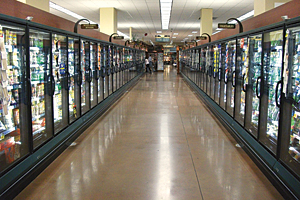
| The value of closed door display cases is highlighted in an extensive report on commercial refrigeration published by the U.S. Department of Energy. |
In 2012 members of the U.S. Department of Energy’s (DOE’s) Better Buildings Alliance (BBA) and its Refrigeration Project Team suggested that DOE focus on developing a best practices guide that retailers could follow when retrofitting open refrigerated supermarket display cases with transparent doors for energy reduction. In response, DOE set about researching and developing guidelines and suggestions for display case retrofits. The DOE report — presented in this five-part article series — outlines the results of this investigation, and was developed through collaboration between DOE, the BBA refrigeration team members, and key members of industry, including technical experts from supermarket refrigeration equipment manufacturing companies.
The report breaks down best practices and guidelines for conducting case retrofits by project stage, from initial planning through project completion and system monitoring. Namely, the guide highlights the following areas of the process:
• Retrofit planning;
• Case modification and door retrofit;
• Refrigeration-system reconfiguration;
• System performance evaluation; and
• Monitoring and follow-up.
This guide also provides background information on display door retrofits and offers specific technical guidance in key areas of the process where sources have suggested that errors may commonly occur. However, due to variations within installed systems, the applicability of sections of this guidance to a given refrigeration system or display case may vary between projects. For this reason, retrofit projects should always be overseen by a qualified refrigeration engineer or contractor.
About BBA
The DOE’s BBA program has the mission of transforming the way that commercial buildings use energy. The BBA invites building owners, managers, and operators to work with the DOE’s Building Technologies Program and with each other to identify and implement best practices, key decision-making tools, and advanced technologies for significant energy savings in their portfolios.
Looking for quick answers on air conditioning, heating and refrigeration topics? Try Ask ACHR NEWS, our new smart AI search tool. Ask ACHR NEWS
BBA members represent more than 9 billion square feet of commercial building space, approximately 20 percent of the total U.S. floor space in their representative sectors. The BBA comprises subgroups focusing on the following areas:
• Retailers, supermarkets, and restaurants;
• Commercial real estate and hospitality;
• Hospitals and health care organizations; and
• Colleges, universities, and other postsecondary institutions.
All BBA efficiency initiatives are driven by targeted project teams composed of BBA members and Building Technologies Office technical experts across all relevant commercial sectors:
• Lighting and electrical;
• Space conditioning;
• Plug and process loads;
• Refrigeration and food service; and
• Market transformation.
Background/Overview
Meeting during early 2012, the Refrigeration Project Team included participation from many supermarket, grocery, and convenience retailers. One topic presented to DOE by numerous retailers as an area of particular interest is that of retrofitting open refrigerated display cases with transparent doors. These procedures convert existing open cases, commonly used in supermarkets, multiline retail stores, and convenience stores, into enclosed merchandising cases through the installation of transparent doors. As open display cases consume more energy than cases with doors, while maintaining the same product temperature, retrofits hold the potential to create significant reductions in overall refrigeration energy consumption.
However, members expressed concern regarding the uniformity and quality of the outcomes of case retrofit projects. Namely, the retailers stated that the impact on system performance has the potential to vary considerably from installation to installation due to the lack of consistent methods for evaluating hardware selection, system design, and installer competency. A poorly performed door retrofit operation, especially one in which the impacts on the refrigeration system (including the compressor rack, refrigerant piping, condensers, and other hardware) are not taken into account, can yield energy savings far below those originally anticipated by the end user at the beginning of the retrofit process.
In response to these concerns, members suggested that DOE develop a document highlighting best practices to serve as standardized guidance that could be followed by any retailer who wishes to undertake a case retrofit project. In 2012, based on this member input, DOE began research and development of this guide. The guide was developed in collaboration with BBA retail members, as well as with technical experts from refrigeration contractors and manufacturers of display cases, display doors, and retrofit kits.
This report is a general guide to best practices and factors for consideration by end users who are planning or evaluating a retrofit operation, and provides the reader direction toward the more detailed analysis needed to successfully undertake a given retrofit project.
In past years, retailers faced with tight operating budgets have sought means of reducing their energy expenditures through increasing the energy efficiency of their refrigerated display cases and associated systems. Generally, the largest consumption of refrigeration system energy in supermarket settings is attributed to open display cases, such as traditional meat and dairy cases, which are subject to much higher heat loads than cases with transparent display doors. One method of decreasing this energy consumption that has become increasingly popular is the practice of retrofitting open display cases with transparent doors. In this situation, an existing open case is fitted with display doors, and is made to function similarly to a case that is designed and shipped from the factory with doors installed. Retailers perform these retrofits to gain benefits including greatly reduced refrigeration energy expenditure, potential savings on building HVAC energy expenditures, and increased shopper comfort levels.
Past laboratory studies and DOE analyses have shown that for medium-temperature, remote-condensing open refrigerated display cases, infiltration loads comprise 70-80 percent of the total case heat loads. For comparison, in display cases manufactured with vertical transparent display doors and operating in a similar configuration, the infiltration accounts for only roughly 10 percent of the heat load that must be removed from the display case. According to discussions between DOE and experts, a properly retrofitted display case can offer energy performance very similar to that of a case designed and shipped from the factory for use with doors. Thus, the implementation of doors on cases, coupled with proper system-level changes, can result in a significant reduction in system energy usage.
Additionally, retrofits require a substantially smaller investment than would be needed to completely replace existing open display cases with new doored cases. Sources consulted in the preparation of this guide told DOE that case-door retrofits, including installation and labor, can cost on the order of half the installed cost of replacing existing open display cases with new doored cases.
In addition to the installation of doors on open cases, the case retrofit process allows store owners the opportunity to make additional concurrent changes to the cases, including lighting and fan upgrades, to improve their energy performance through additional capital investments at that time.
EDITOR’S NOTE: This work was accomplished with the guidance of Brian Holuj, Jason Komen, and Kristen Taddonio of the U.S. Department of Energy, and through the contributions of many Better Buildings Alliance retail members and representatives of industry. The U.S. Department of Energy wishes to particularly acknowledge the efforts of the following parties for providing technical information and assistance during the development of this document: DC Engineering, Hill PHOENIX, Hussmann Corp., REMIS America LLC and REMIS GmbH, and Zero Zone Inc.
This report should be viewed as a general guide to best practices and factors for consideration by end users who are planning or evaluating a retrofit operation, rather than a comprehensive and exhaustive set of specific steps to perform when retrofitting display cases. A qualified refrigeration engineer or firm should always be contracted to oversee any retrofit project. This report was prepared as an account of work sponsored by an agency of the United States government. Neither the United States government, nor any agency thereof, nor any of their employees, nor any of their contractors, subcontractors, or their employees, makes any warranty, express or implied, or assumes any legal liability or responsibility for the accuracy, completeness, or usefulness of any information, apparatus, product, or process disclosed, or represents that its use would not infringe privately owned rights. Reference herein to any specific commercial product, process, or service by trade name, trademark, manufacturer, or otherwise, does not necessarily constitute or imply its endorsement, recommendation, or favoring by the United States government or any agency, contractor, or subcontractor thereof. The views and opinions of authors expressed herein do not necessarily state or reflect those of the United States government or any agency thereof.
Publication date: 4/22/2013
Looking for a reprint of this article?
From high-res PDFs to custom plaques, order your copy today!


