Hydronics Trends: Whole-System Comfort
The application of wet heat technology has expanded over the years and new technologies that improve control and efficiencies are pushing this industry sector further ahead. In light of this equipment and industry emphasis, new trends are developing in radiant and hydronics that are affecting many contractors.
|
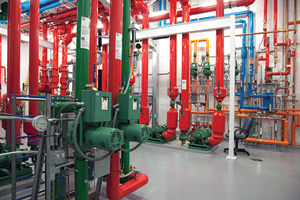
| The design and application of hydronic systems, like this one, is being enhanced by innovative smart technology. |
Air Conditioning Contractors of America (ACCA) embraced this growing corner of the industry, devoting a complete radiant and hydronics learning track at its recently wrapped-up 2013 conference in Orlando. The learning track featured four educational labs led by industry professionals, including Bob “Hot Rod” Rohr, Dan Foley, John Barba, and Brian Stack. The conference track was the latest of several endeavors ACCA has used to embrace the growing “wet” side of the industry.
Whole-System Comfort
ACCA acknowledged the growing importance of wet heat technology in 2011 when it developed the Radiant and Hydronics Council. The decision was precipitated by a member survey where it was discovered that of its 4,000 members, 500 were involved in radiant and the wet side of the HVAC industry.
“After that survey, we realized that it was time to recognize that the wet side of the industry and the dry side of the industry must come together to provide solutions for the customers,” said Paul Stalknecht, president and CEO of ACCA. “In the ultimate end of the game, the customers are king.”
In September 2012, the Radiant and Hydronics Council hosted its inaugural roundtable event.
“The reason why this roundtable is significant is because it brings the leadership of our industry together,” said Foley, after the first roundtable. “What the Radiant and Hydronics Council is looking to do is to not only promote radiant and hydronic heating, but it is also to bring in the other elements of the air side — IAQ, humidification, and more. We are looking at the whole comfort equation.”
Add-On Issues
Another element in the whole comfort equation is the add-on components utilized within hydronic applications, and the challenges they pose for contractors.
Looking for quick answers on air conditioning, heating and refrigeration topics? Try Ask ACHR NEWS, our new smart AI search tool. Ask ACHR NEWS
Steve Scott is the owner of Comfort Technology, a small residential company in Dryden, N.Y. He said he enjoys the simplicity of moving heat via water, but said he was concerned about the challenges complex add-on components add to the overall hydronics system.
“With hydronic heat we hang pumps, aquastats, zone valves, circulator pumps, etc., in order to achieve maximum efficiency from an install,” he explained. “These components are often made by several different manufacturers and keeping everything running optimally can be a challenge.”
Despite the add ons, contractors like Russ Donnici, president of Mechanical Air Service Inc. in San Jose, Calif., have seen an increase in the sale of hydronic technology recently. According to Donnici, it is his customers’ desire for improved comfort, as well as a desire to zone a home, that seems to be pushing this trend in his area.
“We are currently finishing up an 18,000-square-foot home with 32 radiant-heat zones,” he noted. “We also have backup hydronic heat and we built five custom chillers to provide chilled water for cooling.”
Smart Components
As in other HVAC equipment, hydronic equipment is becoming smarter. Manufacturers are beginning to equip their materials with microprocessors at an increasing rate. According to Rohr, there is eventually going to be smart everything from just about everybody — pumps, boilers, valves, etc.
“This trend is likely to push components out of the repair arena and into the replace arena,” he said.
“We don’t fix microprocessors. When a control goes out on a pump or on a boiler, I think we will see more pumps that just get replaced because the brains on them go bad.”
Rohr acknowledged that smart components are helping to pave the way for better controls, and pushing for more efficient performance from hydronic equipment. This in turn is helping set up the wet heat market for smart metering, according to Rohr.
Innovation and Regulation
The need for smarter equipment and controls is pushing forward an innovative trend in the design and application of hydronic systems. Different components are being added to the hydronic mix and Radiant and Hydronics Council member John Siegenthaler P.E., thinks that ECM circulators will become the new normal in hydronics applications. The idea has been embraced and adopted as of Jan. 1, in Europe, said Siegenthaler.
He also agreed with Rohr about the development of Btu metering and Btu-metering stations.
“This is a big thing in Europe,” said Siegenthaler. “In fact, the ASTM [American Society for Testing and Materials] is already working on a standard for the United States.”
Other trends Siegenthaler sees developing is a switch to venting via polypropylene pipe and a move away from PVC; as well as a rise in the usage of radiant ceiling applications.
“Radiant ceilings have a higher coefficient and in the market are in a good position for growth,” he said.
Regional Challenges and Training
Wet heat technology is not immune to regional difficulties, but according to Erik Knaak, vice president of operations for Isaac Heating and Air Conditioning Inc. in Rochester, N.Y., a contractor can never really be surprised where they will find a hydronic application.
“In some areas of the country hydronic technology is much more prevalent, such as in the Northeast and other pockets around the country,” he explained. “We hired a technician from California once though, and most all of his experience was with hydronics. At the time he knew very little about air conditioning and I would never have guessed that.”
Isaac Heating and Air Conditioning deals with a fair amount of wet heat equipment on a regular basis. The technicians install these systems every seven to 10 days during the heating season and work on them, and all their components, during daily service calls.
Knaak noted that training a technician to troubleshoot wet heat technology is more advanced than basic troubleshooting.
“The issues associated with hydronics are unique to these systems,” he said. “Knowing how to bleed a system, how to install a primary/secondary loop, and where to install the riser and the header are all very critical to the safe and proper operation of the equipment. With steam, you run into more specific issues, such as troubleshooting steam traps, condensate returns, and possibly condensate return pumps.”
Tom Spall, owner of T.E. Spall & Son Inc., works out of Carbondale, Pa. His region has historically been a dominantly wet heat area. He prepares his technicians to handle, install, troubleshoot, and repair with weekly training sessions, as well as one-on-one field training.
“Wet heat technology requires that technicians have a more diverse skill set and knowledge of performance criteria for hydronic systems,” he said.
For more information on the ACCA Radiant and Hydronics Council, visit www.acca.org/hydronics.
Publication date: 3/4/2013
Looking for a reprint of this article?
From high-res PDFs to custom plaques, order your copy today!