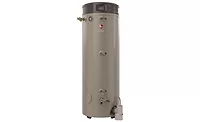
Handling Assorted Water Heater Problems

PROBLEM: NO HOT WATER
For Gas Hot Water Heaters:Remove the inner and outer burner access covers and check to see if the pilot light is lit.
CAUTION: Many modern water heaters no longer use standing pilots. They use electronic ignition to ignite the gas. Do not attempt to manually light an electronic ignition system.
If the pilot light is not lit:
Attempt to re-light pilot light following the instructions posted on the water heater.
If the pilot light will not re-light, the problem could be a clogged pilot line, or gas is not reaching the water heater.
If the pilot light will light but does not stay lit when the gas valve control is released, the problem could be a defective or loose thermocouple, or perhaps a faulty gas control valve. Make sure the thermocouple connection to the control valve is tight.
If the pilot light is lit:
Turn on a hot water tap and let the water run for several minutes. Check to see if burner comes on. If not, run the hot water several more minutes. If the burner still does not come on, the problem could be a defective control valve/thermostat.
Check to see if the control valve knob is in the “on” setting and not set to the “pilot” position.
For Electric Hot Water Heaters:
If you have no hot water from an electric hot water heater, first make sure the breakers are on. Otherwise it is most likely either a bad upper element or thermostat, or it is off on a high limit safety. Some water heaters have a resettable safety switch at the upper thermostat. This usually requires removing the access panel.
CAUTION: High voltage connections are behind access doors. Turn off all power to the appliance at the main panel before removing panel. Use caution when removing panel and double check connections with a voltmeter.
Once confirmed that the electricity is off, see if the red reset button has popped out. If so, try resetting it. You will hear a click. Then re-install panel cover and reset the breaker. You should hear the unit start to charge. Keep in mind that if the upper limit opens it is usually because a thermostat stuck closed and it will do so again, requiring changing.
PROBLEM: INSUFFICIENT HOT WATER
Check the thermostat setting. It may be set too low. Check for leaking faucets. There could be a dip tube problem. If the dip tube has broken or fallen off, incoming cold water will be drawn out through the hot water outlet without being heated.Other possible causes are clogged burners and low gas pressure.
PROBLEM: SLOW HOT WATER RECOVERY
This may be due to sediment buildup in the bottom of the water heater. Flushing the water heater may help. Other possible causes may be insufficient combustion air caused by insufficient ventilation, or improper burner operation.PROBLEM: DISCHARGE FROM TP/RELIEF VALVE
The relief valve will open if either the water temperature is too high or if the pressure gets too high. If the inlet to the water heater is fed directly from the water main with no pressure relief valves or check valves between them, then when the water is heated and it expands, the extra volume of water simply flows back toward the water main. If however there is a blockage such as a check valve or pressure reducing valve with a defective bypass, then the increase in water volume has nowhere to go and the pressure will increase dramatically. Placing an expansion tank in the line at the inlet will give the increased volume of water someplace to go and prevent the relief valve from opening.Another possibility is that the city water pressure has increased above the setting of the relief valve. Again the installation of an expansion tank can help solve this problem, at least with a minor to moderate increase in city pressure. A significant pressure increase will still cause the relief valve to open.
PROBLEM: PILOT LIGHT WON'T STAY LIT
Sometimes a draft will blow the pilot light out. Make sure the burner access covers are in place. Other possible causes are dirt in the gas line, loose thermocouple connections, or a defective thermocouple.PROBLEM: POPPING OR BANGING NOISE
Scale can build up in the bottom of the tank causing all sorts of noises to occur while the water heater is heating water. Try flushing the tank.PROBLEM: HOT WATER SMELLS REALLY BAD
Certain types of bacteria can react with the magnesium anode rod resulting in a rotten egg odor. Cleaning the tank using chlorine bleach or changing the anode rod to aluminum usually will solve the problem.PROBLEM: LEAKING TANK
All tanks eventually leak. It’s like death and taxes. There’s no fix for this. Replace the water heater.Reprinted with permission from Hannabery HVAC from the company’s Web page “Commonly Reported HVAC Problems.” For more information, visit www.hannabery.com.
Publication date: 01/07/2008
Looking for a reprint of this article?
From high-res PDFs to custom plaques, order your copy today!